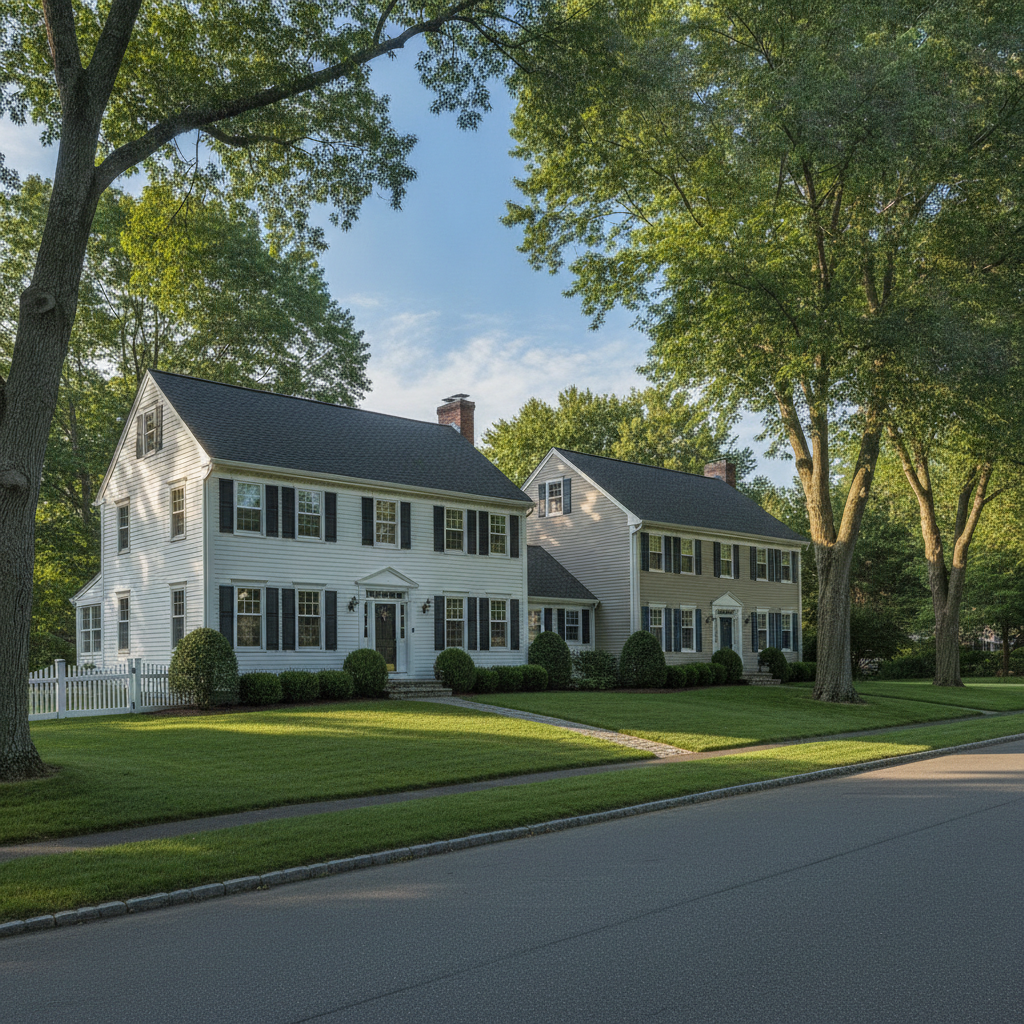
Choosing siding colors for your Fairfield County, CT home
Siding color is one of the highest-visibility decisions a homeowner makes — it sets the tone of the property for the next decade or longer. In Fairfield County, that choice is shaped by a specific mix of factors: a housing stock that spans Colonial-era clapboard to Victorian Italianate to post-war Cape Cods; a climate that runs from Long Island Sound’s salt air to inland Danbury’s harsher freeze-thaw winters; and historic district commissions in towns across the county with real authority over exterior appearances. Getting it right means working with all three at once.
This guide walks through how to approach color selection by architectural style, how the coast-to-inland climate gradient should influence your choices, what to expect from Fairfield County historic districts, and how your siding material affects what colors are available or durable.
The housing stock you’re working with
Fairfield County’s residential architecture reflects several centuries of settlement and growth, and the dominant style in any given town shapes what looks right on a home there.
Colonial and Georgian. Greenwich was settled in 1640, and its residential neighborhoods include significant 18th and early 19th century stock. Colonial and Georgian homes — symmetrical facades, multi-pane windows, center-chimney plans — established the county’s architectural baseline. Traditional palettes here are restrained: white, cream, and soft gray bodies with contrasting dark shutters and trim, or muted brick-red and sage-green clapboard echoing the Federal period.
Victorian and Italianate. Norwalk’s Lockwood-Mathews Mansion (on the National Register of Historic Places) represents the county’s high-Victorian heritage, and the South Main and Washington Streets Historic District preserves period streetscapes from the same era. Victorian-era design — documented in architectural history as explicitly polychromatic — called for three or more colors to articulate brackets, cornices, and window surrounds against the body. Per Wikipedia’s history of the “Painted Ladies” tradition, an 1885 critic described Victorian fashion as “red, yellow, chocolate, orange — everything that is loud.” Modern homeowners with Victorian properties often use a more subdued version of this tradition, but the intent — highlighting trim details — is historically grounded.
Cape Cod. Post-war suburban expansion filled Darien (particularly Noroton Heights), Stratford, Shelton, and parts of Bridgeport with modest Capes and colonials. These homes suit a clean, two-tone approach: a light body with a slightly darker or complementary trim, often in whites, soft blues, or sand tones that echo their coastal neighborhood character.
Shingle-style. The Shingle style was developed in part by New England architects working in coastal communities, and examples appear across Westport, Greenwich, and other shoreline towns. The defining tradition is unpainted cedar shingles — not a color choice at all, but an embrace of natural weathering to silvery gray and warm brown tones as the material ages. Per the architectural history of the style, shingles were sometimes treated with buttermilk to accelerate the weathered-gray finish. Modern fiber cement shingles and engineered shake products can replicate these tones closely using factory-applied finishes.
Coastal vs. inland: how climate shapes color longevity
Fairfield County is not climatically uniform. The towns along Long Island Sound — Greenwich, Stamford, Norwalk, Westport, Westport, Bridgeport, Stratford, Shelton — sit within what the Long Island Sound basin’s warm temperate (Köppen Cfa) classification describes as a moderately milder coastal microclimate compared to inland Connecticut. That moderation cuts both ways for siding color.
Salt spray is real and measurable. Per the documented science of salt spray, salt deposition decreases with distance from the ocean but increases with wind speed — a significant factor during coastal Nor’easters. Salt spray promotes paint film degradation by accelerating oxidation at the surface, particularly where the finish is thin or already chalking. For homes within a quarter-mile of the Sound in Greenwich, Norwalk, Westport, or Stratford, this means paint finishes will dull and break down measurably faster than the same product on an identical home in Danbury or Newtown.
Practical consequence for color. Darker colors show chalking and salt-bleaching more visibly than lighter ones, and they absorb more UV energy, which accelerates the same process. Coastal Fairfield County homeowners are better served by mid-tone or lighter palettes — classic whites, grays, and sage greens — than by deep navies or charcoals that will show degradation quickly. Inland homes in Danbury, Shelton, or Trumbull have more latitude on dark palettes; freeze-thaw cycling is the dominant weathering factor there, not salt.
Color by architectural style
| Style | Classic palette | What holds up |
|---|---|---|
| Colonial / Georgian | White, cream, pale gray body; black, dark green, or burgundy shutters | Enduring — resist trend-driven updates |
| Victorian / Italianate | Three-color scheme: body + sash/trim + accent details | Choose a restrained version of the historical model |
| Cape Cod | White, pale blue, sandy neutral body; white trim | Light bodies reduce UV-driven fade |
| Shingle-style | Natural weathered cedar gray; warm brown cedar tones | Factory-tinted finishes can pre-match weathered gray |
| Post-war Colonial / ranch | Versatile — wider range works | Consider neighborhood context and fixed elements (brick, stone) |
The most durable curb appeal decisions share one feature: the color selected works with the fixed elements of the home — the roofline color, any brick or stone, the masonry of the chimney or foundation — rather than against them. In Fairfield County’s varied stock, the roof color varies considerably: dark charcoal shingles are common on Colonials; warmer earth tones appear on Capes and ranch homes. Start there before selecting body and trim.
Material determines what “color” means
The siding material you install determines how you get color and how long it stays.
Fiber cement (James Hardie HZ5®). James Hardie’s products engineered for cold climates with freezing temperatures, snow, and ice — marketed under the “Engineered for Climate®” program as HZ5® — are the most color-durable option for Connecticut. The HardieZone 5 product line carries a 30-year limited, transferable warranty (per jameshardie.com). The factory-applied ColorPlus Technology finish comes with its own separate limited color warranty from James Hardie and is designed to resist fading, chipping, and cracking in climate conditions like those in Connecticut — delaying the repainting cycle. Custom or field-painted fiber cement is also an option if you want a color not offered in the ColorPlus palette, with the trade-off of losing the factory warranty and beginning the repainting cadence earlier.
Vinyl. Vinyl’s color is integral to the material — it does not accept paint. The upside: no repainting, ever. The trade-off: no color changes over the life of the product without full re-siding. UV-grade fade-resistant vinyl products will hold color better over time, but coastal homes near the Sound that are exposed to direct south or west sun will still see some chalking. Select lighter, neutral tones if coastal UV and salt air are factors.
Engineered wood (LP SmartSide). Engineered wood takes paint exactly like real cedar, which gives full palette flexibility. The trade-off is a required repainting commitment — cut edges and penetrations must be field-primed at installation and the surface repainted on a regular cycle. LP SmartSide performs well in Connecticut but requires consistent paint maintenance to protect the substrate. Choose a high-quality exterior paint with a primer-included formulation and a finish designed for wood substrates.
Gunner Roofing is a James Hardie Elite Contractor and installs HardieZone 5 fiber cement products across Fairfield County. Every Gunner siding project includes full water-resistive barrier installation, correct flashing at all penetrations and roof-to-wall junctions, and verified ground clearances — foundational work that protects the investment in both material and finish.
Historic districts in Fairfield County
Several Fairfield County towns maintain historic-district review over exterior alterations, including siding material and color. Norwalk’s South Main and Washington Streets Historic District is one documented example; Greenwich, Westport, Bridgeport, and the town of Fairfield also have historic-district review. Confirm whether your property sits within a district before making changes.
The NPS Preservation Brief #10 (Exterior Paint Problems on Historic Woodwork) is the federal reference on historic paint surfaces and is commonly cited in local design guidelines.
What this means practically:
- Color is frequently reviewable. Historic-district commissions commonly require review (often a Certificate of Appropriateness) before exterior changes; confirm with your town’s commission.
- Vinyl may be discouraged. Historic-district design guidelines often discourage vinyl because it cannot replicate the profile of original clapboard or shingles. Fiber cement, detailed to match original profiles, is a common approved alternative in many districts.
- Color palettes matter. Some districts publish approved or recommended color ranges tied to the period character of the district. Others are more flexible. There is no single county-wide list — each town’s guidelines are different.
Before ordering any material or selecting a final color for a Fairfield County historic district property, contact your town’s Historic District Commission or Planning and Zoning department directly. Gunner Roofing handles permit applications on every project and is familiar with the process in Connecticut municipalities.
Five practical tips before you choose
- Test large samples in Connecticut light. The color temperature of New England daylight is cooler and bluer than California or Florida light. A warm taupe that looks inviting on a paint chip can read as muddy gray in overcast November light. Buy sample quarts and apply them to at least two-foot squares on the actual wall, in both sun and shade.
- Start with your roof. Your roofline color and texture are fixed for 20-plus years. Every siding color needs to work with it, not despite it.
- Coastal homes: go lighter. Salt spray and coastal UV are the dominant degradation forces for Long Island Sound-facing walls. Lighter bodies show chalking more gradually and require less frequent repainting.
- Trim contrast is structural. Strong body-to-trim contrast (dark body, white trim, or vice versa) reads well on Colonials and Capes where the architectural detail is worth highlighting. Low-contrast tone-on-tone reads more contemporary and works on simpler post-war stock.
- Check your neighbors — respectfully. Curb appeal is partly relative. A home that matches the visual register of its block holds value better than one that reads as out of place, regardless of how well-executed the palette is in isolation.
Frequently asked questions
What siding colors work best on Colonial homes in Fairfield County, CT?
Colonial homes in Fairfield County have traditionally used restrained, period-appropriate palettes: white, cream, and pale gray bodies with contrasting dark shutters — black, deep green, or dark navy — and white trim. These are durable choices both aesthetically and practically, as lighter body colors resist UV and salt-spray degradation better than dark ones in coastal locations near Long Island Sound.
Can I change my siding color if I live in a historic district?
Possibly, but it depends on the district. Historic-district commissions commonly require a Certificate of Appropriateness before exterior alterations, including repainting or re-siding. The review process and approved palettes vary by town; several Fairfield County towns, including Norwalk, maintain active Historic District Commissions with their own guidelines. Contact your town’s commission or Planning and Zoning department before making any changes.
Does fiber cement siding hold its color better than vinyl in coastal Connecticut?
In practice, both hold color well — but through different mechanisms. James Hardie HZ5 fiber cement with factory-applied ColorPlus finish carries a separate limited color warranty from the manufacturer and resists chipping and cracking in freeze-thaw climates. Vinyl’s color is integral to the material and does not fade as quickly as field-applied paint. The key coastal durability difference: fiber cement can be repainted when the finish eventually ages, giving it a longer second life; vinyl cannot be repainted, so color refresh means replacement.
How often do Fairfield County homeowners need to repaint fiber cement siding?
With a factory-applied finish (James Hardie ColorPlus), repainting is typically deferred well beyond a field-painted installation. When repainting is needed — or if fiber cement was installed with field paint — plan on a regular repainting cycle depending on coastal exposure, sun orientation, and paint quality. Coastal homes near Long Island Sound will need attention sooner than inland homes in Danbury or Trumbull due to salt spray and UV. Use a premium 100% acrylic exterior paint with a primer coat on bare or lightly sanded surfaces.
Does siding color affect a home’s energy performance in Connecticut?
Marginally. Darker exterior colors absorb more solar heat in summer, which can increase cooling loads on south and west walls in Connecticut’s warm season. Lighter colors reflect more solar energy. In Connecticut’s climate, heating loads dominate energy use over the year, so the effect is modest — the bigger thermal performance drivers are continuous insulation, air sealing, and window U-factors. Color alone should not drive your selection over aesthetics, material, and maintenance considerations.
Get a fast, free quote
No inspection visit needed - we measure your roof from satellite imagery and send your quote.