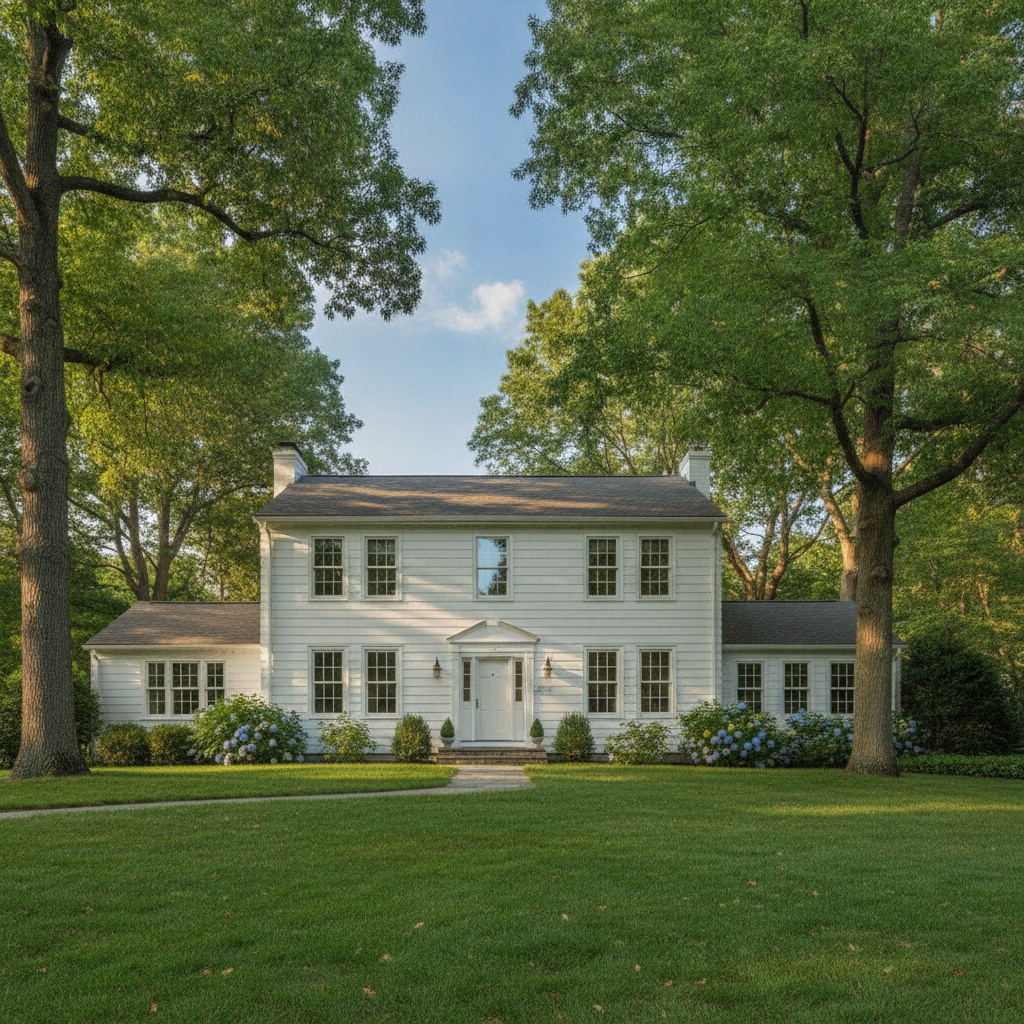
Window replacement in Greenburgh, NY involves a specific set of energy-code requirements, a permit process that differs depending on which part of Greenburgh you live in, and a housing stock — mix of mid-century Colonials, split-levels, and ranch homes — that drives most of the window-style decisions homeowners face. Gunner Roofing is an Andersen Certified Elite contractor serving Greenburgh and the broader Westchester County area, handling the full project from permit to installation.
Greenburgh’s Housing Stock and Why It Matters for Windows
Greenburgh is an unusual municipality. Much of that unincorporated area developed in the post-WWII era, producing a dense inventory of split-levels, raised Colonials, and ranch homes from the 1950s through the 1970s, plus a layer of 1980s–1990s construction in hamlets like Hartsdale, Edgemont, Fairview, and White Plains–adjacent neighborhoods.
That housing era is directly relevant to windows: homes built before the mid-1990s typically have single-pane or early double-pane units with aluminum or early vinyl frames — well past their useful life and a significant source of heat gain in summer and heat loss in winter. Even early low-E double-pane units from the late 1990s fall short of today’s performance benchmarks.
Energy Code Requirements for Greenburgh Windows
Westchester County falls in Climate Zone 4 under the 2020 NYS Energy Conservation Construction Code. The code’s prescriptive path for replacement windows in Climate Zone 4 sets a maximum U-factor of 0.32 and a maximum SHGC of 0.40 (per 2020 NYS Energy Code Table R402.1.2).
Those are the code minimums. ENERGY STAR v7.0 — effective October 23, 2023 — sets a tighter Northern zone standard: U-factor ≤ 0.22 and SHGC ≥ 0.17 (per ENERGY STAR v7.0 Final Specification). Most quality double-pane windows installed today meet or exceed ENERGY STAR; the gap between “code minimum” and “ENERGY STAR” represents a meaningful difference in long-term comfort and utility costs.
A note on what these numbers mean:
- U-factor measures heat loss through the window assembly. Rated on a scale of roughly 0.20–1.20 (per NFRC); lower is better for heat retention.
- SHGC (Solar Heat Gain Coefficient) measures how much solar heat passes through the glass. For Westchester, you want it low enough to avoid summer overheating but not so low that you lose useful winter solar gain — hence the balanced Northern zone criteria above.
For a typical Greenburgh split-level or ranch, upgrading from a 1970s aluminum single-pane unit to a modern double-pane low-E window at U-0.22 or better can meaningfully reduce conducted heat gain on hot July and August days, when afternoon sun hits west- and south-facing rooms hardest.
Permits in Greenburgh: Unincorporated Town vs. the Villages
This is the most common point of confusion for Greenburgh homeowners.
If you live in the unincorporated Town of Greenburgh (hamlets: Hartsdale, Edgemont, Fairview, White Plains–adjacent, etc.), building permits are issued by the Town of Greenburgh Building Department (per the Town’s published FAQ). Under New York State Executive Law §381, each local government must administer the Uniform Fire Prevention and Building Code within its boundaries; for unincorporated areas of a town, that responsibility falls to the town itself.
If you live in one of the incorporated villages within Greenburgh, requirements vary by municipality; confirm with your local building department or historic-district commission.
Requirements vary by municipality; confirm with your local building department. Gunner handles the permit application on every project — it’s included in the scope, not an add-on.
Window Styles Common in Greenburgh Homes
The dominant housing types in Greenburgh’s unincorporated neighborhoods drive a predictable set of window needs:
Double-hung windows are the most prevalent style in mid-century Colonials and split-levels. Both sashes tilt inward for easy cleaning — practical for second-floor installation in Greenburgh’s typical two-story stock. Per DOE guidance on window types, double-hungs have slightly higher air leakage potential than casements because the meeting rail creates an additional seal point, but modern weatherstripping largely closes that gap.
Casement windows are common in 1980s–1990s construction and perform well on the air-sealing front — when closed, the sash compresses against the frame and creates a tighter seal than a sliding or hung unit. They’re also the default choice for picture-window conversions in open-plan spaces.
Sliding (gliding) windows appear frequently in ranch homes and basement applications. They offer wide sightlines but require clean tracks and good seals to avoid air infiltration at the corners.
Picture windows — fixed, non-opening — show up in mid-century great rooms. Because they don’t open, there’s no operator hardware to fail, and the unit can achieve the lowest U-factors available since there’s no sash–frame interlock to seal.
Summer Heat Performance: What to Prioritize Right Now
In July and August, Greenburgh’s inland position means afternoon temps regularly climb into the upper 80s and low 90s, and west-facing windows in particular can deliver significant radiant heat into living spaces. The right window spec addresses this directly:
- Low-E glass coating blocks a portion of infrared radiation before it enters the room. Most ENERGY STAR–qualified windows include at least a basic low-E coating; look for units with a coating tuned for the Northern zone (moderate SHGC, not the ultra-low SHGC coatings designed for the South).
- Double-pane with argon fill — argon gas between panes has lower thermal conductivity than air, reducing U-factor. This is standard on virtually all ENERGY STAR–qualified replacement windows.
- Warm-edge spacers reduce condensation at the glass edge and marginally improve the edge-of-glass U-factor, which matters in a full-frame replacement where the spacer is visible in the finished product.
If your current windows have single-pane glass, you’ll also notice a dramatic reduction in road noise and exterior sound after the upgrade — a quality-of-life benefit that’s particularly noticeable in Greenburgh neighborhoods close to the Bronx River Parkway, I-287, or the Sprain Brook.
What a Gunner Window Project Includes
Gunner Roofing is an Andersen Certified Elite contractor serving Greenburgh and Westchester County. As noted, Gunner pulls the building permit on every project. The installation scope covers:
- Full frame or insert installation depending on frame condition — a rotted or damaged frame requires full-frame replacement; a structurally sound existing frame can take an insert for lower cost.
- Proper flashing and caulking at the rough opening to prevent water intrusion at the window-wall junction.
- Interior and exterior trim restoration as needed.
- Post-installation inspection and operation check on all operable units.
Gunner is fully licensed, insured, and bonded in New York.
FAQ
Do I need a permit to replace windows in Greenburgh, NY?
If you live in the unincorporated Town of Greenburgh, permits are administered by the Town of Greenburgh Building Department. If you live in one of the incorporated villages within Greenburgh, requirements vary by municipality; confirm with your local building department. Permit requirements vary by scope of work and jurisdiction; Gunner pulls the permit on every project.
What U-factor do replacement windows need to meet in Westchester County?
The 2020 NYS Energy Code prescriptive path for Climate Zone 4 (which includes Westchester County) requires a maximum U-factor of 0.32. ENERGY STAR v7.0 Northern zone criteria are stricter: U-factor ≤ 0.22, effective October 23, 2023. Most quality replacement windows installed today meet ENERGY STAR.
What’s the difference between U-factor and SHGC?
U-factor measures how much heat escapes through the window assembly — lower means better insulation. SHGC measures how much solar heat passes through the glass — lower means less summer heat gain. For the Northern climate zone (NY/CT), you want both low U-factor and a moderate SHGC that lets in some winter solar gain without overheating in summer.
Which window style is most common in Greenburgh homes?
Mid-century split-levels and Colonials — the dominant housing type in Greenburgh’s unincorporated hamlets — typically use double-hung windows. Casements are common in 1980s–1990s construction and offer a tighter seal. The right choice depends on your home’s framing, the room’s ventilation needs, and your existing trim profile.
How long do replacement windows last in Westchester’s climate?
Vinyl-frame double-pane windows commonly last in the range of 20–30 years; fiberglass frames tend to hold up longer. Westchester’s summer humidity, UV exposure, and freeze-thaw cycling in winter put real stress on seals and frame materials over time. When insulated glass units (IGUs) fog — indicating seal failure — it’s a reliable sign that replacement is due regardless of frame condition.
Does Gunner Roofing install windows in Greenburgh?
Yes. Gunner serves Greenburgh and the broader Westchester County area as an Andersen Certified Elite contractor. The company is fully licensed, insured, and bonded in New York and handles the permit on every project.
Get a fast, free quote
No inspection visit needed - we measure your roof from satellite imagery and send your quote.