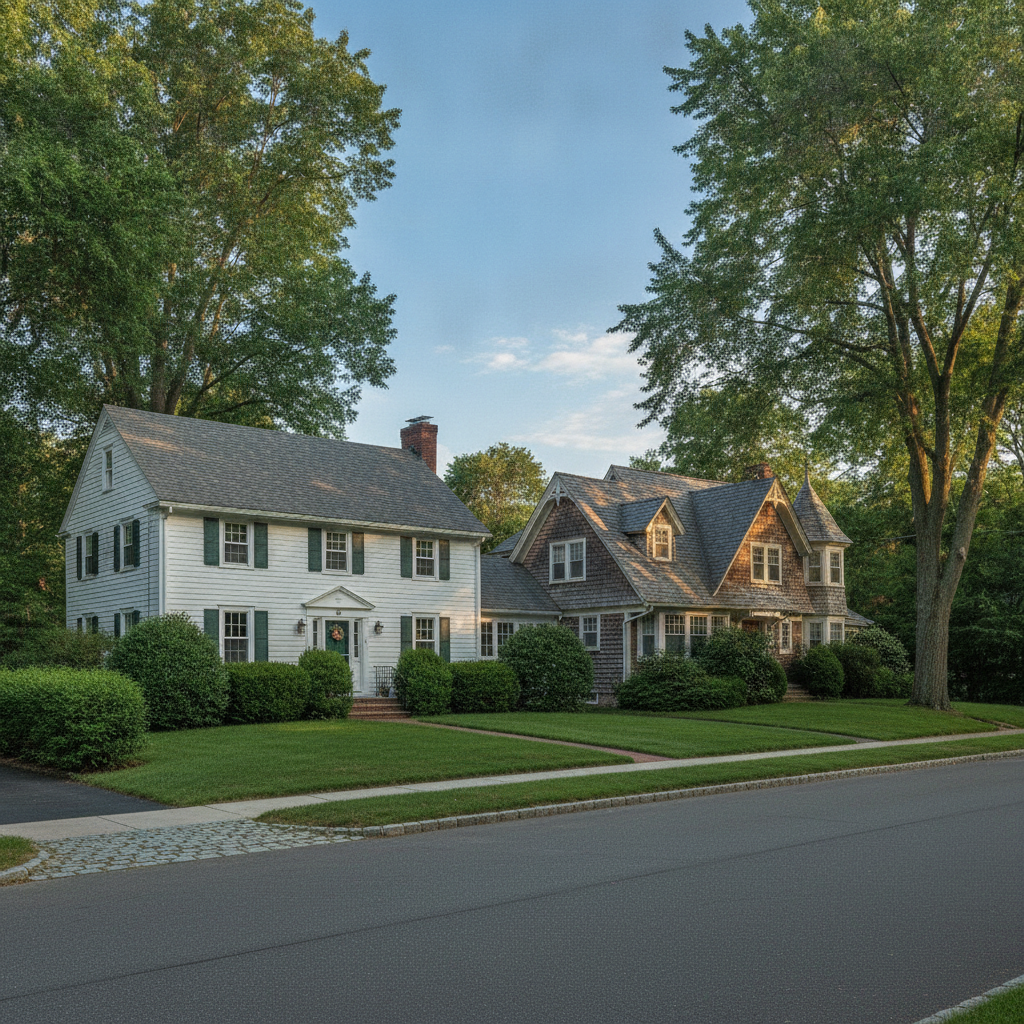
For most Fairfield County homeowners replacing a roof, the choice between GAF Timberline HDZ® and Timberline® UHDZ™ comes down to two things: budget and how much dimensional texture you want on the roofline. Both shingles use LayerLock® technology — the same patented dual-phase bonding system — and both share identical installation requirements per the GAF LayerLock installation manual (RESTL622). The UHDZ is the premium-tier step up: a more dimensional profile with a look that more closely simulates hand-cut wood shake. For a coastal Fairfield County home where curb appeal and the visual weight of the roofline matter, knowing where these shingles are the same — and where they differ — is the first call to make.
What HDZ and UHDZ Share
Both shingles belong to the GAF Timberline LayerLock family. Per RESTL622, which covers HDZ, UHDZ, and several other LayerLock products under a single unified instruction set, every key installation parameter is identical:
| Spec | HDZ & UHDZ (per GAF RESTL622) |
|---|---|
| Minimum slope | 2:12 |
| Minimum deck thickness | 3/8″ (10 mm) plywood or OSB |
| Coverage per 3 bundles | 98.4 sq ft (9.14 sq m) |
| Exposure | 5 5/8″ (143 mm) |
| Standard nailing | 4 nails per shingle |
| Enhanced nailing | 6 nails (required by some local codes and for enhanced wind coverage) |
| Nail penetration | At least 3/4″ (19 mm) into wood deck |
Both are also eligible for the WindProven™ limited wind warranty when installed as a qualifying complete system. WindProven is the first shingle warranty of its kind to carry no stated maximum wind speed, per the GAF press release announcing the HDZ (January 10, 2020). The catch — and it matters on the coast — is that WindProven is a system warranty, not a standalone shingle warranty. It requires all five qualifying components: GAF LayerLock shingles (4-nail pattern), Starter Strip Shingles at both eaves and rakes, qualifying Ridge Cap Shingles, qualifying Roof Deck Protection underlayment, and either qualifying attic ventilation or a Leak Barrier. Neither HDZ nor UHDZ earns WindProven coverage on its own; the full assembly does.
How HDZ and UHDZ Differ
Profile and shadow depth. From the street, UHDZ reads closer to the look of wood shake or dimensional slate; HDZ reads as a clean standard architectural shingle. Both look substantially better than the three-tab shingles still on many Fairfield County homes built before the 1990s.
Weight per square. For most reroofing work in Fairfield County, neither product creates a structural concern on an adequate deck. On older homes where deck boards or roof framing show significant wear, an inspection before material selection is worth it regardless.
Price. UHDZ generally carries a higher material cost per square than HDZ. The difference isn’t enormous per shingle, but on a typical Fairfield County colonial — roof areas commonly running 30 to 50 squares — the UHDZ premium is real. Whether it’s worth it depends on the factors in the next section.
Colorway availability. If a specific color is a deciding factor, confirm UHDZ availability in that color before committing.
The Coastal Fairfield County Factor
Fairfield County’s shoreline communities — Greenwich, Stamford, Darien, Norwalk, Westport, Fairfield, Bridgeport, Stratford — sit on or near Long Island Sound. That position comes with real roofing considerations that don’t apply the same way inland.
Wind exposure. Coastal homes face higher sustained and gust wind loads. Fairfield County sits in the track of Atlantic tropical systems and major Nor’easters; hurricane-force gusts are possible in a direct or close-passing storm. For both HDZ and UHDZ, WindProven system coverage is the direct answer to this exposure — but again, only if the full qualifying system is installed. A contractor who puts only the shingles down without qualifying starter strips, ridge cap, and underlayment delivers no WindProven eligibility regardless of which product was chosen. On any coastal Fairfield County project, Gunner specs the full five-component GAF system precisely because WindProven eligibility is built in from the start.
Salt air and UV. Salt air doesn’t degrade asphalt shingles the way it attacks exposed aluminum or steel — shingles are impervious to salt corrosion. What the coastal environment does deliver is elevated UV intensity from water reflection and higher humidity cycling, which can accelerate granule loss on south- and west-facing slopes over time. Neither HDZ nor UHDZ has a documented performance edge over the other in this regard.
Housing stock. Fairfield County’s coast spans a wide range of housing types — late-Victorian and shingle-style cottages in the historic pockets of Greenwich and Darien, mid-century capes and ranches in Bridgeport and Stratford, and newer colonials and contemporaries throughout the county. The UHDZ’s deeper texture tends to complement older, architecturally detailed home profiles; the HDZ’s cleaner shadow reads well on simpler contemporary and mid-century construction. This is an aesthetic judgment, not a performance one.
When to Choose HDZ
The Timberline HDZ is the right call for most Fairfield County homeowners:
- Budget-conscious replacements where the material cost difference matters and the priority is a full WindProven-eligible GAF system.
- Simpler home profiles — ranches, basic colonials, capes with clean lines — where the HDZ’s standard architectural profile reads exactly right.
- Post-storm replacement where the goal is a reliable, warranty-backed roof without the aesthetic upgrade premium.
HDZ is one of Gunner’s primary shingle recommendations across Westchester County, NY and Fairfield County, CT. It delivers the LayerLock dual-phase bond and WindProven system eligibility at a price that makes the complete system achievable without stretching the budget.
When to Choose UHDZ
The Timberline UHDZ earns its premium in specific situations:
- High-value coastal properties where the roofline is visible from the street and the dimensional look measurably affects curb appeal and resale value.
- Architecturally detailed older homes — particularly Victorians, shingle-style Colonials, or craftsman bungalows in the shoreline towns — where UHDZ’s depth of shadow better complements ornate exterior profiles.
- Steeply pitched roofs (Gambrel, steep Colonial, Mansard) where the roof plane is a major visual surface of the facade and the texture reads clearly from the street.
- Pre-sale renovations where a new roof is a selling point and listing photos matter.
The rule of thumb: if the roof is a design feature of the home, UHDZ is worth the premium. If the roof is working quietly in the background, HDZ does that job just as well.
What Matters More Than the Product Choice
Whether you choose HDZ or UHDZ, the installation system around the shingle determines how the roof performs in a coastal Connecticut climate:
Ice-and-water shield at the eaves. Per the GAF LayerLock installation instructions (RESTL622), eave flashing must extend 24″ (610 mm) beyond the interior wall line. Requirements vary by municipality; confirm with your local building department or historic-district commission. Gunner installs ice-and-water shield to meet or exceed this requirement on every roof replacement.
Leak barrier in all valleys. Fairfield County colonials and capes often have complex roof geometry — dormers, intersecting ridges, low-slope sections over additions. Every valley gets a dedicated leak barrier in a Gunner installation.
Proper attic ventilation. Inadequate attic ventilation shortens shingle life regardless of which product is installed. Gunner addresses attic air sealing, insulation, and ventilation on every roof replacement — the actual work, not just an assessment. The FHA minimum, per the GAF Pro Field Guide (RESGN103), is 1 sq ft of net free ventilation area per 300 sq ft of ceiling area; we meet or exceed that on every job.
Step and counter-flashing at all penetrations. Chimneys, dormers, and skylights are the most common leak points on Fairfield County colonials and capes. Every penetration gets step flashing and counter-flashing in a Gunner installation.
Gunner handles the building permit — pulling and managing the permit application — on every project in Connecticut.
Lifespan in Fairfield County: What to Plan For
Both the HDZ and UHDZ carry a Lifetime limited warranty for the original owner. Real-world service life in Fairfield County’s climate — coastal humidity, summer UV, freeze-thaw cycles, and storm exposure — is shorter than the maximum-rated term. With proper installation and ventilation, a realistic replacement horizon is in the range of 20–28 years (Gunner’s climate-adjusted estimate using InterNACHI’s service-life framework as a baseline). Factors that shorten lifespan on coastal properties specifically: elevated UV from water reflection, higher humidity cycling, and storm impact frequency from summer systems and Atlantic Nor’easters.
Neither shingle has a documented longevity edge over the other. Installation quality, ventilation, and the system components around the shingle are the primary variables within your control.
Frequently Asked Questions
Q: Is UHDZ significantly better than HDZ for coastal Connecticut wind resistance?
No. Both shingles use LayerLock® technology and both are eligible for the WindProven™ limited wind warranty when installed as part of a qualifying five-component GAF system. The product choice (HDZ vs. UHDZ) does not change the wind performance equation — the system assembly does. On coastal Fairfield County projects, Gunner specifies the full qualifying system with either product.
Q: Does Gunner install both GAF Timberline HDZ and UHDZ?
Yes. Both are among Gunner Roofing’s primary shingle recommendations for residential roof replacements in Fairfield County, CT and Westchester County, NY. Gunner is a GAF Master Elite® 3-Star President’s Club contractor — fewer than 3% of roofing contractors nationally qualify for GAF Master Elite®, per GAF — which means we can offer Golden Pledge® and Silver Pledge™ enhanced warranties as available options on qualifying installations.
Q: What warranty comes with GAF Timberline HDZ or UHDZ?
Both carry a Lifetime limited warranty for the original owner on the shingle itself. Golden Pledge® and Silver Pledge™ enhanced warranties are available as opt-in upgrades through GAF Master Elite® contractors like Gunner Roofing on qualifying full-system installations. These are not automatic; ask about the warranty tiers before work begins.
Q: Do I need a building permit to replace a roof in Fairfield County, CT?
Requirements vary by municipality — confirm the specifics with your local building department or historic-district commission. Gunner Roofing handles the permit application and management on every project — you don’t navigate that process yourself. We confirm what’s required in your specific town before work begins.
Q: How do I know which profile fits my home?
UHDZ’s more dimensional profile complements architecturally detailed and older homes — Victorians, craftsman bungalows, shingle-style colonials — where the roof profile is a visible design element. HDZ’s cleaner profile works well on simpler contemporary and mid-century construction. GAF’s online visualizer at gaf.com lets you preview colorways on a representative home; bring photos to the estimate and we can walk through the options.
Q: Can either shingle be used on a low-slope roof section?
Per the GAF installation instructions (RESTL622), the minimum slope for both HDZ and UHDZ is 2:12. Slopes between 2:12 and less than 4:12 require two layers of underlayment. Slopes below 2:12 are not approved for either product — a low-slope membrane system (modified bitumen, TPO) is required for those sections. Many Fairfield County colonials have low-slope shed dormers or porch roofs that need the correct low-slope specification.
Get a fast, free quote
No inspection visit needed - we measure your roof from satellite imagery and send your quote.