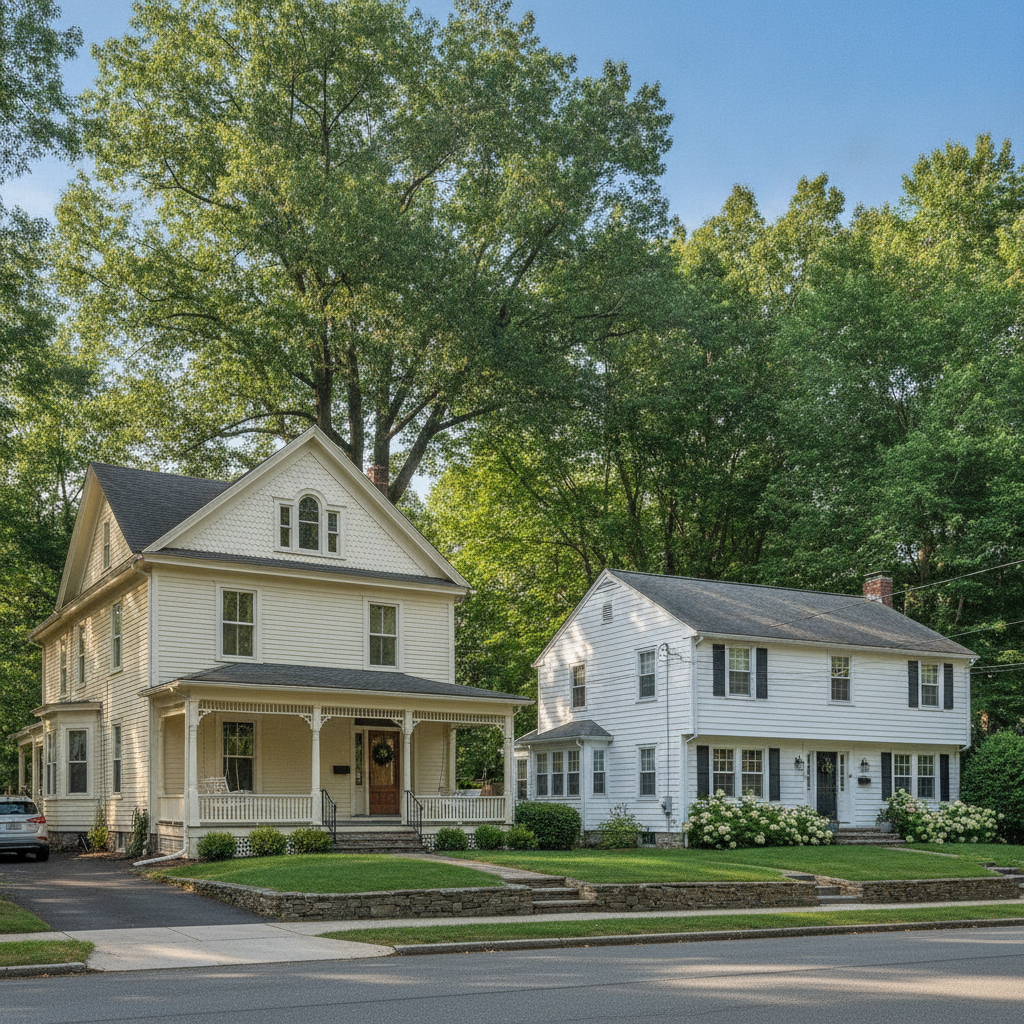
Westchester County, NY is not a single housing market — it’s two. The villages strung along the Hudson River (Tarrytown, Dobbs Ferry, Hastings-on-Hudson, and others) contain a significant concentration of Victorian and early-20th-century residential architecture, where a siding replacement often intersects with historic-district review or period-appropriate material choices. Inland and north, the postwar suburbs — Cape Cods, split-levels, and brick-veneer Colonials from the 1950s through 1970s — present a different challenge: aging original siding that needs a straightforward, durable upgrade. Knowing which context you’re in shapes every material decision you’ll make.
Gunner Roofing is a James Hardie Elite Contractor and serves Westchester County as a core part of its New York service area. We’re also fully licensed, insured, and bonded in New York — and we pull the building permit on every project.
The Two Westchester Housing Contexts
The Hudson River Corridor: Victorian and Early-20th-Century Stock
The river-facing villages developed early. Tarrytown’s historic districts, established beginning in 1979, reflect a 19th- through early-20th-century housing stock (per the village’s published historic-district code). Similar conditions exist in neighboring river towns throughout the lower Hudson Valley. Original siding on these homes is most often true wood clapboard, narrow wood shingles, or decorative fish-scale shingles on Queen Anne and Folk Victorian styles — all of which deteriorated over a century of Northeast freeze-thaw cycles and summer humidity.
Two things follow from this context:
-
Historic review may apply. In Tarrytown, for example, the Architectural Review Board reviews exterior alterations to buildings visible from a public street, and changes in a designated historic district require a certificate of appropriateness (per Village of Tarrytown Village Code Ch. 9 and Ch. 191). Requirements vary by municipality — if your home is in or adjacent to a historic or landmark district in any Westchester village or town, confirm the review process with your local building department or historic-district commission before ordering materials.
-
Material choice affects approval likelihood. Because the administrative review is external (Gunner handles your building permit on every project per our standing practice, but a historic-district certificate of appropriateness is a separate municipal determination), the material you select matters. Fiber cement — particularly James Hardie’s lap siding profiles — is widely evaluated favorably in historic and preservation contexts because it can replicate wood clapboard dimensions and paint behavior. We can tell you what others in similar situations have used; confirm the specific approval path with your commission.
Inland Westchester: Postwar Suburban Stock
Move inland — toward the Greenburgh corridor, the Route 9A suburbs, or the communities off the Saw Mill and Bronx River Parkways — and the housing era shifts to the 1950s, ’60s, and ’70s. These are typically Cape Cods, split-levels, and early ranch homes. Original siding is often aluminum, early vinyl, or T-1-11 plywood panel, now aged well past its useful life. Some were sided in the 1980s and ’90s with vinyl that is now chalking, cracking, or no longer holding color.
Here the calculus is simpler: you’re choosing a modern siding system for performance and durability, not period match. The three realistic contenders are fiber cement, premium vinyl, and — for homeowners who want a natural wood look — real cedar.
Material Options for Westchester Homeowners
James Hardie Fiber Cement — Gunner’s Premium Lead
Fiber cement is the material Gunner leads with for Westchester projects, and for good reason. It is dimensionally stable enough to hold paint without the expansion and contraction that wood undergoes through Westchester’s temperature swings; it does not rot or support insect damage; and in HardieZone 5 formulation (the climate zone covering the New York / Connecticut region, per the James Hardie HZ5 best-practice guide), it is engineered for the specific moisture and thermal cycling of the Northeast.
Lifespan. InterNACHI’s life-expectancy reference lists fiber cement’s ideal-condition range in the 25–40 year bracket. In Westchester’s real climate — high summer humidity, hard freeze-thaw cycling fall through spring, and periodic wind-driven rain events — a realistic service life is somewhat lower than that ideal-condition top end. James Hardie’s ColorPlus Technology factory-applied finish carries a 15-year limited warranty against peeling, cracking, and chipping (per the James Hardie ColorPlus warranty documentation).
What to watch. Every Gunner siding project includes a full water-resistive barrier, correct flashing at all penetrations and roof-to-wall junctions, and verified ground clearances. On fiber cement specifically, the HZ5 guide calls out minimum clearances from soil and grade — a detail that matters on older Westchester homes where finished grade has crept up over decades of landscaping. If ground clearance is inadequate, Gunner addresses it before the cladding goes on.
CertainTeed Vinyl — Gunner’s Vinyl Option
Premium vinyl remains a practical choice for the postwar suburban stock in inland Westchester — particularly on split-levels and Cape Cods where the original aluminum or early vinyl is failing.
Lifespan. InterNACHI lists vinyl siding in the 20–40 year ideal-condition range.
Where vinyl works well. For straightforward lap siding replacements on postwar-era homes without historic-district oversight, vinyl is faster to install, requires no painting, and eliminates the paint-maintenance cycle that drives many Westchester homeowners to replace it in the first place.
Where vinyl is less appropriate. On homes where historic-district review applies, thin-profiled vinyl is often evaluated differently than fiber cement or wood. See the river-corridor context above.
Cedar — For Homeowners Who Want the Real Thing
Gunner is a Cedar Shake & Shingle Bureau (CSSB) member and installs natural cedar siding on projects where the homeowner wants authentic wood character. Cedar reads well on Victorian-era homes in the Hudson River villages, and in period-preservation contexts it is sometimes the most defensible material choice.
The tradeoff is maintenance: cedar requires periodic painting or staining and is susceptible to moisture damage if the coating cycle lapses. Installed and maintained correctly, it can last a long time; but it demands more homeowner engagement than fiber cement or vinyl.
What the Water-Resistive Barrier Does (and Why It Matters Here)
Regardless of which exterior cladding you choose, all exterior walls in a code-compliant installation require a water-resistive barrier behind the cladding — per IBC 2021 §1403.2, which New York State has adopted with amendments. The WRB is the drainage plane that intercepts any water that gets behind the siding and channels it out. On older Westchester homes — particularly those being stripped of original wood clapboard or aluminum — the condition of what’s underneath is often a surprise: deteriorated felt paper, missing flashing at windows and doors, or compressed insulation that has lost its thermal value.
Every Gunner siding project includes a new WRB installation and correct flashing at all penetrations and roof-to-wall junctions. We also verify ground clearances for fiber cement installs per the HZ5 best-practice guide. This is standard practice, not an upgrade.
Permitting in Westchester County
Under New York State Executive Law §381 (per the NYS Department of State Legal Memorandum LG03), each local government — incorporated village, town, or city — administers and enforces the Uniform Code within its boundaries. That means permit authority in Westchester is fragmented: incorporated villages permit within their own limits, and the town covers the unincorporated area.
In the Town of Greenburgh, for example, the Town of Greenburgh Building Department handles permitting for the unincorporated Town, while the incorporated villages within Greenburgh maintain their own building programs (per the Town of Greenburgh Building Department FAQ).
What this means for a siding project: the building department you file with depends entirely on whether your address is in an incorporated village or in an unincorporated town area. Gunner handles the permit application and management on every project, so we navigate this for you — but knowing your municipality’s structure helps explain why permit timelines vary within the county.
Comparison Summary
| James Hardie Fiber Cement | CertainTeed Vinyl | Cedar | |
|---|---|---|---|
| Best for | Victorian river-corridor homes; postwar homes where paint longevity matters | Postwar suburban stock, budget-conscious projects | Authentic wood character; period preservation |
| Lifespan (ideal condition, InterNACHI) | 25–40 years | 20–40 years | Variable — maintenance-dependent |
| Typical Westchester real-world range | Shorter than ideal-condition max; climate-adjusted | Lower end of range in heavy UV/thermal cycling | Shorter without consistent coating |
| Maintenance | Paint every 15+ years (factory finish) | None (no painting) | Paint/stain every several years |
| Historic-district contexts | Widely evaluated favorably; confirm with your commission | Less likely to match period profiles | Strong match for Victorian/period homes |
| Gunner installs? | Yes — our premium lead | Yes — our vinyl option | Yes — CSSB member |
FAQ
Do I need a permit to replace siding in Westchester County? Yes — exterior siding replacement typically requires a building permit in Westchester municipalities. The permitting authority depends on your address: incorporated villages issue their own permits; the town covers unincorporated areas. Under NYS Executive Law §381, each local government administers and enforces the Uniform Code. Gunner pulls and manages the permit on every project.
Does my home need historic-district review before a siding replacement? If your home is in or near a designated historic district or landmark area — common in the Hudson River corridor villages — you may need a certificate of appropriateness from your municipality’s review body before exterior alterations. Requirements vary by municipality; confirm with your local building department or historic-district commission. In the Village of Tarrytown, for example, the Architectural Review Board reviews exterior alterations visible from a public street, per the village code.
What siding material works best on Victorian-era Westchester homes? James Hardie fiber cement, in the lap siding and shingle profiles, replicates the dimensions and paintability of original wood clapboard closely enough to satisfy most period-preservation evaluations. Cedar is an option where only authentic wood will do. Confirm approval requirements with your local review body before selecting.
How long does fiber cement siding last in Westchester County? InterNACHI’s life-expectancy chart lists fiber cement at 25–40 years under ideal conditions. In Westchester’s climate — freeze-thaw cycling, high summer humidity, and periodic wind-driven rain — plan for the lower-to-middle portion of that range as a realistic expectation, rather than the top end. The James Hardie ColorPlus factory finish carries a 15-year limited warranty against peeling, cracking, and chipping.
What is included in every Gunner siding installation? Every Gunner siding project includes a full water-resistive barrier, correct flashing at all penetrations and roof-to-wall junctions, and verified ground clearances (especially relevant for fiber cement). We also pull and manage the building permit on every project.
Is vinyl siding a good choice for inland Westchester homes? For postwar-era Cape Cods, split-levels, and ranches in inland Westchester — where the original aluminum or early vinyl is failing — premium insulated vinyl is a practical, low-maintenance option. It is less likely to be the right call on homes in historic-district areas, where fiber cement or cedar typically reads better architecturally.
Get a fast, free quote
No inspection visit needed - we measure your roof from satellite imagery and send your quote.