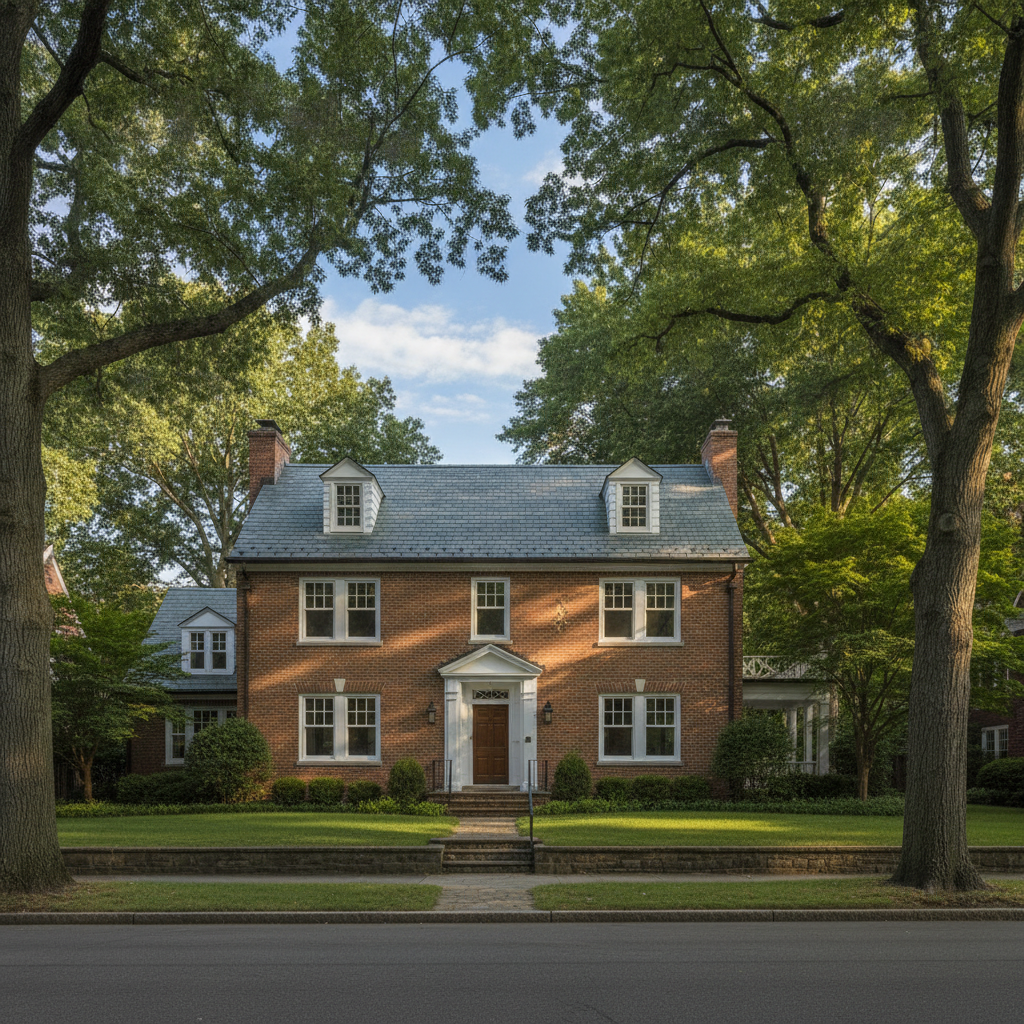
Which window frame material fits a Yonkers home?
For most Yonkers homes, the answer to the frame-material question comes down to three things: the home’s age and architectural character, the climate demands of the Hudson River corridor, and how much maintenance the homeowner is willing to do. Vinyl frames are low-cost, thermally efficient, and require no painting — the right call for mid-century ranches and utility-focused replacements. Clad-wood frames (aluminum or fiberglass exterior over a wood interior) suit Yonkers’ dense stock of pre-war Colonials, Tudors, and brick multi-families where the original window profiles are part of what the neighborhood looks like.
Why frame material matters more in Yonkers than in most Westchester towns
Yonkers sits at a geographic and climatic intersection that puts real stress on window frames. The Hudson River runs along the city’s entire western border, feeding persistent summer humidity into every block — especially in the lower-elevation Getty Square and Riverdale-adjacent neighborhoods on the riverfront slopes. The urban density raises ambient temperatures above what purely suburban Westchester towns see: dense block coverage and asphalt absorb and re-radiate solar heat through July and August.
Add the architectural reality: much of Yonkers’ housing stock is pre-war. Neighborhoods like Park Hill, Dunwoodie, McLean Heights, and Ludlow carry block after block of brick Colonials, Tudor revivals, and two- and three-family rowhouses with tall, narrow window openings and detailed masonry surrounds. In these homes, frame material is not just a thermal decision — it determines whether the replacement window fits the building visually and whether the local building or landmarks requirements can be satisfied.
Finally: noise. Yonkers sits along Metro-North’s Harlem Line corridor, the New York State Thruway (I-87), and the Saw Mill River Parkway. Homes within a few blocks of these corridors face sustained traffic and train noise that a well-specified window can meaningfully reduce. Frame rigidity affects how well a window unit holds a laminated or acoustic glass package over time — a point that matters more in Yonkers than in quieter Westchester communities.
The three frame materials
Vinyl
They carry no surface finish that ages, are inherently resistant to moisture, and will not rot or rust. Because the frame is the insulator — there is no conductive path from exterior to interior through the vinyl — vinyl frames often achieve strong U-factors without thermal breaks.
Thermal performance. Modern multi-chamber vinyl extrusions trap still air in discrete cavities, providing insulation across the frame. Per the U.S. Department of Energy, vinyl frames are among the better-performing frame types in cold climates for this reason.
Humidity and expansion. Vinyl expands and contracts with temperature more than fiberglass — a real consideration in Yonkers’ range of summer heat and winter cold. Premium vinyl windows account for this with engineering tolerances in the sash and weatherstripping. Cheaper commodity vinyl units can rack or bind in frames that have racked or settled, which is common in Yonkers’ older housing.
Aesthetics. Vinyl comes in white, tan, and a limited range of painted or foiled finishes. It cannot be repainted in the field. For homes with painted or stained wood window surrounds, matching vinyl’s available colors to the building’s period character can be difficult.
Best fit in Yonkers. Mid-century Cape Cods, ranches, and colonials in neighborhoods like Crestwood and Woodstock where thermal performance and low maintenance take priority over period appearance. Also appropriate for rear and side elevations of any home where visual character is a lower concern.
Fiberglass
Fiberglass-reinforced frames are made from glass-fiber composite — the same base material as the glass in the window unit itself — which gives them an unusual property: they expand and contract at nearly the same rate as the glass. That match between frame and glass reduces stress on the seal over decades of temperature cycling.
Thermal performance. Fiberglass frames are excellent insulators and, like vinyl, can be engineered with foam-filled cavities for additional R-value. Their dimensional stability means weatherstripping stays aligned over the life of the window.
Humidity resistance. Fiberglass does not absorb moisture, does not rot, and does not warp — an advantage in Yonkers’ riverfront humidity and the condensation that accumulates on exterior frames in summer. The material holds paint: fiberglass windows can be factory-painted and field-repainted if the finish fades or a color change is needed.
Aesthetics. Fiberglass profiles can be made slimmer than vinyl, which helps preserve the sight-line character of older window openings. They accept paint, so a fiberglass window can be matched to the existing color scheme of a 1920s Tudor or 1930s Colonial without the permanent-color limitation of vinyl.
Best fit in Yonkers. Pre-war Colonials, Tudors, and brick multi-families where period appearance matters but the owner wants the long-term maintenance advantage of non-wood frames. Also a strong fit for south and west-facing elevations where solar and humidity cycling is most aggressive.
Clad-wood (aluminum or fiberglass exterior over wood interior)
Clad-wood frames are a wood frame protected on the exterior by a thin aluminum or fiberglass cladding. The interior is exposed wood — typically pine, Douglas fir, or a hardwood — which can be painted or stained to match the home’s interior trim. The exterior cladding handles weather, UV, and moisture without exposing the wood directly to the elements.
Thermal performance. Wood is a natural insulator; its U-factor contribution is meaningful. The drawback is that wood frames are wider than vinyl or fiberglass for equivalent structural performance, which reduces the glass area in a given opening slightly. With a good glass package, clad-wood windows readily achieve ENERGY STAR Northern zone performance.
Maintenance reality. The exterior cladding eliminates the traditional painted-wood maintenance cycle on the outside. The interior wood still requires attention — it should be painted or sealed at installation and periodically touched up. This is considerably less work than a fully exposed wood window, but not zero.
Character match for Yonkers’ pre-war stock. Clad-wood windows are the closest match to the look of original wood windows in Yonkers’ period homes: the profiles are similar, the interior wood can match original trim, and the sightlines on the exterior look like painted wood rather than vinyl or composite. In neighborhoods with strong architectural character — Lawrence Park West, the Heights, and parts of Park Hill — clad-wood is often the right answer for street-facing elevations.
Cost. Clad-wood windows carry the highest installed price of the three options, reflecting the material cost and the more detailed installation required to match original profiles and achieve tight flashing at masonry surrounds.
Best fit in Yonkers. Street-facing elevations of pre-war Colonials, Tudors, brick rowhouses, and larger single-family homes where architectural character is a priority and budget allows. If your home is in or near a historically significant area, confirm any applicable appearance requirements with your local building or landmarks commission before ordering — requirements vary by municipality and district.
Energy code baseline for Yonkers
Yonkers is in IECC Climate Zone 4. Under the 2020 New York State Energy Conservation Construction Code (Table R402.1.2), replacement windows must meet a maximum U-factor of 0.32 and a maximum SHGC of 0.40. This is the code floor — every window sold for residential use in this market clears it easily.
The more meaningful target is ENERGY STAR Version 7.0 Northern climate zone certification, which tightens the requirements to a U-factor of 0.22 or lower and a minimum SHGC of 0.17 (in effect since October 23, 2023). A low-E coating on the glass, combined with an argon or krypton fill in the insulating unit, is what gets a window from code-minimum to ENERGY STAR performance — and that spec is available in all three frame types.
For Yonkers homes with significant west-facing glass — common on streets that run north-south along the Hudson bluffs — a low SHGC helps block solar heat gain in July and August without sacrificing winter passive solar. The right balance depends on orientation and shading; a competent installer will walk through this before you order.
A quick comparison
| Vinyl | Fiberglass | Clad-wood | |
|---|---|---|---|
| Moisture/rot resistance | Excellent | Excellent | Good (cladding protects; wood interior needs sealing) |
| Dimensional stability | Good (some thermal movement) | Excellent (low expansion) | Good with cladding |
| Field-repaintable | No | Yes | Interior: yes; exterior: cladding is factory-finished |
| Period-character match | Fair | Good | Excellent |
| Relative installed cost | $ | $$ | $$$ |
| Best Yonkers fit | Mid-century / utility-first | Pre-war + performance | Pre-war + appearance priority |
What Gunner Roofing installs in Yonkers
Gunner Roofing is an Andersen Certified Elite contractor (per Gunner’s verified company facts) and installs Andersen windows across Westchester County, including Yonkers. Gunner is fully licensed, insured, and bonded in New York, and pulls the required building permit on every window project as a standard part of the job.
Frequently asked questions
Which window frame material lasts longest in Yonkers’s climate? Fiberglass and high-quality vinyl both offer excellent long-term performance in Westchester County’s climate. Fiberglass has a slight durability edge because it expands and contracts at nearly the same rate as the glass, reducing stress on seals over decades of temperature cycling. Clad-wood frames also perform well when the interior wood is properly sealed and maintained. Wood-only frames without cladding require the most maintenance in Yonkers’ Hudson corridor humidity.
Do I need a permit to replace windows in Yonkers? Requirements vary by municipality; confirm with your local building department or historic-district commission.
What does ENERGY STAR Northern zone mean for Yonkers windows? Yonkers falls in ENERGY STAR’s Northern climate zone. Version 7.0 of the program (in effect since October 2023) sets a maximum U-factor of 0.22 and a minimum SHGC of 0.17 for certified windows in this zone — per the ENERGY STAR final specification. The state code floor (U-factor 0.32) is lower; ENERGY STAR is the practical performance target worth specifying.
Can vinyl windows be painted to match an older Yonkers home? Standard vinyl windows cannot be field-painted — the color is integral to the material. Some manufacturers offer factory-painted or foiled finishes in a wider color range, but the selection is limited compared to painted wood or fiberglass. For period-sensitive homes in Yonkers, fiberglass or clad-wood gives more flexibility.
What is the best window frame for a pre-war Yonkers home? For street-facing elevations of pre-war Colonials, Tudors, and brick multi-families, clad-wood or fiberglass frames are typically the best fit. Clad-wood most closely matches the profile and look of original wood windows; fiberglass offers nearly the same appearance with less interior maintenance. Confirm any local appearance requirements with your municipality before ordering.
Does frame material affect how well a window blocks noise? Frame rigidity helps, but the glass package — laminated glass with a PVB interlayer, or a triple-pane unit — is the primary driver of sound attenuation. For homes near the Thruway, Metro-North corridor, or Saw Mill Parkway, specify the acoustic glass option and confirm the STC rating with your installer.
Get a fast, free quote
No inspection visit needed - we measure your roof from satellite imagery and send your quote.