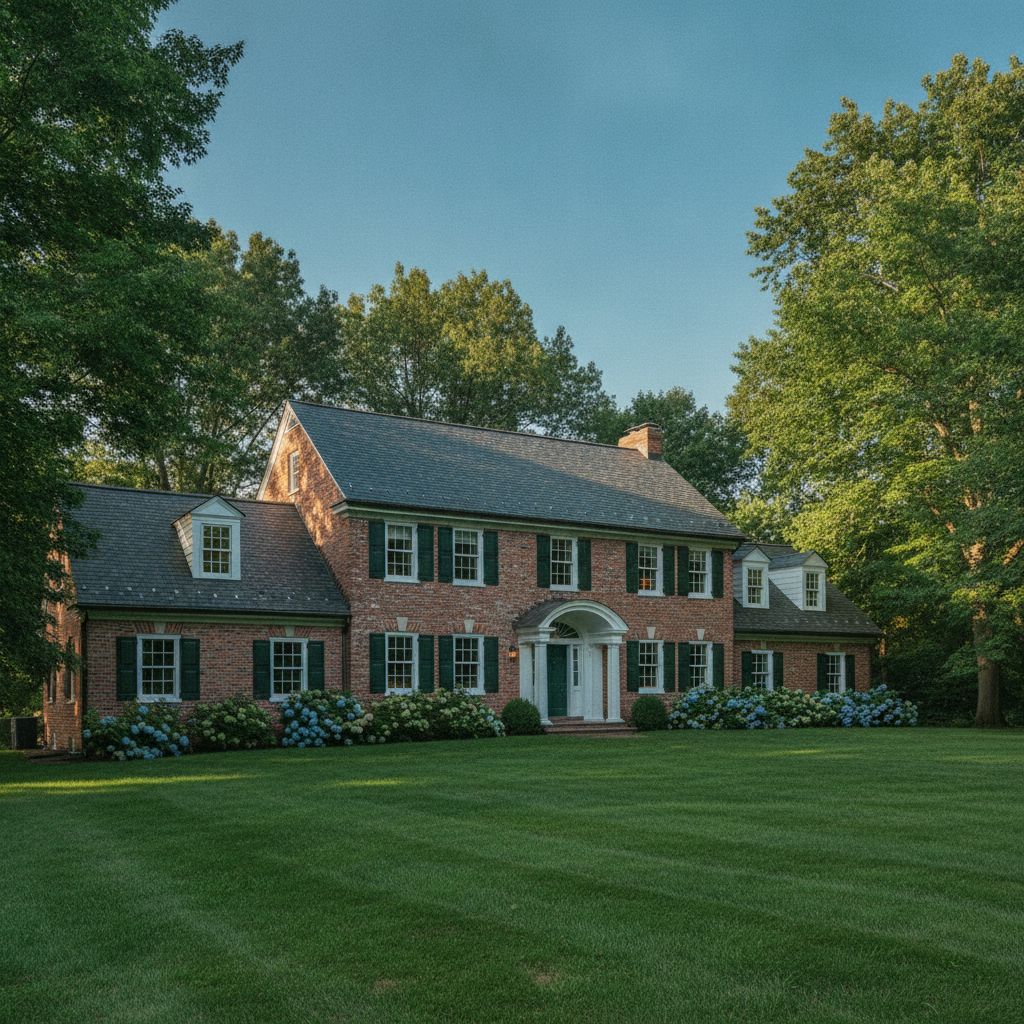
A full roof replacement in Fairfield County, CT does not have a single price tag — and any contractor who quotes you a number before seeing your roof is guessing. What drives cost is a combination of roof size, pitch and complexity, material selection, how many old layers need to come off, what the deck looks like underneath, and what the mechanical systems (flashing, ventilation, penetrations) require. This guide walks through each driver honestly so you can evaluate proposals with confidence and understand why an accurate number requires an on-site inspection.
Roof Size: The Starting Point
Every roofing estimate begins with squares — one roofing square equals 100 square feet of roof surface. A modest Cape Cod might be 18–22 squares. A large Colonial or Tudor with dormers, multiple wings, and a steep pitch can exceed 45–60 squares. Because labor and material are priced per square, size alone can more than double the scope between two homes on the same street.
Fairfield County’s housing stock skews toward the larger end. Greenwich, Darien, Westport, New Canaan, and Ridgefield are known for substantial homes — four-bedroom Colonials, Tudors, and coastal estates with multiple roof planes, deep overhangs, and intricate dormers. This is the first reason replacement projects here frequently run above a simple regional benchmark.
Pitch and Complexity
Steeper pitches require more labor. A roofer working on a 12:12 pitch (45-degree angle) needs safety rigging, slower footing, and more time per square than one working on a 4:12 walkable slope. Multiple valleys, hip returns, intersecting pitches, and curved dormers add cutting time and require more starter courses, hip-and-ridge material, and precision at every seam.
Complexity multipliers accumulate fast on a large, multi-pitch roof. A straightforward gable roof might take two days; a comparable-area roof with a dozen valleys, three dormers, a chimney, skylights, and a porch overhang may take four or five.
Material Choice: The Biggest Cost Swing
After size, material is the largest variable.
Architectural asphalt shingles — the category that includes GAF Timberline HDZ and UHDZ, Owens Corning Duration, and TAMKO Heritage — represent the baseline cost tier. They offer good performance for the Connecticut climate and a range of warranty options.
Premium synthetic slate and shake — products like DaVinci Roofscapes and Brava Roof Tile — cost significantly more per square to purchase and install. Labor is also higher because these materials require careful layout, more precise cutting, and specific fastener patterns. For homes in historic neighborhoods or coastal areas where appearance and durability both matter, the premium may make sense over the long term.
Cedar shake (Gunner is a member of the Cedar Shake & Shingle Bureau) is a third tier — labor-intensive installation, ongoing maintenance requirements, and a price point well above standard asphalt.
No responsible cost guide for Fairfield County publishes a single per-square figure across material tiers. The spread between a standard architectural shingle and a premium synthetic slate installation on the same roof can be substantial. The right question is: which material is appropriate for your home’s age, style, HOA covenants (if any), and long-term budget?
Tear-Off: One Layer or Two?
Requirements vary by municipality; confirm with your local building department or historic-district commission. If your home has one existing layer, tear-off adds disposal cost and labor but is relatively straightforward. If it has two layers — common on houses that received a lay-over rather than a full replacement years ago — whether both must come off depends on local requirements; if full tear-off is required, disposal cost roughly doubles.
Requirements vary by municipality; confirm with your local building department.
Deck Condition and Structural Repairs
Once the old shingles are off, the deck gets inspected. Soft spots, rot, delaminated plywood, sagging rafters — any of these get repaired before new material goes down. On older Fairfield County homes (many built from the early to mid 20th century), unexpected deck rot is not unusual, especially around chimneys, valleys, and flat or low-slope sections where water has collected over the years.
A sound deck requires no additional work. A deck with localized rot may add a few sheets of plywood. Structural rafter repairs are less common but possible on very old homes. No honest contractor can tell you what the deck looks like until the tear-off is done — which is why reputable contracts itemize deck repair as a potential line item, not a hidden surprise.
Flashing, Ventilation, and Code Compliance
On every Gunner roof replacement, the scope includes: ice-and-water shield installed to meet or exceed code minimums, leak barrier through all valleys, step and counter-flashing at all penetrations (dormers, chimneys, skylights, wall terminations), and proper attic ventilation (per company policy, internal-verified). This is not optional.
Older homes often have inadequate attic ventilation, which traps heat and moisture and degrades shingles from the inside out. On roof replacements Gunner addresses all three layers — air sealing, insulation, and ventilation — and performs the attic air-sealing and insulation work itself.
If existing penetrations (a gas flue, a bathroom exhaust vent, a chimney stack) need new flashing, that work is included in a full replacement scope. Dormers with step flashing that was never installed correctly are common in Fairfield County’s older stock — correcting that at replacement time is far cheaper than re-opening the roof later.
Permits
Gunner handles the building permit — pulling and managing the permit application — on every project, in every case (per company policy, internal-verified). Permit cost is part of the project; you do not need to manage the municipal paperwork. Permit requirements and fees vary by municipality in Connecticut; your project manager will confirm the specific jurisdiction timeline as part of scoping.
Why Fairfield County Projects Often Run Higher
Three factors converge in this county that distinguish it from a simpler inland market:
Housing scale. The concentration of large, complex-roofline homes means more squares, more valley cuts, and more flashing detail per job.
Coastal salt-air exposure. Homes in Westport, Norwalk, Greenwich, and Stratford face Long Island Sound. Salt air accelerates metal corrosion and can degrade certain roofing adhesives faster. Proper material selection and flashing — copper or high-quality aluminum rather than galvanized at high-exposure locations — matters more in a coastal setting.
Material expectations. Homes in this market frequently support premium material choices that are the right fit architecturally and financially. DaVinci composite slate on a Greenwich Tudor costs more than standard shingles — but it is also more appropriate for the home.
None of these factors means a roof replacement in Fairfield County is unaffordable. They mean that scoping it accurately requires someone who has actually seen the roof.
Why You Need an On-Site Estimate
Satellite measurements give square footage. They do not reveal deck rot, flashing condition, the number of existing layers, attic ventilation deficiencies, chimney flashing failures, or the true complexity of dormers and valleys. Every one of those variables affects scope and cost.
Gunner provides free, no-obligation on-site estimates for Fairfield County homeowners. A project manager measures the roof, walks the attic, assesses the existing flashing and deck, and gives you a detailed line-item proposal — not a range-based guess.
A Note on Insurance
If your roof was damaged by a hail storm, wind event, or this summer’s severe weather, your homeowners insurance policy may cover some or all of the replacement cost — depending on your policy’s terms, your deductible, and whether the damage meets the carrier’s threshold. Whether a new roof restores replacement-cost vs. actual-cash-value (depreciated) settlement is a policy-specific question. If you suspect storm damage, document it with photos and contact your carrier. Gunner can work with your adjuster to scope the damage; availability and any applicable coverage depend entirely on your specific insurer and policy — confirm with your carrier or a licensed agent.
Ready for an accurate number? Gunner Roofing is fully licensed, insured, and bonded in Connecticut, and fewer than 3% of roofing contractors nationally qualify for GAF Master Elite® status (per GAF). Schedule a free on-site estimate and get a detailed, line-item proposal for your Fairfield County home — no obligation, no pressure.
Get a fast, free quote
No inspection visit needed - we measure your roof from satellite imagery and send your quote.