Every roofer has a list. The questions that come in at 9 p.m. on a Tuesday, the ones scrawled on a notepad during an estimate, the ones a homeowner asks while slightly embarrassed (“Is this a dumb question?”). It’s never a dumb question. Roofs are complicated, misconceptions are everywhere, and the stakes are high enough that you should want real answers.
Here are seven of the most genuinely odd — but completely real — questions we hear from NY and CT homeowners, answered as plainly as we can.
1. Do Metal Roofs Attract Lightning?
No — and this one is worth clearing up completely because it stops people from considering a durable, long-lasting roofing option for no good reason.
Lightning travels the path of least resistance to ground. It targets the highest point in an area based on geometry and atmospheric conditions — not the material at that point. A metal roof on a two-story Colonial in Westchester is not meaningfully different, from lightning’s perspective, than an asphalt-shingled roof at the same height.
Where metal actually has an edge: it’s non-combustible. If lightning does strike, a metal roof won’t ignite the way wood framing or sheathing can if a strike causes arcing. Any home with a lightning protection concern (tall trees nearby, isolated hilltop, etc.) should consult a certified lightning protection installer — that assessment applies equally regardless of roofing material.
Curious whether metal roofing makes sense for your home? A free Gunner estimate covers material options with no pressure.
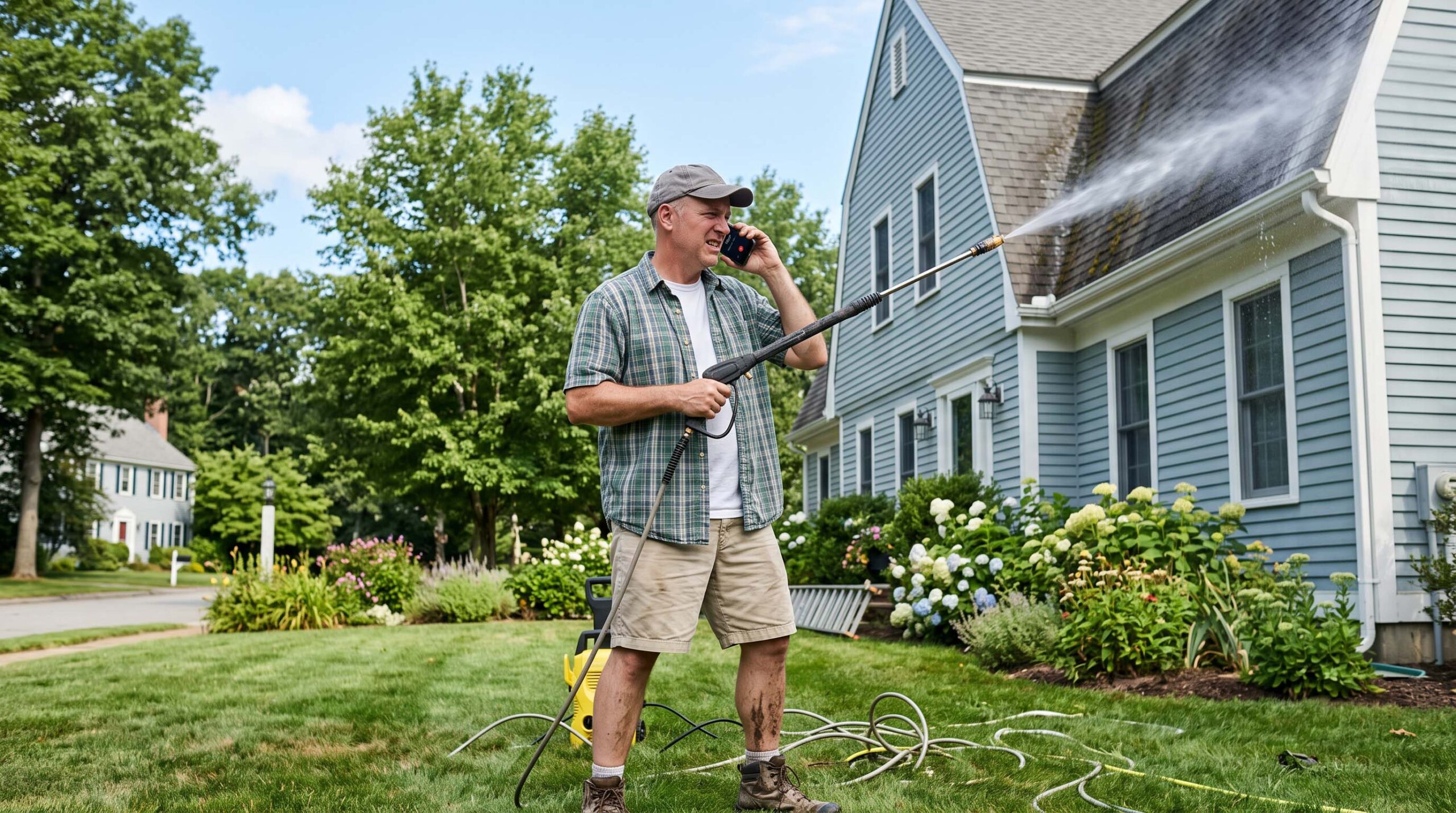
2. Can I Pressure-Wash My Asphalt Shingles?
Please don’t.
Asphalt shingles rely on their ceramic granule surface for UV protection, weathering resistance, and fire ratings. High-pressure water strips those granules — not all at once, but enough in a single pass to meaningfully shorten the roof’s service life. Per GAF’s steep-slope roofing field guide, aggressive cleaning methods that dislodge granules void the conditions for optimal shingle performance.
If you have algae streaking (see question 6), the correct approach is a professional soft-wash treatment using low pressure and a diluted cleaning solution — not a pressure washer. If debris has collected in valleys or gutters, clear it by hand or with low-pressure rinsing.
A roof that looks clean after pressure-washing but has lost a significant layer of granules is a roof that just lost years of useful life.
If your shingles look rough and you’re wondering whether it’s cosmetic or structural, we’ll take a look for free.
3. Do Dark Shingles Really Cook My Attic?
Somewhat — but ventilation is the real story.
Darker shingles do absorb more solar radiation than lighter ones, and that energy transfers into the roof deck. According to the U.S. Department of Energy, reducing attic heat gain has a meaningful effect on cooling loads in summer. So the concern isn’t imaginary.
Here’s what actually matters more: whether your attic has adequate ventilation to flush that heat before it builds. Under the 2020 Residential Code of New York State (IRC §R806) and the 2021 Connecticut State Building Code (which mirrors the same IRC requirements), attics must provide a minimum net free ventilation area of 1/150 of the conditioned floor area — reducible to 1/300 when vents are balanced between low (soffit) intake and high (ridge or gable) exhaust. An attic that’s properly ventilated handles the heat load from dark shingles without pushing it into your living space.
If your second floor runs hot in August and your energy bills are high, check ventilation before assuming shingle color is the culprit. It almost always turns out to be a ventilation or insulation issue.
Gunner addresses ventilation as part of every roof replacement — not as an upsell, as standard practice.
4. Do Squirrels Actually Chew Through Roofs?
Yes — and if you live in Westchester or Fairfield County under a mature canopy of oaks and maples, this is a genuine concern, not an abstract one.
Squirrels (and other rodents) target wooden soffit boards, fascia, and any existing gap or soft spot at a roof edge or dormer junction. They’re persistent: if there’s a cavity they can smell or hear on the other side, they’ll work at it. Once inside, attic insulation and electrical wiring are vulnerable.
The important thing to understand is the order of operations: pest exclusion first, then roof repair. If you close an entry point without addressing the animal situation, you may be trapping something inside — and if you repair without exclusion, you’ll have a new chew point in short order. The right sequence is a pest control company (to identify and seal entry points, handle any occupants), then a roofer to address structural damage.
If you’re hearing scratching in the ceiling after a rainstorm or in early morning, it’s worth investigating before the next season.
Gunner handles the roofing side of the equation — give us a call once the pest company has cleared the way.
5. Can I Walk on My Roof to Check It After a Storm?
Technically — but we’d generally say: don’t, unless you’re experienced with roof work and know the pitch and condition of what you’re stepping onto.
Asphalt shingles can be scuffed, cracked, or delaminated by foot traffic, particularly on steeper pitches or in warm weather when the asphalt softens slightly. Wet shingles are slippery in ways that aren’t obvious from the edge. And storm damage often includes weakened sections that look intact from the gutter line but aren’t load-bearing.
After a summer storm in NY or CT, the most useful self-inspection is from the ground: walk the perimeter with binoculars and look for lifted or missing shingles, damaged ridge cap, dented or displaced flashing at chimneys and dormers, and any debris still on the roof. Photograph what you find. Then call a roofer for a proper inspection.
Gunner offers a free, no-obligation estimate — we’ll get eyes on it safely and give you an honest assessment.
6. Why Does My Roof Have Black Streaks — Is That Mold?
It’s not mold — it’s a cyanobacterium called Gloeocapsa magma that feeds on the limestone filler embedded in asphalt shingles. It appears as dark bluish-green to black streaking that runs down the roof face, usually starting near the ridge and working downward. In the Northeast’s humid summers, it spreads easily — spores carry on wind and rain, which is why you’ll often see the same streaking pattern across multiple homes on a block.
It’s worth addressing: beyond aesthetics, heavy algae growth retains moisture against the shingle surface, which over time accelerates weathering. Algae-resistant shingles — like the GAF Timberline line with StainGuard Plus™, which Gunner installs — use GAF’s time-release, copper-based algae-fighting technology to inhibit Gloeocapsa magma, and are a good choice if you’re in a neighborhood where streaking is common.
For existing streaking, a professional soft-wash treatment (low pressure, appropriate cleaning solution) removes it without stripping granules. Do not pressure-wash. See question 2.
If your shingles are heavily streaked and you’re near the end of their service life anyway, it may be worth comparing cleaning costs against replacement — we can walk you through that.
7. Will Replacing My Roof Actually Lower My Homeowners Insurance?
It might — but no one can responsibly promise you a specific dollar amount or percentage, because the outcome depends entirely on your carrier, your policy, and your specific home.
Here’s the mechanism that matters: insurers assess the likelihood and severity of a future claim. A new roof reduces the probability of weather-related damage claims, and on older homes, replacement often restores replacement-cost (RCV) coverage where the policy previously paid only the depreciated (ACV) value. Impact-resistant shingles — Class 4 rated for hail resistance — may qualify for premium credits with some carriers in NY and CT, but availability and the amount vary by insurer and are not universal. Confirm the specifics with your agent or a licensed insurance professional.
What’s worth knowing: hang on to your permit records, installation date, and product specs after a new roof — that’s the documentation an insurer typically wants, so you’re not scrambling when it’s time to update your policy. (Gunner pulls the permit on every job, so that record already exists.)
Get a free estimate at GunnerRoofing.com; bring the quote to your insurance conversation.
Frequently Asked Questions
Got a question that didn’t make the list? Start with a free, no-obligation quote at GunnerRoofing.com — we’ll answer it in person.
Get a fast, free quote
No inspection visit needed - we measure your roof from satellite imagery and send your quote.