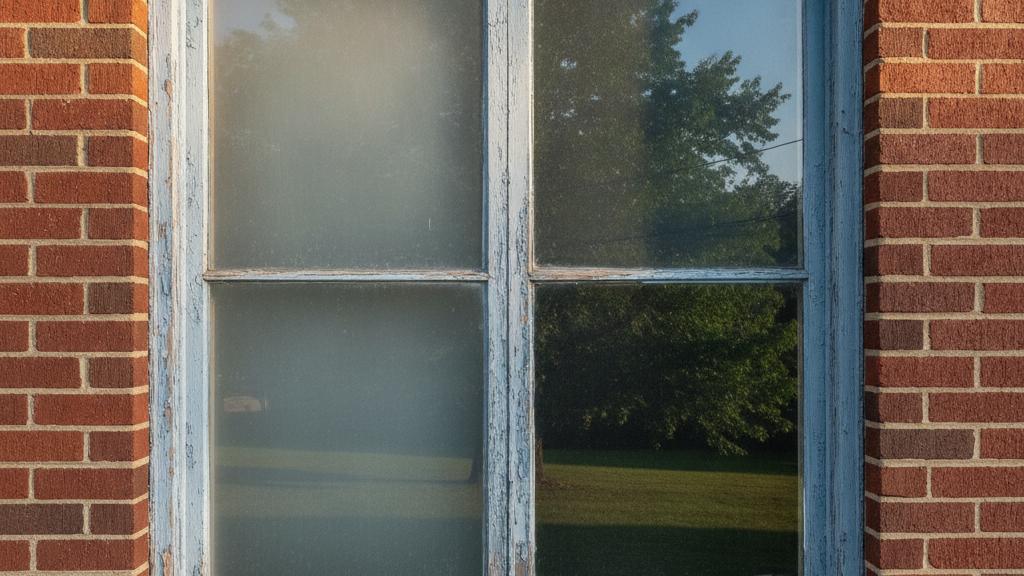
That milky haze trapped between your window panes is not something you can clean off — and it is not going to clear up on its own. It is a failed seal on the insulating glass unit (IGU), and the only real fixes are either swapping the glass unit or replacing the window. Here is how to know which option makes sense for your Yonkers home and what each choice actually involves.
What that fog actually is — and why it forms
A standard double-pane window is built around an IGU: two layers of glass with a sealed air gap between them, typically filled with argon gas, held apart by an aluminum or warm-edge spacer. The seal that keeps that gas in and outside air out is a dual-pane sealant around the perimeter. Over time, heat cycling, UV exposure, and moisture work that seal loose. Once it breaches, humid outside air migrates into the cavity.
Per Andersen Windows’ condensation guidance, moisture appearing between the panes is always a structural failure of the IGU — the seal is gone and the inert gas fill has been displaced. It cannot be wiped away from the inside because it is physically inside the unit. Interior condensation (on the room-facing surface of the glass in cold weather) is a different phenomenon: that is typically a humidity management issue in the house, not a window failure.
In Yonkers specifically, the Hudson River valley concentrates summer humidity. The city’s dense pre-war neighborhoods — Park Hill, Nepperhan, Dunwoodie, and the row-house corridors along South Broadway — include a large share of homes built before modern double-pane technology was standard. Many of those original single-pane units were replaced with early double-pane windows in the 1980s and 1990s. That generation of IGUs is well past the typical seal-life range that most glass manufacturers cite.
The two-question decision tree
Before discussing repair vs. replacement, two questions narrow the options significantly:
1. Is this a manufacturer-supported, replaceable IGU or a factory-integral sash?
Newer name-brand windows — Andersen, Pella, and similar lines — are designed so that the glass unit can be ordered and replaced separately, without disturbing the frame. The sash (the moving section that holds the glass) stays in place; only the pane assembly is swapped. This is only viable if: – The window brand and product line can still supply that exact IGU – The frame and sash are otherwise structurally sound (no rot, no racking, no failed hardware) – The original installation is less than roughly 15–20 years old (older units may have non-standard spacer geometry or discontinued glass specs)
2. What is the condition of everything else?
A fogged IGU in an otherwise excellent frame with tight weatherstripping, solid hardware, and good flashing is a candidate for glass-only swap. A fogged IGU in a window where the wood sill has softened, the sash sticks, or the frame has pulled away from the rough opening is a candidate for full replacement — because replacing the glass in a deteriorated frame just kicks the other failure modes down the road.
IGU swap: when it makes sense
An IGU replacement makes the most economic sense when:
- The frame is structurally intact and air-seals properly
- The product line is current and the replacement unit is available from the manufacturer
- The fogging is isolated to one or two windows in an otherwise well-performing assembly
- The window was installed within the last 10–15 years and the rest of the system (low-E coating, gas fill, U-factor) still meets current performance expectations
What an IGU swap restores: the thermal separation between panes and the visual clarity of the glass. What it does not change: the frame’s U-factor performance, its air-leakage rate, the hardware condition, or the installation flashing.
One realistic limit: if your windows predate ENERGY STAR Version 7.0 (effective October 23, 2023), swapping the IGU puts you back to the original unit’s performance spec — not a current Northern climate-zone standard. Per ENERGY STAR v7.0, the Northern zone maximum U-factor is 0.22 (per the EPA/ENERGY STAR specification). A replacement unit sourced to the original window’s spec may have a higher U-factor than that. If energy performance is a significant driver, full replacement with a current-spec window may deliver more value than an IGU swap.
Full window replacement: when the glass isn’t the only problem
Full replacement becomes the better option when any of these conditions apply:
| Condition | Why IGU swap isn’t enough |
|---|---|
| Frame or sill rot | Rot spreads; a new glass unit in a compromised frame will fail again |
| Racked or bowed frame | Causes air leakage IGU replacement cannot address |
| Sticking or inoperable sash | Hardware and sash geometry issues require frame-level work |
| Window predates current energy codes | New York State Energy Code (Climate Zone 4, Westchester County) sets prescriptive maximum U-factor at 0.32 per 2020 NYS ECCC Table R402.1.2; a truly underperforming older window may benefit more from a full upgrade |
| Multiple failed units across the house | Economies of scale favor a full replacement project over piecemeal IGU orders |
For Yonkers’ pre-war brick housing stock specifically, frame condition is the decisive variable. Masonry-set wood frames in row houses and Tudors are subject to decades of moisture cycling and paint-over-paint buildup that eventually compromises both the structural integrity of the frame and the air seal at the rough opening. When those frames are in poor condition, a glass swap treats the symptom rather than the problem.
Why Yonkers’ housing stock makes this more common
The Hudson River valley runs directly through Westchester County, and Yonkers sits at its mouth — right where the river’s humidity corridor meets the urban heat island effect of the city and the Bronx. Summer afternoon dewpoints regularly spike after convective thunderstorms track up the valley, which accelerates the moisture-cycling stress on window seals. Homes on elevated lots in Park Hill or the Getty Square area with western exposures take direct afternoon sun combined with that humidity load, which is harder on early-generation IGU seals than typical inland suburban conditions.
The combination of older housing stock and above-average humidity stress means that if you are seeing fogged windows in a Yonkers pre-war home, you are unlikely to be the only one on the block. It also means that a whole-house audit — looking at every window rather than just the ones you have noticed — often reveals two or three additional units in early stages of failure.
What to expect from the replacement process
Requirements vary by municipality; confirm with your local building department or historic-district commission. Gunner handles the permit-pulling and management on every project — it is included.
For Yonkers’ pre-war brick construction, the installation method matters. Masonry openings require a different installation approach than wood-framed new construction — typically a pocket or flush-fin install with proper flashing at the head, sill, and jambs to prevent the water intrusion that originally compromised the frame. Proper air sealing at the rough opening is equally important: foam or low-expansion sealant at the perimeter before the trim goes on is what separates a window that performs to spec from one that air-leaks even with a perfect IGU.
Andersen options for Yonkers homes
Gunner is an Andersen Certified Elite contractor. For Yonkers’ mix of architectural styles:
- 400 Series — Fits the aesthetic of pre-war Colonials and Tudors while offering contemporary thermal performance.
- A-Series — Andersen’s premium architectural line. Better for high-spec projects on Park Hill Victorians or where the window is architecturally prominent.
FAQ
Can the fog be fixed without replacing the whole window? Sometimes — if the frame is sound and the product line can supply a replacement IGU. If the frame has rot, racking, or air-sealing failures, full replacement is the right answer.
Is fogged glass a thermal performance problem or just cosmetic? Both. A failed IGU seal means the argon fill is gone and the window is performing below its rated U-factor. The haze is the visible indicator of that thermal degradation.
Do I need a permit for window replacement in Yonkers? Requirements vary by municipality; confirm with your local building department or historic-district commission. Gunner pulls the permit on every job.
What U-factor should replacement windows meet in Westchester County? The 2020 NYS Energy Code requires a maximum U-factor of 0.32 for Climate Zone 4 (which includes Westchester County, per Table R402.1.2). ENERGY STAR v7.0 sets a tighter Northern zone standard of U ≤ 0.22.
Why is this especially common in Yonkers? A large share of the housing stock is pre-war brick construction fitted with first-generation double-pane windows in the 1980s and 1990s. Those seals are now at or past typical service life, and the Hudson River valley’s summer humidity load accelerates the degradation.
If you are seeing foggy glass in your Yonkers home — or want a whole-house read on window condition before the next heating season — get a free, no-obligation estimate at GunnerRoofing.com.
Get a fast, free quote
No inspection visit needed - we measure your roof from satellite imagery and send your quote.