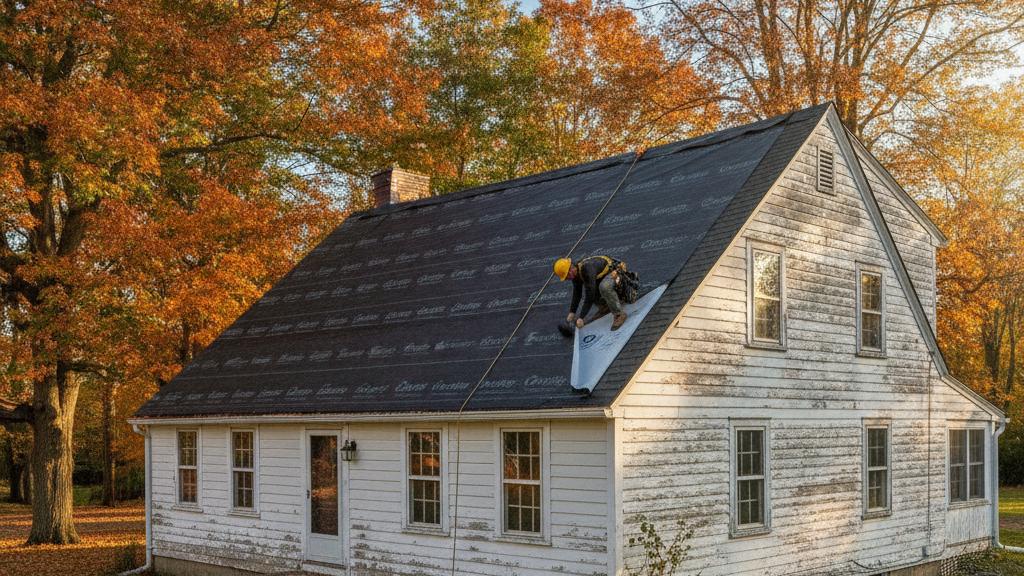
Ice-and-water shield (also called a leak barrier or ice barrier) is a self-adhering, polymer-modified bitumen membrane that bonds directly to the roof deck and seals around every nail or fastener. Both New York and Connecticut building codes require it at the eaves on any residential roof — and it must extend at least 24 inches inside the exterior wall line of the building, per §R905.1.2 of the adopted Residential Code in each state. On a roof replacement in Westchester or Fairfield County, this layer is not optional.
What Ice-and-Water Shield Actually Is
Standard felt underlayment (or synthetic roll stock) is a non-adhering slip sheet. It sheds water under normal conditions but is not sealed against backflow. Ice-and-water shield is fundamentally different: it is a rubberized asphalt membrane with a self-adhering underside that bonds to the plywood or OSB deck. When a nail or staple penetrates it, the membrane grips the fastener and seals the hole.
That sealing behavior matters for two failure scenarios common in NY and CT:
- Ice dams. When warm attic air melts roof snow and the meltwater refreezes at a cold eave, a ridge of ice forms and backs liquid water up the slope. Standard underlayment cannot stop water traveling uphill under shingle laps. The self-adhering membrane can.
- Wind-driven rain. Nor’easters and fall storms routinely drive rain horizontally under shingle tabs and through gaps at the eave, rake, and valley. A fully adhered membrane blocks that path.
The membrane is typically installed in the lowest courses of the roof — at the eaves and in the valleys — before any shingles or underlayment go on. It is not a substitute for good ventilation or air sealing, but it is the last line of defense once water gets behind the shingles.
What New York and Connecticut Code Requires
Both states have adopted residential building codes based on the International Residential Code (IRC), and both include §R905.1.2, which governs ice barriers.
New York State — The 2020 Residential Code of New York State (based on IRC 2018) requires, in areas with a history of ice formation along the eaves, that an ice barrier be applied in lieu of normal underlayment. Per §R905.1.2, the barrier must consist of a minimum two layers of underlayment cemented together, or a self-adhering polymer-modified bitumen sheet, and must extend from the lowest roof edges to a point not less than 24 inches inside the exterior wall line of the building.
Westchester County falls in Climate Zone 4 under New York’s energy code, but the ice-barrier requirement under §R905.1.2 is triggered by the local history of ice dam conditions (Table R301.2), not by climate zone — and every municipality in the Gunner service area qualifies. Requirements are administered by each local jurisdiction; confirm specifics with your local building department, since New York municipalities administer and enforce the Uniform Code within their own boundaries (per NYS Dept. of State Legal Memorandum LG03).
Connecticut — Connecticut’s 2021 State Building Code (based on IRC 2018) includes the same §R905.1.2 requirement. Connecticut’s Table R301.2 designates the entire state as an ice-barrier-required region. The minimum eave coverage is again 24 inches inside the exterior wall line.
In practice, this means that on a typical Cape Cod or Colonial with a standard 16-inch rafter tail, a single 36-inch-wide roll of ice-and-water shield does not reliably reach 24 inches inside the wall. Two overlapping courses — totaling roughly 5–6 feet up the roof slope — are common on structures with wider overhangs.
What the Code Does NOT Require Everywhere
The 24-inch minimum is the code floor for eave coverage. It does not require ice-and-water shield at the ridgeline, over the full deck, or at every valley — though full-deck coverage and valley coverage are legitimate upgrades for high-risk roofs. The code triggers on ice-dam history; where a specific municipality or project has no such history, the requirement may not apply. In practice, every market Gunner serves in Westchester and Fairfield County qualifies.
Where Ice-and-Water Shield Goes on a Roof
Code sets a minimum; good practice goes further. The GAF Steep-Slope Pro Field Guide identifies the critical locations where leak barrier must or should be installed:
| Location | Code-required (NY/CT) | GAF warranty requirement |
|---|---|---|
| Eaves — 24 in. inside warm wall | Yes | Yes |
| All valleys | Not universally specified | Yes — all valleys |
| Dormers and sidewalls | Not universally specified | Yes — all dormers, firewalls, sidewalls |
| Plumbing vents, skylights, chimneys | Not universally specified | Yes — all penetrations |
| Full-deck coverage | No — not standard code | Optional; allowed for extreme ice/wind risk |
The eave is the most important location because it is where ice dams concentrate and where wind-driven water enters first. But valleys are a close second — they collect and accelerate all the runoff from the adjacent roof slopes, and a compromised valley is one of the most common leak sources on aging NY/CT roofs.
Does Slope Affect the Requirement?
Slope affects shingle installation minimums, but the ice-barrier requirement under §R905.1.2 is triggered by ice-dam history, not slope alone. Very low-slope sections — below the minimum for asphalt shingles — have different underlayment rules entirely. For standard steep-slope asphalt shingle work, the 24-inch eave rule applies wherever ice dam conditions are present, regardless of the exact pitch.
What Gunner Installs on Every Roof Replacement
Every Gunner roof replacement includes ice-and-water shield installed to meet or exceed code minimums. On every job in the NY and CT service area, that means the full eave coverage to 24 inches inside the wall line, plus leak barrier run through all valleys, plus step flashing and counter-flashing at every chimney, dormer, skylight, and wall termination.
On GAF roof installations, Gunner installs the complete GAF system — including GAF Leak Barrier (WeatherWatch® or StormGuard® depending on application), GAF LayerLock™ shingles, GAF Starter Strip Shingles at eaves and rakes, qualifying GAF Ridge Cap Shingles, and qualifying GAF Roof Deck Protection. This full assembly is what makes a GAF roof eligible for the WindProven® Limited Wind Warranty and for the enhanced coverage tiers.
As a GAF Master Elite® 3-Star President’s Club contractor — a designation held by fewer than 3% of roofing contractors nationally (per GAF) — Gunner offers the GAF Golden Pledge® and Silver Pledge™ enhanced system warranties as opt-in tiers. Those warranties carry their own enhanced leak-barrier requirements beyond code minimums, including coverage at all dormers, sidewalls, and penetrations, not just the eaves.
Gunner also handles the building permit on every project. Permit requirements vary by municipality; confirm with your local building department or historic-district commission. Having the permit in place means the installation is documented and the homeowner has a clear record if a future insurance claim or sale requires it.
Frequently Asked Questions
What is ice-and-water shield? A self-adhering, polymer-modified bitumen membrane that bonds to the roof deck and seals around every fastener. It provides a true waterproof barrier in the most vulnerable areas of the roof — eaves, valleys, and penetrations — where standard underlayment cannot stop water that is traveling uphill or horizontally.
Is it required in New York? Yes. The 2020 Residential Code of New York State (§R905.1.2) requires an ice barrier at the eaves — a self-adhering polymer-modified bitumen sheet — wherever there is a local history of ice dam formation. It must reach at least 24 inches inside the exterior wall line. Requirements are administered by the local jurisdiction, so confirm with your building department.
Is it required in Connecticut? Yes. Connecticut’s 2021 State Building Code (§R905.1.2) carries the same requirement, and Connecticut’s Table R301.2 designates the entire state as an ice-barrier-required region.
How high does it need to go? At minimum, from the lowest roof edge to 24 inches inside the exterior wall line. On structures with wide overhangs, that typically means two overlapping 36-inch courses up the slope.
Does it cover the whole roof? Code requires it at the eaves. Good practice — and GAF warranty requirements — also extend it through valleys, at dormers and sidewalls, and around every roof penetration.
What is the difference between ice-and-water shield and felt underlayment? Standard felt or synthetic underlayment sheds water under normal conditions but cannot block water that is traveling uphill behind an ice dam or being driven horizontally by wind. Ice-and-water shield is self-adhering — it bonds to the deck and seals nail holes, creating a true waterproof membrane where the roof is most vulnerable.
With fall storms arriving in Westchester and Fairfield County and the first freeze on the horizon, now is the right time to confirm your roof’s eave protection before the season’s first ice-dam conditions appear. For a free, no-obligation estimate, visit GunnerRoofing.com.
Get a fast, free quote
No inspection visit needed - we measure your roof from satellite imagery and send your quote.