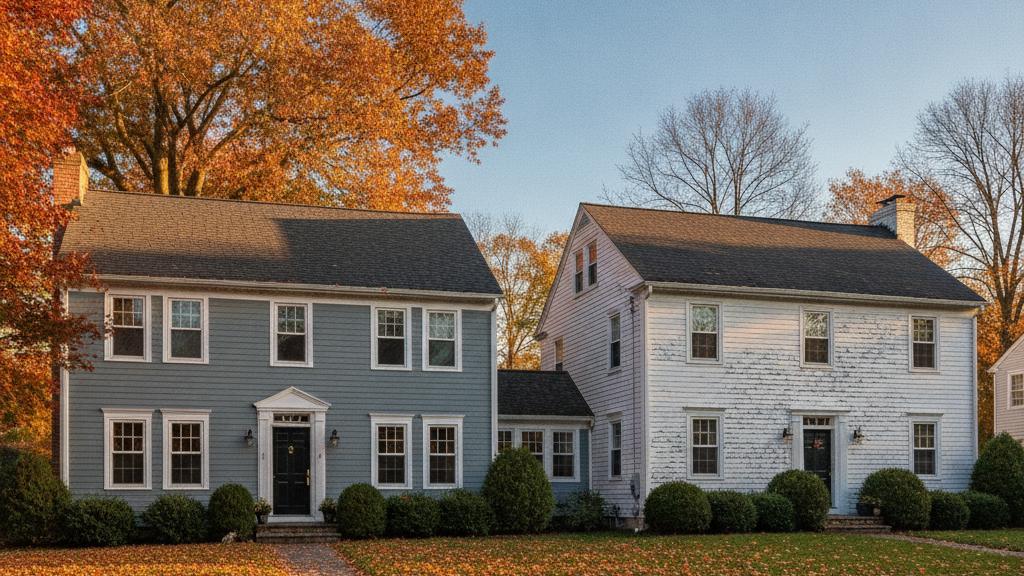
Fiber cement or vinyl siding — which one is still standing clean after a hail cell tracks through Westchester County? The short answer: fiber cement, particularly James Hardie in the HardieZone 5 specification, weathers hail better than standard vinyl. Thicker premium vinyl performs meaningfully better than builder-grade, and natural cedar falls somewhere in between — with a significant maintenance catch. Here’s how each material responds to hail impact, and what that means for a Westchester home heading into fall storm season.
Why Hail Is a Real Concern for Westchester Siding
Westchester County sits at the convergence of Hudson Valley and coastal Connecticut weather corridors. Late-summer and fall convective storms — particularly those that track northeast out of the mid-Atlantic — produce hail events with some regularity, often reaching the 1-inch “severe” threshold set by NOAA’s Storm Prediction Center. Significant-severe hail (2 inches or larger, roughly hen-egg size per NOAA SPC) is less frequent but not rare after a strong supercell.
The county’s housing stock makes this more relevant than the map suggests. A large share of Westchester’s older neighborhoods — particularly the mid-century Colonial and Tudor properties common in inland communities like White Plains, Scarsdale, and Mount Vernon — carry original wood siding, or vinyl siding installed in the 1980s and 1990s when thinner profiles were the norm. When that material gets hit, the damage is visible and costly to repair.
How Hail Hits Siding (and Why Material Matters)
Hail transfers kinetic energy on impact. What happens next depends entirely on how the cladding material absorbs and dissipates that energy:
- Rigid, dense materials (fiber cement) absorb and distribute impact loads — similar to how a masonry surface resists a sharp blow. Damage is rare below about 1.5–2 inches in diameter.
- Ductile materials (vinyl) deform plastically. Thin vinyl dents and stays dented. Thicker, higher-density profiles recover better, but a direct hit from severe hail will still leave marks.
- Wood (cedar or similar) absorbs some impact and can split on direct strikes. The bigger post-storm risk with wood is moisture intrusion through any breach.
Material-by-Material Breakdown
| Material | Hail Resistance | Damage Type | Typical Westchester Service Life* | Post-Storm Action Needed |
|---|---|---|---|---|
| James Hardie fiber cement (HZ5) | Excellent | Rare — surface chip on extreme impact only | 30–35 yrs | Visual inspection; minor chips re-caulked |
| Premium vinyl (thicker profile) | Moderate | Dents — cosmetic, not structural | 18–22 yrs | Inspect for cracks; replace dented panels |
| Builder-grade vinyl (thin) | Poor | Dents and cracks, panel separation possible | 12–18 yrs | Panel replacement often needed after severe event |
| Natural cedar | Moderate | Splits, checks, paint/stain breach on direct hit | 15–20 yrs (unpainted) | Inspect for splits, refinish breached areas promptly |
*Westchester real-world estimates, climate-adjusted downward from InterNACHI ideal-condition ranges per the region’s freeze-thaw cycles, humidity, and storm exposure. Warranties (a separate, contractual figure) are quoted verbatim from manufacturer documentation and are not shortened here.
Fiber Cement: Why It Leads in Hail Resistance
James Hardie fiber cement is composed of Portland cement, sand, and cellulose fiber — a dense, rigid matrix that doesn’t deform under typical hail impact. The product Gunner installs in Westchester County is spec’d to the HZ5 (HardieZone 5) standard, which is calibrated for this region’s humidity and freeze-thaw cycling.
The physics favor fiber cement in a hail event: a rigid surface dissipates impact energy rather than concentrating it in a dent. IBHS research on cladding impact resistance consistently shows non-brittle dense cladding materials outperforming vinyl under simulated hail loading. Below roughly 1.5–2 inches in diameter, fiber cement surfaces typically show no visible damage whatsoever. A direct strike from larger hail may produce a surface chip, but the panel itself remains structurally sound and water-resistant — a minor cosmetic repair rather than a full panel replacement.
James Hardie backs this with a 30-year non-prorated substrate warranty and a 15-year limited finish warranty on ColorPlus factory-finished panels (per the James Hardie warranty documentation).
Vinyl: Profile Thickness Is the Deciding Variable
Not all vinyl performs the same. The critical variable is wall thickness, measured in thousandths of an inch:
- Builder-grade vinyl can dent under moderate hail and may crack outright in severe impacts. A dented vinyl panel won’t re-spring; it requires replacement.
- Premium vinyl (CertainTeed’s higher-end profiles, for instance, run thicker per CertainTeed’s installation guide) resists minor impacts better, but still cannot match the mass of fiber cement. It handles cosmetic dents from moderate hail, but severe events leave visible damage.
Vinyl’s real liability after a hailstorm is inspection: a dent that appears cosmetic can also indicate a panel lock that’s been jarred loose, which creates a moisture pathway. Any hail event warrants a walk-around inspection of vinyl siding, paying attention to panel joints, corners, and any areas where the strike pattern was dense.
Natural Cedar: Functional but Maintenance-Intensive After a Storm
Cedar’s cellular structure gives it moderate impact resistance — it’s softer than fiber cement but denser than vinyl, and it tends to split or check on a direct strike rather than dent. The problem post-storm isn’t the immediate damage so much as what happens next: a split or cracked cedar board, even a small one, allows moisture under the paint or stain. In Westchester’s fall and winter conditions — where temperature cycling between above and below freezing accelerates moisture damage — an uninspected storm breach can cause rot at the board ends well before the next season.
Cedar siding that sees a significant hail event needs a prompt inspection and immediate refinishing of any damaged areas. That’s manageable, but it’s a concrete maintenance cost that fiber cement and premium vinyl don’t carry.
What to Do Right After a Westchester Hailstorm
- Do a perimeter walk within 48 hours. Look for dents in vinyl, chips in fiber cement, splits in wood, and — importantly — check all trim, corner boards, and window surrounds separately. These narrower pieces are often hit harder than field siding because they protrude slightly.
- Check the roof as well. Hail that damages siding almost certainly hit the roof too. Gunner performs hail/storm-damage roof inspections on request, covering field shingles, ridge caps, valleys, flashing, gutters, and penetrations.
- Document with photos before any cleanup. Time-stamp them. If an insurance claim follows, sequential documentation matters.
- Don’t defer maintenance on cedar or wood. A moisture breach left over the winter is a rot problem by spring.
Permitting and Siding Replacement After a Storm Claim
Requirements vary by municipality; confirm with your local building department or historic-district commission.
Gunner handles the permit on every siding project — pulling and managing the application is included on all jobs, which matters for insurance-claim work where documentation timelines are tight.
Insurance Mechanics: What to Expect
If your siding took a documented hail hit, your homeowners policy may cover replacement. The key variables — whether your policy settles at replacement cost value (RCV) or actual cash value (ACV), and whether a hail event meets your carrier’s damage threshold — depend on your specific policy terms and insurer. Availability and settlement amounts vary by carrier and program; confirm with your carrier or a licensed insurance agent before assuming coverage scope. The general mechanism: hail damage that breaches the material or creates a functional deficiency (not purely cosmetic) is more likely to meet the claims threshold than surface-level denting alone.
Gunner’s Recommendation for Westchester Homes
For homes being re-sided in Westchester County, James Hardie fiber cement in the HZ5 specification is Gunner’s premium recommendation — it is the siding line we lead with, and Gunner is a James Hardie Elite Contractor. The combination of hail resistance, freeze-thaw performance, low maintenance, and long service life makes the cost difference from vinyl defensible over the life of the home.
CertainTeed is Gunner’s recommended vinyl option for homeowners where fiber cement’s higher upfront cost isn’t in scope — in that case, specify the thicker profiles, not builder-grade.
Every Gunner siding project includes full water-resistive barrier (WRB) installation and correct flashing at all penetrations and roof-to-wall junctions, which is the structural protection layer behind the cladding regardless of which material you choose.
Get a free, no-obligation estimate — including an on-site review of any existing storm damage — at GunnerRoofing.com.
Frequently Asked Questions
Will hail damage my fiber cement siding? Under typical Westchester hail events (1-inch severe threshold per NOAA SPC), James Hardie fiber cement shows negligible to no visible damage. Extreme hail — 2 inches or larger — may produce a surface chip, but the panel remains structurally intact and water-resistant. Fiber cement’s dense composition dissipates impact energy rather than denting.
Does hail damage void the James Hardie warranty? Storm damage is typically addressed through homeowners insurance rather than the product warranty. The 30-year non-prorated substrate warranty and 15-year ColorPlus finish warranty remain in effect for their original scope.
How do I know if my vinyl siding is damaged after hail? Walk the perimeter and look for dents, cracks, or areas where panel locks have separated. Press lightly on any dented area — if the panel feels loose from the wall, the lock is compromised. Pay extra attention to corner posts, trim boards, and the courses immediately above window and door openings, which protrude into the hail path.
Does re-siding a Westchester home after a storm claim require a permit? Requirements vary by municipality; confirm with your local building department or historic-district commission. Gunner pulls and manages the permit on every project.
Is cedar siding a good choice for a hail-prone area? Cedar has moderate impact resistance but requires prompt inspection and refinishing after any storm breach. Its main post-storm risk is moisture intrusion through splits or checks, which can accelerate rot in Westchester’s freeze-thaw climate. Fiber cement is a lower-maintenance alternative with better impact resistance for the same regional character.
Which siding is best for Westchester County homes overall? James Hardie fiber cement (HZ5 spec) is Gunner’s premium recommendation for Westchester. It offers the best combination of hail resistance, freeze-thaw durability, low maintenance, and long service life for this region’s climate.
Get a fast, free quote
No inspection visit needed - we measure your roof from satellite imagery and send your quote.