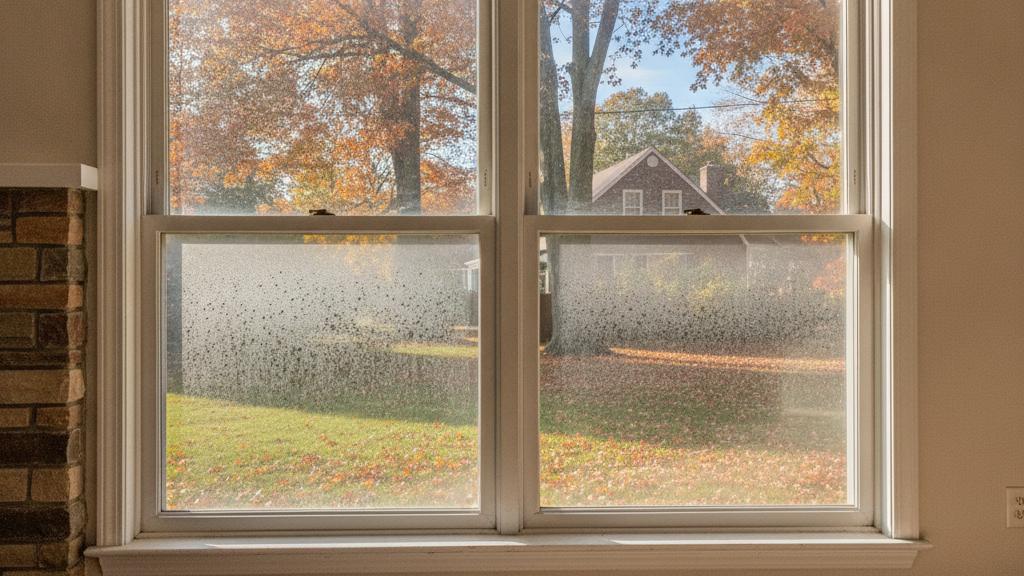
When October arrives and outdoor temps start dropping overnight, condensation on windows becomes one of the most common calls we get in Greenburgh. The quick answer: if you’re seeing moisture on the interior surface of the glass, that’s a humidity management issue in your home — not necessarily a window failure. If you’re seeing persistent fog trapped between the glass panes, that’s a failed insulating glass unit that won’t resolve on its own. New windows fix the second problem definitively and can dramatically reduce the first.
Two Types of Window Condensation — and Why They’re Completely Different Problems
Condensation forms when warm, moist air contacts a surface cooler than its dew point. Where it appears tells you exactly what’s failing.
Interior-surface condensation — water droplets or a film on the room-facing side of the glass — means the glass is cold enough to chill the indoor air to its dew point. This is primarily a home humidity issue: the window is just the first cold surface moisture finds. Per Andersen Windows’ condensation guidance, interior-surface condensation typically signals that indoor humidity is too high relative to outdoor temperatures, not that the window is failing structurally.
Inter-pane fogging — a milky haze or streaking permanently trapped between the two panes — means the insulating glass unit (IGU) seal has failed. Humid air has infiltrated the sealed cavity. Per Andersen, this is a structural failure: it cannot be wiped away from either side, and the window’s rated thermal performance is gone.
New windows address both, but through different mechanisms:
| Condition | What’s happening | What new windows do |
|---|---|---|
| Moisture on interior glass surface | Indoor air hitting cold glass below its dew point | Higher-performance glazing (lower U-factor, warm-edge spacers) keeps the glass surface warmer, raising the threshold before condensation forms |
| Fog trapped between panes | IGU seal failure — argon fill displaced by humid air | Replacement eliminates the failed unit entirely; a new IGU restores the thermal gap and clarity |
| Drafts + condensation at frame edges | Air infiltration at the rough opening or frame | Full-frame replacement reseals the opening; insert-only won’t fix a compromised rough opening |
Why This Hits Greenburgh’s Split-Levels and Ranch Homes First
Greenburgh’s unincorporated hamlets — Hartsdale, Edgemont, Fairview, Ardsley Road corridors — developed heavily in the postwar decades. The dominant housing types are split-levels, raised Colonials, and ranch homes built from the 1950s through the 1970s. That stock has a characteristic the condensation problem amplifies: partially below-grade lower levels.
In a split-level or raised Colonial, the lower family room or rec room often sits one-half story below grade. Those rooms hold more moisture year-round because ground-contact walls and slabs don’t dry out the way above-grade construction does. When October nights drop into the 40s, the windows in those below-grade spaces — which are already in a wetter microenvironment — are the first to show condensation. If those windows are original aluminum-frame single-panes or first-generation double-panes from the 1980s, they don’t have the thermal mass or insulating capacity to keep the glass surface above the dew point once the outdoor temperature drops.
This pattern is distinct from towns with predominantly above-grade Colonial and Tudor housing stock. It’s not that Greenburgh has worse windows on average — it’s that a large share of the housing type produces consistent, predictable condensation conditions that show up every fall in the same rooms.
What Makes a Window More Resistant to Condensation?
Two specs matter most for fall-through-winter condensation resistance in Westchester County’s Climate Zone 4.
U-factor: Measures heat flow through the whole window assembly — frame, spacer, and glass. Rated on a scale of roughly 0.20–1.20 (per NFRC); lower means the glass stays warmer relative to interior air, which raises the outdoor temperature threshold at which condensation forms on the interior surface. The 2020 NYS Energy Conservation Construction Code sets a prescriptive maximum U-factor of 0.32 for Climate Zone 4 (which includes Westchester County, per Table R402.1.2). ENERGY STAR Version 7.0 Northern zone criteria, effective October 23, 2023, require U ≤ 0.22 — a meaningfully tighter standard.
Warm-edge spacers: The spacer bar that separates the two panes at the edge of the IGU is a thermal bridge. Old aluminum spacers conduct heat rapidly at the glass edge, making the perimeter of the glass significantly colder than the center — which is why condensation often forms as a ring around the window edge before the center fogs. Modern warm-edge spacers (foam, structural foam composites, or stainless steel alternatives) reduce that edge-of-glass heat transfer, per DOE guidance on window IGU configurations. In split-level lower levels — where baseline moisture is already higher — warm-edge spacers meaningfully reduce the condensation ring effect.
Double-pane with argon fill: Argon gas has lower thermal conductivity than air, which improves the U-factor of the cavity itself. Per DOE guidance, this is standard on virtually all ENERGY STAR–qualified replacement windows installed today.
A 1970s aluminum single-pane unit in a below-grade Greenburgh family room might have an effective U-factor above 1.0 — roughly five times less insulating than an ENERGY STAR Northern zone window at U-0.22. That gap is the difference between a glass surface that stays well above the dew point on a 45°F October night and one that sweats every morning.
When New Windows Solve the Problem vs. When They Don’t
New windows definitively fix inter-pane fogging — the failed IGU is gone. They also raise the glass surface temperature enough to eliminate or substantially reduce interior condensation in most cases. But they’re not the only variable.
What new windows fix: – Persistent inter-pane fog (failed IGU seal — this requires full replacement) – Condensation on cold glass surface at moderately low outdoor temps – Drafty frames that bring cold air directly to the glass edge – Edge-of-glass condensation rings caused by aluminum spacers
What new windows won’t fully fix on their own: – Condensation caused by unusually high indoor relative humidity — this requires improving ventilation, exhaust fans in bathrooms and kitchens, or dehumidification in below-grade spaces – Condensation on walls or ceilings — a separate building-envelope issue – Window wells that collect water against below-grade masonry — drainage matters, not the window spec
If you’re seeing condensation heavily on new windows in a below-grade room, the room’s humidity level is likely the primary driver. Improving exhaust ventilation and keeping indoor relative humidity in check during the transition season will bring it under control. Per Andersen’s condensation guidance, some interior-surface condensation on even high-performance windows can occur in rooms with unusually high moisture loads — bathrooms, laundry areas, heavily planted spaces.
Andersen Options That Address Condensation Performance in Greenburgh Homes
Gunner Roofing is an Andersen Certified Elite contractor. For Greenburgh’s postwar housing stock, two lines are most relevant:
Andersen 400 Series — Wood interior with Perma-Shield vinyl-clad exterior (per Andersen product specifications). The 400 Series is the standard choice for Greenburgh’s mid-century split-levels and raised Colonials — it matches the era’s trim profiles, and vinyl cladding handles the moisture exposure that’s common at or near grade. Available with low-E glass and argon fill to meet ENERGY STAR Northern zone criteria.
Andersen A-Series — Fiberglass and composite exterior with slim sightlines (per Andersen product specifications). Better for higher-spec projects or homes with architecturally prominent windows. Fiberglass frames have lower thermal expansion than vinyl, which contributes to long-term seal integrity in the repeated temperature cycles of Westchester winters.
Both series can be spec’d to meet or exceed the ENERGY STAR v7.0 Northern zone threshold of U ≤ 0.22.
What Gunner Includes on a Window Project in Greenburgh
Gunner pulls the building permit on every project — it’s included, not an add-on. Requirements vary by municipality; confirm with your local building department for specifics on the unincorporated Town of Greenburgh vs. the incorporated villages within it.
The installation includes full flashing at the rough opening, proper air sealing at the perimeter before trim is set, and a post-installation operation check on all operable units. For below-grade lower-level windows in Greenburgh’s split-levels — where the window-to-grade relationship means water management at the sill matters as much as the glazing spec — the installation approach at the sill and exterior casing is not optional detail work.
Gunner is fully licensed, insured, and bonded in New York.
FAQ
Why are my windows sweating on the inside when temperatures drop in October? Interior-surface condensation in fall means the glass is dropping below the dew point of your indoor air. Old aluminum-frame or single-pane windows with high U-factors are most prone to this, especially in below-grade rooms where baseline moisture is higher. New windows with low U-factors keep the glass surface warmer, which typically eliminates or substantially reduces interior condensation.
What’s the difference between interior condensation and fog between the panes? Interior condensation (on the room-facing surface) is a dew-point phenomenon — humid indoor air hitting cold glass. It can sometimes be managed with ventilation. Inter-pane fogging means the IGU seal has failed: humid air has entered the sealed cavity between the panes. Per Andersen Windows, inter-pane fog cannot be cleaned off from either side, and the window’s thermal performance is degraded. That requires replacing the glass unit or the full window.
Do I need a permit to replace windows in Greenburgh, NY? Requirements vary by municipality; confirm with your local building department. Gunner handles the permit application on every project — it’s part of the standard scope.
What U-factor should replacement windows meet in Westchester County? The 2020 NYS Energy Conservation Construction Code sets a prescriptive maximum U-factor of 0.32 for Climate Zone 4, which includes Westchester County (per Table R402.1.2). ENERGY STAR Version 7.0, effective October 23, 2023, sets a tighter Northern zone threshold of U ≤ 0.22. Most quality replacement windows installed today meet the ENERGY STAR standard.
Why is condensation especially common in split-level lower levels in Greenburgh? Split-levels and raised Colonials — Greenburgh’s dominant postwar housing type — typically have partially below-grade lower levels with higher ambient moisture year-round. When October outdoor temperatures drop, those rooms see condensation on old windows first because the glass surface temperatures fall below the dew point of that wetter air mass.
Does Gunner Roofing install windows in Greenburgh? Yes. Gunner serves Greenburgh and the broader Westchester County area as an Andersen Certified Elite contractor, fully licensed, insured, and bonded in New York. The company handles the permit on every project.
Ready to get a free, no-obligation estimate? Visit GunnerRoofing.com to start online or schedule an on-site visit.
Get a fast, free quote
No inspection visit needed - we measure your roof from satellite imagery and send your quote.