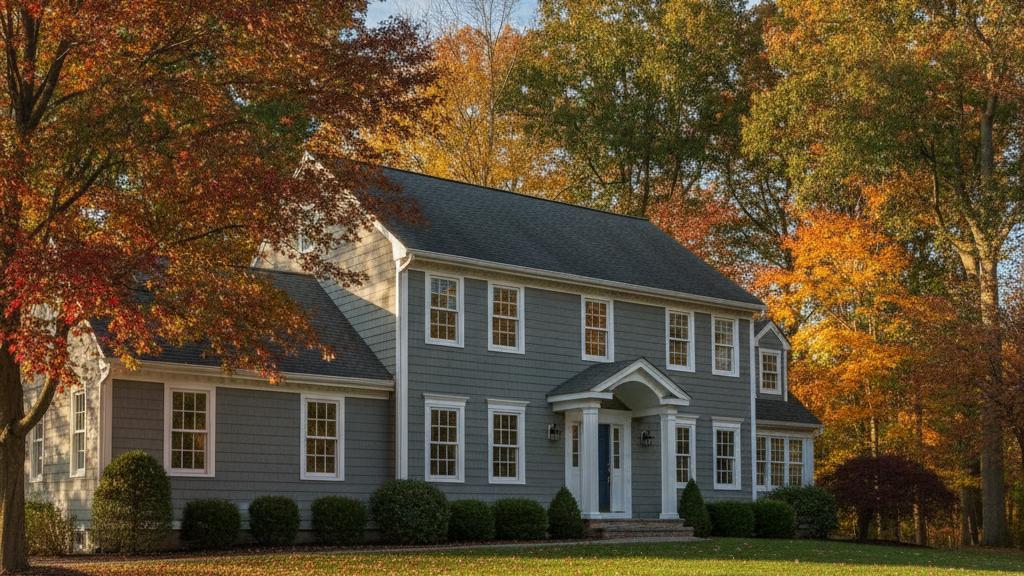
If you’re shopping James Hardie fiber cement siding, you’ll see the letters “HZ5” on the product packaging and installation guide. It’s not a model number — it’s a climate designation, and for Westchester County homeowners, it matters more than you might think.
HardieZone 5 (HZ5) is the James Hardie product line engineered specifically for climates with seasonal temperature swings, freezing temperatures, and snow and ice — per the HardieZone Best Practices Installation Guide (v9.1). Westchester County falls squarely in that target zone. Understanding what HZ5 means helps you ask better questions when getting quotes, and confirms that the siding being installed on your home is actually matched to your climate.
What Is the HardieZone System?
James Hardie introduced the HardieZone system to address a fundamental engineering reality: siding that performs well in humid, hot conditions (think coastal Florida) is built differently than siding optimized for the cold, wet, freeze-thaw cycles of the Northeast.
The company analyzed eight climatic variables affecting long-term exterior performance and divided North America into two zones (per the HZ5 guide):
- HZ5 — climate zones 1–5. Engineered for seasonal temperature variation, freezing temperatures, and snow and ice.
- HZ10 — climate zones 6–10. Engineered for high humidity, hot dry conditions, and high rainfall.
Westchester County is in IECC Climate Zone 4 per the 2020 NYS Energy Conservation Construction Code (Table R402.1.2), placing it firmly within HZ5 territory. Every James Hardie product installed here — HardiePlank® lap siding, HardieShingle® siding, HardiePanel® vertical siding, HardieTrim®, and HardieSoffit® — carries the HZ5 designation.
Why Freeze-Thaw Performance Is the Real Test
Westchester winters are not extreme by northern standards, but they are relentless in a specific way: temperatures cycle repeatedly above and below freezing throughout the season. That pattern is harder on exterior cladding than a single deep freeze.
Here’s why it matters for siding materials:
Wood absorbs moisture, expands, contracts, and eventually rots, checks, or delaminates at the paint line. Repetitive freeze-thaw cycles accelerate every one of those failure modes.
Vinyl is dimensionally unstable under temperature extremes — it can warp in heat and grow brittle in cold, and the nailing slots that allow thermal movement become a source of water infiltration if not installed with the correct gaps.
Fiber cement — the base material in all James Hardie products — has significantly greater dimensional stability than wood or vinyl under normal environmental conditions, per the HZ5 guide. It doesn’t rot, it doesn’t absorb moisture the way wood does, and it’s rated non-combustible per ASTM E136.
The HZ5 formulation builds on that baseline by optimizing the fiber-cement composite composition for the specific stresses of cold-climate cycling. The result is a product James Hardie warrants for 30 years (limited, transferable) in HZ5 conditions — per the James Hardie HardieZone System warranty page.
What HZ5 Installation Requirements Actually Mean on the Job
The climate engineering doesn’t stop at the product formula. James Hardie publishes specific installation requirements for HZ5 products that are non-negotiable if the warranty is to remain valid. These directly affect how a crew works on your Westchester home.
Ground Clearance: Minimum 6 Inches
HZ5 products must be installed with a minimum 6-inch clearance between the bottom course of siding and finished grade, per the HZ5 guide (§4, Clearances). In Westchester, where older Colonial and ranch-style homes sometimes have low foundation reveals and landscaping that has crept up over decades, achieving this clearance occasionally requires grading corrections. Clearances greater than 6 inches may be required by local building codes — requirements vary by municipality; confirm with your local building department.
Siding to Solid Surfaces: Minimum 2 Inches
Where siding meets a roof, deck surface, steps, driveway, or patio, a minimum 2-inch clearance is required (HZ5 guide §4). In practice, this means kickout flashing at roof-to-wall intersections is not optional — it’s a hard requirement for warranty compliance and water management. The HZ5 guide specifies kickout flashing at a minimum 4-by-4-inch size, angled between 100° and 110°, per IRC code reference R905.2.8.3 as cited in the guide.
Water-Resistive Barrier: Required Behind All Cladding
Prior to installation, a water-resistive barrier (WRB) must be installed behind the siding, per IBC 2021 §1403.2 — the same requirement applies whether you’re installing HZ5 fiber cement or any other cladding. On every Gunner siding project, the full WRB installation, correct flashing at all penetrations and roof-to-wall junctions, and verified ground clearances are included as standard.
Flashing at Every Penetration
Windows, doors, hose bibs, vents, electrical outlets, and HVAC penetrations all require Z-flashing and blocking per the HZ5 guide. James Hardie does not recommend raw aluminum flashing — painted or coated aluminum is specified for compatibility with cement products.
The Product Line: What Goes on Your House
HZ5 is available across the full James Hardie residential siding lineup:
| Product | Profile | Common Use |
|---|---|---|
| HardiePlank® | Lap siding, 5.25″–12″ widths | Primary wall cladding, Colonial/Ranch |
| HardieShingle® | Cedar-shingle profile | Accent gable ends, full siding |
| HardiePanel® | Vertical board | Board-and-batten, contemporary |
| HardieTrim® | Boards and battens | Corner boards, window/door surrounds |
| HardieSoffit® | Vented and non-vented | Soffits, porch ceilings |
All are available with ColorPlus® Technology — James Hardie’s factory-applied finish, which carries a 15-year limited warranty against peeling, cracking, and chipping (per the James Hardie ColorPlus Technology Limited Finish Warranty). Field-painted versions are also available; the 30-year substrate warranty applies to both.
How Long Does HZ5 Fiber Cement Actually Last in Westchester?
James Hardie warrants the substrate for 30 years under the HardieZone system. Real-world service life in Westchester’s climate will depend on maintenance, drainage, and installation quality — with periodic repainting typically needed before that point.
For comparison, wood siding in Westchester’s climate typically requires repainting every 5–7 years and replacement considerably sooner. Vinyl avoids paint but can warp or become brittle with age.
Fall Is the Right Time to Evaluate Your Siding
As temperatures drop in October, the stress points in aging siding become visible before winter makes them worse. Look for:
- Caulk cracking at window surrounds and corner boards — gaps here let cold air and water in with each freeze-thaw cycle
- Paint peeling at the bottom course — especially on north-facing walls that don’t dry out as readily
- Cupping or buckling on wood or vinyl — a sign the substrate has been cycling through moisture for seasons
- Any gap between siding and the foundation line — standing water at the base course is the beginning of the end for most siding materials
If your siding is showing more than one of these signs, a full replacement before the next heating season is worth pricing. With HZ5 fiber cement and a properly installed WRB, you’re setting the wall assembly up to handle twenty or thirty more Westchester winters without the same maintenance cycle.
Gunner Roofing and James Hardie HZ5
Gunner is a James Hardie Elite Contractor, and James Hardie fiber cement is our premium siding recommendation for Westchester County homes. We are also fully licensed, insured, and bonded in New York. On every siding project, we install the complete WRB, all required flashings, and pull the building permit — the permit is included on every job, managed start to finish.
For a free, no-obligation estimate on HardiePlank or any other HZ5 product for your Westchester home, visit GunnerRoofing.com.
Frequently Asked Questions
What is HardieZone 5? HardieZone 5 (HZ5) is James Hardie’s fiber cement product line engineered for climate zones 1–5, which includes the Northeast. Per the James Hardie HardieZone Best Practices Installation Guide (v9.1), HZ5 products are specifically designed to perform in climates with seasonal temperature variation, freezing temperatures, and snow and ice — conditions that characterize Westchester County, NY.
Is Westchester County in HZ5 or HZ10? Westchester County is in HZ5 territory. It falls within IECC Climate Zone 4 per the 2020 NYS Energy Conservation Construction Code (Table R402.1.2), which sits squarely within the HZ5 range (climate zones 1–5). HZ10 products are designed for humid, hot, and high-rainfall climates and are not appropriate for Westchester installations.
What is the warranty on HZ5 fiber cement siding? James Hardie offers a 30-year limited transferable product warranty on HZ5 siding substrates, per the James Hardie HardieZone System warranty. Factory-applied ColorPlus® Technology finishes carry an additional 15-year limited warranty against peeling, cracking, and chipping.
What clearances are required for HZ5 siding installation? Per the HZ5 Best Practices Installation Guide: a minimum 6-inch clearance from finished grade, a minimum 2-inch clearance from roofs, decks, steps, and other solid surfaces, and a minimum 1/4-inch clearance from horizontal flashings. These clearances are required for warranty validity and proper moisture management.
Does James Hardie HZ5 siding require a water-resistive barrier? Yes. A water-resistive barrier (WRB) behind the cladding is required by IBC 2021 §1403.2, and James Hardie’s HZ5 installation guide requires one prior to siding installation. On Gunner siding projects, the full WRB and correct flashing at all penetrations are included as standard.
Can I install HZ5 siding over my existing siding? Generally no, without stripping the old cladding first — the HZ5 guide’s clearance requirements (particularly the 6-inch ground clearance and 2-inch solid-surface clearance) are difficult or impossible to maintain when layering over existing siding, and the WRB cannot be properly installed or inspected. Confirm any specific situation with your contractor and local building department.
Get a fast, free quote
No inspection visit needed - we measure your roof from satellite imagery and send your quote.