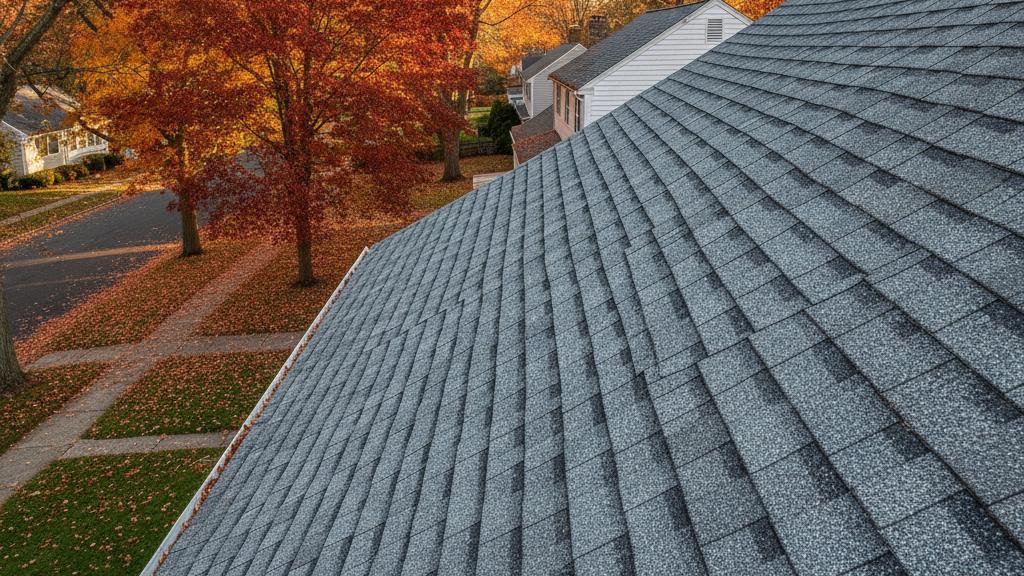
Those dark, downward-running stains on your roof are almost certainly a living organism — a blue-green algae called Gloeocapsa magma — not dirt, mold, or an equipment stain. The algae feeds on the limestone filler in asphalt shingles, spreads by wind and rain, and thrives in the humid Northeast climate of New York and Connecticut. Cleaning removes the visible staining; whether it comes back depends entirely on what’s on your shingles — or what’s in them.
What Are the Black Streaks?
Gloeocapsa magma is a cyanobacterium (loosely called “roof algae”) that grows in a dark, protective sheath — which is why it shows as black or dark gray rather than green. It arrives as airborne spores, lands on a shingle surface, and spreads downward with rain runoff. Shaded areas and north-facing slopes show staining first because they dry slowly. In humid coastal markets like Fairfield County, CT, and the Long Island Sound–influenced parts of Westchester County, NY, the combination of salt-laden air, regular fog, and slow-drying shade can accelerate growth compared to drier inland areas.
The algae doesn’t immediately damage shingles, but it accelerates weathering over time: the dark pigment absorbs more heat, which degrades granule adhesion faster. Left for years, heavy colonization can shorten shingle service life.
How Roof Algae Is Cleaned
The standard approach is a diluted bleach-and-water solution (sodium hypochlorite) applied with low pressure and then rinsed — not pressure-washed. High-pressure washing blasts off granules, which shortens shingle life. A professional roof wash applied correctly is a surface treatment; it kills the algae so rain can carry the dead growth away over the following weeks.
What cleaning does not do:
- It does not remove the conditions that allowed growth in the first place (shade, humidity, north-facing slope).
- It does not change your shingles’ composition.
- Without algae-resistant shingles or copper/zinc strips, regrowth typically begins within a few years in humid NY/CT conditions.
Will the Streaks Come Back?
Yes — unless your shingles contain an active algae deterrent, or you add copper or zinc strips at the ridge. Here’s how the main options compare:
| Approach | How It Works | Recurrence Risk |
|---|---|---|
| Bleach wash only | Kills existing algae | High — regrowth likely within 2–4 years in humid NY/CT |
| Wash + zinc or copper ridge strips | Metal ions leach downslope with rain | Moderate — effective only directly downslope of the strip |
| Algae-resistant shingles (copper granules) | Time-release copper granules distributed across the surface | Low for the warranted period while granules remain active |
GAF’s StainGuard Plus technology embeds time-release copper-based granules throughout the shingle surface to resist Gloeocapsa magma (per GAF). The GAF Timberline HDZ and UHDZ lines — Gunner Roofing’s primary shingle recommendations — are available with StainGuard Plus protection.
What Affects How Fast Algae Returns?
Shade. Roof sections under overhanging trees or adjacent to taller structures dry slowly. Algae thrives on a damp surface. Trimming overhanging branches improves airflow and drying, which slows regrowth.
Roof pitch. Shallow pitches drain slowly and stay wet longer, giving algae a better foothold than steep-slope roofs.
Granule loss. As shingles age, their granules wear. An older roof with depleted granules provides less protection — whether algae-resistant or not — because the active copper layer is gone. This is why staining often appears on roofs that are a decade or more old.
Gutters. Clogged gutters back water up against the shingle edge at the eave. In fall, decomposing leaf matter in gutters creates an organic environment that encourages both algae and moss at the roof edge. Keeping gutters clear is part of an integrated maintenance approach.
Should You Replace a Stained Roof?
Not necessarily. Algae staining alone is a cosmetic and long-term wear issue, not emergency structural damage. But staining is also a signal worth taking seriously:
- If the roof is newer (under 10 years) and staining is heavy, it may indicate a ventilation problem causing slow drying, or shade conditions that will keep driving regrowth. Address the root cause.
- If the roof is aging (approaching or past the typical service life for your shingle type), heavy staining combined with granule loss, curling, or cracking shingles is a reason to have a roofer assess replacement. New algae-resistant shingles reset the clock.
- If you’re planning to sell, streak-covered shingles affect curb appeal and can flag a deferred-maintenance question for buyers.
Gunner’s free, no-obligation estimate includes a roof assessment — we’ll tell you whether cleaning or replacement makes sense for your home’s specific age, slope, and condition.
Algae vs. Moss vs. Lichen: Not the Same Problem
| Growth | Appearance | Root Damage? | Harder to Remove? |
|---|---|---|---|
| Algae (Gloeocapsa magma) | Dark black/gray downward streaks | No (surface only) | No — bleach wash works |
| Moss | Green/brown fuzzy mat, especially at ridge and north slope | Yes — lifts shingle edges | Moderate |
| Lichen | Gray-green crusty spots, often circular | Yes — bonds to granules | Yes — physical removal risks granules |
Moss and lichen are more damaging because they physically attach to or lift the shingle. Moss rhizoids (root-like structures) work under shingle tabs and can cause edge curl and moisture infiltration over time. Lichen is the most difficult to remove cleanly. If you see any of these in combination with algae, a professional inspection is warranted — especially before a Northeast winter when any lifted shingle edge becomes an ice-and-water vulnerability.
What Gunner Does on Roof Replacements
When Gunner replaces a roof, every job includes proper attic ventilation as part of the system — balanced intake at the soffit and exhaust at the ridge. Adequate ventilation keeps the roof deck drier, which slows the moisture-driven conditions that let algae and moss take hold in the first place. On GAF installations we spec the full qualifying system, including GAF LayerLock shingles, starter strips at eaves and rakes, qualifying ridge cap, roof deck protection, and leak barrier through all valleys. Where the homeowner is concerned about algae recurrence, we recommend the StainGuard Plus shingle variants — the same protection built into the Timberline HDZ and UHDZ lines.
Gunner is a GAF Master Elite® 3-Star President’s Club contractor — a designation held by fewer than 3% of roofing contractors nationally (per GAF). We pull the permit on every job, in every jurisdiction, in NY and CT.
Frequently Asked Questions
What causes black streaks on a roof? Black streaks are caused by a blue-green algae called Gloeocapsa magma. It grows in a dark protective sheath, feeds on the limestone filler in asphalt shingles, and spreads downward with rain. The Northeast’s humid climate — especially in coastal sections of NY and CT — creates ideal conditions for growth.
Will the black streaks come back after cleaning? They often do, typically within a few years in humid NY/CT conditions, unless the shingles contain an algae deterrent. Algae-resistant shingles with embedded copper granules are the most effective long-term answer. Zinc or copper ridge strips offer partial protection in the area directly downslope of the strip.
Is it safe to pressure-wash black streaks off a roof? No. High-pressure washing removes the protective granules on asphalt shingles, which shortens shingle life. The correct method is low-pressure application of a diluted sodium hypochlorite solution. The dead algae washes off with subsequent rain over the next several weeks.
Does roof algae actually damage shingles? Not immediately, but over time. The dark pigment absorbs more heat than a clean shingle, accelerating granule wear. Algae staining is often a signal that a roof is aging — especially when it appears alongside granule loss or curling.
What’s the difference between roof algae, moss, and lichen? Algae stays on the surface and is easiest to treat. Moss lifts shingle edges with root-like structures, allowing moisture in. Lichen bonds to granules and is hardest to remove cleanly. All three are more common on shaded north-facing slopes in humid NY/CT climates.
Do algae-resistant shingles actually work? Yes, within their warranted protection period while granules remain active. GAF’s StainGuard Plus uses time-release copper-based granules distributed across the shingle surface. As shingles age and granules wear, that protection diminishes — which is why older stained roofs often warrant a replacement conversation rather than another cleaning cycle.
Ready to find out whether your streaked roof needs cleaning, new algae-resistant shingles, or a full replacement? Get a free, no-obligation estimate at GunnerRoofing.com.
Get a fast, free quote
No inspection visit needed - we measure your roof from satellite imagery and send your quote.