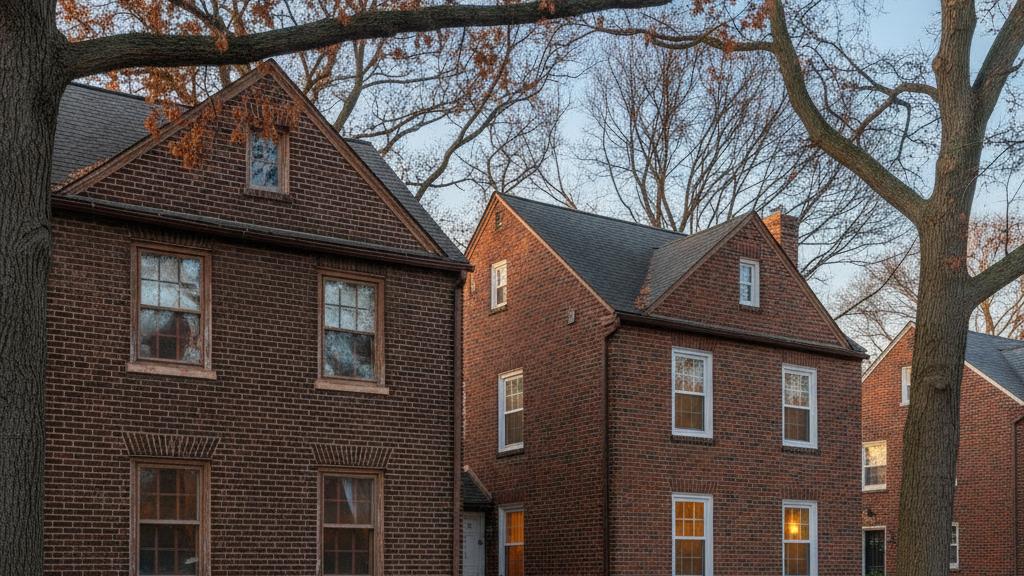
New windows can reduce what you pay to heat your home, but the savings vary significantly depending on what you’re replacing, what you install, and how the windows are installed. For Yonkers homeowners with pre-war brick Colonials, attached row houses, or multi-exposure apartment-style buildings, the math is often favorable — those homes tend to have a lot of window area relative to floor space, and older single-pane or failed double-pane units are a major heat-loss path every November through March.
The short answer: qualified ENERGY STAR windows with a U-factor at or below 0.22 (per ENERGY STAR’s Northern climate zone criteria, effective October 2023) will reduce heat loss through the glass assembly meaningfully compared to older units. What they won’t do is cut your heating bill to zero or produce a guaranteed dollar figure. Here’s what’s actually driving the numbers — and what to look for.
Why Windows Lose Heat (and How New Ones Stop It)
Heat moves through windows in three ways: conduction through the glass and frame, convection in the air space between panes, and radiation. Modern replacement windows attack all three.
Double- and triple-pane glazing with gas fills (typically argon or krypton) dramatically slow conduction and convection compared to single-pane glass or even early double-pane units with air gaps. Per the U.S. Department of Energy, adding a second or third pane and replacing air with an inert gas fill reduces the rate of heat transfer through the glazing assembly.
Low-emissivity (low-E) coatings are microscopically thin metallic layers applied to one or more pane surfaces. They reflect long-wave infrared (heat) back toward its source — in winter that means keeping radiant heat inside the room. Most quality replacement windows include at least one low-E coating as standard.
Frame material matters too. A thermally broken or composite frame conducts less heat than an aluminum frame with no thermal break. Andersen’s Fibrex composite material, used in the 400 Series and A-Series lines, is engineered for dimensional stability across temperature cycling — important in Westchester’s freeze-thaw winters where a frame that expands and contracts can allow air to infiltrate around the sash.
Understanding U-Factor: The Number That Tells You the Most
The U-factor (rated by the NFRC — National Fenestration Rating Council) measures how quickly a window assembly conducts heat. The scale runs roughly 0.20 to 1.20; a lower number is better. Per NFRC, the label on the window is the authoritative per-unit performance figure.
For context on what those numbers mean in your jurisdiction:
| Benchmark | U-Factor | Context |
|---|---|---|
| NYS code minimum (Westchester, Climate Zone 4) | 0.32 | Per 2020 NYS Energy Code Table R402.1.2 |
| CT code minimum (Climate Zone 5) | Tighter than CZ4 | Per 2021 CT State Building Code (2018 IBC base) |
| ENERGY STAR Northern zone (NY & CT) | ≤ 0.22 | Per ENERGY STAR v7.0, effective Oct 23, 2023 |
| High-performance triple-pane | varies | Qualitative range; confirm on NFRC label |
Westchester County (including Yonkers) is Climate Zone 4 under the 2020 NYS Energy Code. The code minimum of U-0.32 is a floor, not a target — windows at or above that threshold are merely legal. To actually improve on what a home built decades ago already has, you need to go below that number.
Fairfield County, CT is Climate Zone 5, which carries a stricter code minimum than Westchester. If you have a home in both markets or are comparing apples to apples across the state line, note that the floor differs.
What Governs How Much You’ll Actually Save
A lower U-factor window will lose less heat per square foot of glass than a higher one — that’s physics. But how much that reduces your heating bill depends on several variables:
How much of your heat loss is through windows today. In a well-insulated home with tight walls and a new roof, windows may represent a larger share of total heat loss than in a leaky older home where air sealing is the dominant problem. Replacing windows in a very leaky building envelope helps, but you’ll notice the improvement more once the bigger air-infiltration issues are also addressed.
Air sealing at the rough opening. A well-specified window installed in an unsealed rough opening will underperform. Proper installation includes foam or batt insulation packed into the gap between the window frame and the framing, then covered with an air-sealing membrane or caulk. This is where installation quality matters as much as the window itself.
The size and exposure of your window area. This is where Yonkers’ specific housing stock comes in. Pre-war brick row houses and attached multi-family buildings in neighborhoods like Park Hill, Nodine Hill, and Dunwoodie often have two or three full window bays per floor on the north or west exposures — the cold sides. A home with many large windows on a cold exposure will see a proportionally larger benefit from a window upgrade than a typical single-family Ranch with a modest window-to-wall ratio.
Glazing orientation and SHGC. Solar Heat Gain Coefficient (SHGC) measures how much solar radiation passes through the window. In northern climates, south-facing windows with a higher SHGC can actually contribute useful passive solar gain in winter — a very low SHGC blocks that. For north-facing windows, SHGC matters less. The ENERGY STAR Northern zone minimum SHGC is 0.17, but a range of coatings is available; your installer should discuss orientation-specific selection.
What New Windows Won’t Do
New windows won’t compensate for missing attic insulation, uninsulated rim joists, or a heating system that’s undersized or leaking conditioned air into unconditioned spaces. They’re one component of the building envelope. A home energy audit before or concurrent with a window project gives you a complete picture of where heat is going.
New windows also won’t guarantee a specific dollar saving — no contractor or manufacturer can honestly promise that, because it depends on your existing windows’ condition, your fuel type, usage patterns, and utility rates. Carriers and programs vary on whether energy-efficiency upgrades to windows influence premiums or qualify for incentives; confirm with your carrier or a licensed agent.
Andersen’s 400 Series and A-Series in a Yonkers Context
Gunner installs Andersen windows and is an Andersen Certified Elite contractor. For most Yonkers homes, the 400 Series — wood interior with Perma-Shield vinyl-clad exterior — is the practical starting point: it handles the city’s humidity and freeze-thaw cycle well, it fits standard residential rough openings, and it’s available in double-hung, casement, and awning configurations that suit both pre-war and mid-century construction.
For older homes in Park Hill or the Ludlow neighborhood where the original window openings are taller and narrower — and where the character of the brick facade is worth preserving — the A-Series is an option worth discussing with your installer. The Fibrex composite frame in the A-Series is dimensionally stable across Westchester’s temperature swings.
Both series are available in configurations that meet or exceed the ENERGY STAR Northern zone U-factor requirement of 0.22. Gunner handles the permit on every window replacement project in Yonkers, as on all projects.
A Practical Checklist Before You Buy
- Get the NFRC label for any window you’re considering — it’s the authoritative number, not the marketing description.
- Target U ≤ 0.22 to meet ENERGY STAR Northern zone; going lower adds performance but the return diminishes on a cost-per-unit basis.
- Consider SHGC by orientation — south-facing can tolerate a higher SHGC in a heating-dominated climate; north and west should be lower.
- Insist on proper rough-opening air sealing — the best window underperforms if installed in an unsealed gap.
- Building permit — requirements vary by municipality; confirm with your local building department or historic-district commission.
Get a free, no-obligation estimate at GunnerRoofing.com — Gunner serves Yonkers and all of Westchester County.
Get a fast, free quote
No inspection visit needed - we measure your roof from satellite imagery and send your quote.