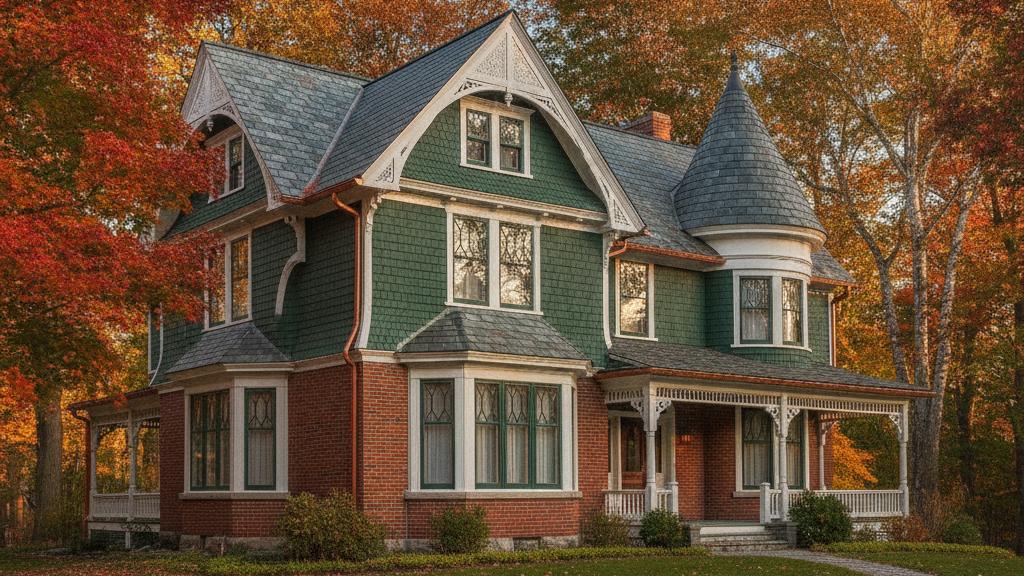
Get the material choice wrong and you either fail a historic-district review or end up with something that looks out of place for decades. Get the installation wrong and you can damage a structure that took generations to build.
The good news: NY and CT have more options today than ever before. Modern composite slates, synthetic shakes, and premium clay-look tiles can match a period profile closely while outperforming the originals in freeze-thaw durability. Here’s what matters, what to watch for this fall before winter sets in, and how to navigate approvals.
What “Historic” Actually Means for Your Roof
A historic home in Westchester or Fairfield County may fall under one or more layers of review:
-
National Register of Historic Places (NRHP). Listing on the NRHP is primarily an honor and a gateway to federal tax incentives for income-producing properties — it does not, by itself, restrict what you can do to your own home. The Secretary of the Interior’s Standards for Rehabilitation guide what’s considered appropriate work, but they’re only binding when federal or state funding or tax credits are involved (per the National Park Service’s guidelines at nps.gov/subjects/historicpreservation/standards.htm).
-
Local historic districts and landmark designations. These carry actual regulatory teeth for private homeowners. A local historic-district or landmarks commission can require a Certificate of Appropriateness (COA) before any exterior alteration — including a roof replacement — is approved. Requirements vary significantly by municipality; confirm with your local historic-district or landmarks commission before you sign a contract.
-
Standard building permits. Requirements vary by municipality; confirm with your local building department or historic-district commission. Gunner handles the permit application on every project.
The practical implication: if your home is in a locally designated historic district, your contractor needs to know that before specifying materials. The COA review process can take weeks, and showing up with the wrong material sample is a common, avoidable mistake.
The Core Challenge: Material Matching
Historic roofs in NY and CT were typically covered with one of four materials:
| Original material | Typical era | Key characteristic |
|---|---|---|
| Slate (natural) | 1860s–1940s | Thin, irregular, heavy (per InterNACHI service-life chart) |
| Wood shake/shingle | 1700s–1920s | Rough texture, shadow lines, needs maintenance |
| Clay tile (Spanish or flat) | 1890s–1930s | Mediterranean profile, very heavy |
| Copper or terne-coated metal | 1800s onward | Flat-seam or standing-seam; still used today |
The challenge is that the ideal-condition originals — especially natural slate — are expensive, heavy, and demand highly specialized installation. Many NY/CT attic structures were not engineered to handle a new slate load. And fall is precisely the wrong time to begin a lengthy slate-sourcing process: slate quarries have long lead times, and you don’t want to leave a vulnerable roof deck exposed heading into a freeze-thaw winter.
Modern Alternatives: What Works in a Historic Context
Three composite/synthetic categories now replicate historic profiles convincingly enough to satisfy many (though not all) local commissions. Commission standards vary — always bring the product’s color samples, profiles, and spec sheets to any COA meeting.
Composite Slate (DaVinci and Brava)
Both DaVinci Roofscapes and Brava Roof Tile manufacture composite slate and shake profiles designed for cold-climate performance. Gunner is a DaVinci Masterpiece Contractor and a Brava Preferred Contractor.
DaVinci’s engineered composite handles the steep-slope pitches common on Victorian and Colonial Revival homes, and the profiles are cast to replicate the dimensional variation of hand-split natural slate. For a historic review, the thickness, shadow lines, and color palette are the factors commissions most closely examine.
Brava’s composite slate is similarly cast from natural stone molds and comes in multiple thickness profiles. Both products are significantly lighter than natural slate, which matters when the original roof structure is being reused rather than replaced.
Caution: some stricter local commissions in NY and CT distinguish between “approved” materials by name, and a composite, however faithful, may not qualify. Bring the product spec sheet and get a preliminary opinion from your commission before committing.
Synthetic Shake
For homes with original wood shake roofs — common in the Arts-and-Crafts bungalows and Tudor Revivals scattered through Westchester and Fairfield — synthetic shake can match the rough texture, butt thickness, and color weathering of aged cedar without the maintenance burden or fire-risk of real wood.
Gunner is a Cedar Shake & Shingle Bureau (CSSB) member and installs authentic cedar shake where commissions specifically require it. When the commission accepts a synthetic alternative, synthetic shake is worth serious consideration for its durability in freeze-thaw conditions.
Premium Architectural Asphalt for Non-District Homes
If your home has historical character but no local landmark or historic-district designation, a high-definition architectural shingle (such as GAF Timberline HDZ) can be the right answer — especially for Colonial, Cape Cod, or ranch styles where the roof profile is relatively simple. The HDZ’s layered, dimensional appearance reads far better on a period home than a flat three-tab ever could.
For homes in this category — historically styled but not under commission review — this is often the most practical fall choice. Lead times are shorter, installation is faster, and you’re off the deck before the first hard freeze.
Why Fall Is the Right Time to Move
Historic restoration projects almost always take longer than standard replacements because of the material-sourcing and approval timeline. If your roof is showing its age heading into late fall:
- Freeze-thaw damage accelerates quickly. A failing underlayment or a cracked flashing joint that is a minor leak in October can become significant structural damage by March as water infiltrates, freezes, and expands in the substrate.
- Commission review takes time. Starting a COA application in November or December means you are unlikely to have a decision before late winter at the earliest. Starting now — or as soon as possible — keeps spring in play.
- Composite and specialty products have lead times. DaVinci, Brava, and natural slate all have longer manufacturing or sourcing cycles than off-the-shelf asphalt. A fall conversation positions you for a spring installation.
The right move right now is to get a professional inspection, establish what your review requirements are, and get the material discussion started before the ground freezes.
What a Proper Historic Restoration Includes
Regardless of the top-surface material, a correctly executed historic roof restoration includes the same system components as any quality roof replacement:
- Ice-and-water shield run at all eaves and valleys — critical for the freeze-thaw exposure in NY/CT winters
- Synthetic underlayment over the full deck
- Step and counter-flashing at all chimneys, dormers, and wall intersections — often the original source of leaks on aged historic roofs, since original lead or copper flashing fails long before the slate or tile above it
- Attic ventilation assessment — many historic homes have under-ventilated attics; Gunner addresses air sealing, insulation, and ventilation on every roof replacement
The flashing detail on a historic home deserves particular attention. Original chimneys are often larger than modern ones, and a masonry chimney on a 100-year-old house may have repointing and crown work that is overdue at the same time the roof is being replaced. Address the masonry and the flashing together — not sequentially — to avoid reopening the work.
Navigating the Approval Process
A few practical notes on working through a local review:
- Start with a pre-application conversation. Most commissions will give informal guidance on materials before you submit a formal COA application. This saves time if the material you’ve chosen isn’t going to be approved.
- Bring physical samples, not just photos. Commissions respond to texture, thickness, and profile — these don’t come through on a screen.
- Document the existing condition. Good pre-work photos of the original roof (profile, color, shadow lines, coursing pattern) are the strongest argument for a material match.
- Let your contractor pull the building permit. Once the COA is issued, the standard building permit is a separate step. Gunner handles the permit application on every project — the COA is on you and your commission, but the permit is on us.
Requirements vary by municipality; confirm the specific process with your local historic-district or landmarks commission.
Gunner’s Role in Historic Restoration
Gunner Roofing is a GAF Master Elite® contractor — a designation held by fewer than 3% of roofing contractors nationally (per GAF). We’re also a DaVinci Masterpiece Contractor, a Brava Preferred Contractor, and a Cedar Shake & Shingle Bureau member, which means we have direct experience with the specialty materials most often specified on historic restorations.
We’re fully licensed, insured, and bonded in New York and Connecticut. On every roof replacement, Gunner installs ice-and-water shield to meet or exceed code minimums, runs leak barrier through all valleys, and sets step and counter-flashing at every penetration. We also handle the attic air-sealing and insulation — not just an assessment, but the actual work.
For a historic home specifically, we’re comfortable navigating the commission process alongside you: identifying the right material for your review tier, bringing the samples, and sequencing the work so you’re protected going into winter.
Start with a free, no-obligation estimate at GunnerRoofing.com.
Frequently Asked Questions
Does my historic home need commission approval for a roof replacement? Only if it falls within a locally designated historic district or is an individually landmarked property. NRHP listing alone does not trigger local review unless federal funding or tax credits are involved. Requirements vary by municipality; confirm with your local historic-district or landmarks commission.
Can a composite slate pass a historic-district review in NY or CT? Sometimes. Some commissions accept modern composites that closely replicate the original profile and color; others require natural materials. Bring physical samples and get a preliminary opinion before committing to a product. Commission standards vary significantly across Westchester and Fairfield County municipalities.
How long does a composite slate or shake roof last in the Northeast? Based on InterNACHI’s Standard Estimated Life Expectancy Chart and adjusted for NY/CT freeze-thaw and storm exposure, real-world service life for a well-installed composite slate or shake is typically in the range of several decades, though manufacturer warranties vary — confirm the specific warranty term with the manufacturer before purchase. Natural slate, well-maintained, can outlast the building; realistically maintained in NY/CT, expect meaningful service but eventual flashing failure before the slate itself goes.
What’s the most common failure point on an aging historic roof? Flashing — not the top surface. Lead and copper flashings at chimneys, dormers, and wall intersections fail long before natural slate or clay tile does. If a historic roof is leaking, start by inspecting the flashing before assuming the field material needs replacement.
When is fall the right time to act on a historic roof? If your roof is showing deterioration — missing material, cracked flashing, water stains in the attic — act now. Freeze-thaw cycles accelerate existing damage quickly, and commission review plus specialty material lead times mean spring installation requires a fall start.
Does Gunner handle the permit for a historic roof replacement? Yes. Gunner pulls and manages the building permit application on every project. The Commission review (COA) is a separate process that runs before the permit — Gunner can help you understand what’s needed for each step.
Get a fast, free quote
No inspection visit needed - we measure your roof from satellite imagery and send your quote.