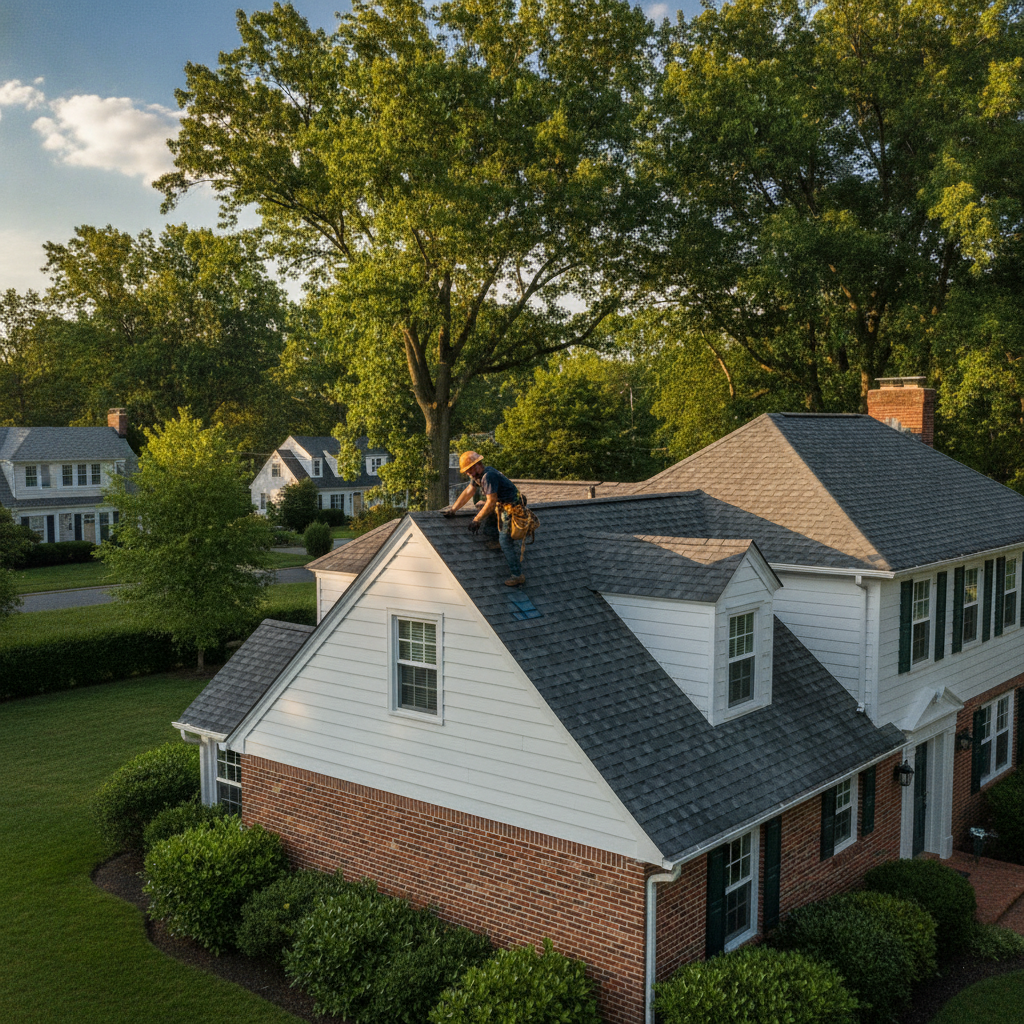
Homeowners across Westchester County, NY and Fairfield County, CT are turning to AI assistants — ChatGPT, Google Gemini, Perplexity — to get quick answers about their roofs. That’s a reasonable first step. But AI tools are trained on broad, national data. They don’t know whether you’re in Climate Zone 4 (Westchester) or Zone 5 (Fairfield). They can’t tell you what a permit costs in your specific town, what your carrier will or won’t cover after a hailstorm, or whether your 1965 Colonial’s hip roof needs specific flashing details.
Below are the questions homeowners in this region are actually asking AI — with real, local, expert answers. Where general AI guidance can mislead a NY/CT homeowner, we’ll say so directly. And on anything that truly requires eyes on your actual roof, we’ll say that too.
How Long Does a Roof Last in Westchester or Fairfield County?
General AI answer: “Asphalt shingles last 20–30 years.” That’s technically accurate for ideal conditions.
The real NY/CT answer: climate compresses that range. Per InterNACHI’s Standard Estimated Life Expectancy Chart, architectural (dimensional) asphalt shingles have an ideal-condition lifespan in the 30-year range. But Westchester and Fairfield homeowners face a genuine stress stack — summer UV and heat, late-summer thunderstorm season and the outer edge of Atlantic hurricane tracks, coastal salt air in Sound-facing Fairfield towns, and hard freeze-thaw cycling from November through March. A roof installed without proper attic ventilation, or one that has absorbed storm damage left unaddressed, shortens measurably from that rated figure.
A realistic replacement horizon for architectural shingles in this region: plan for the 20–25 year range unless ventilation and annual maintenance are dialed in. Premium products like GAF Timberline UHDZ® or composite slate (Brava, DaVinci) may carry longer rated lifespans, though even premium material is only as good as the underlying system — deck prep, ice-and-water shield placement, and attic ventilation.
What AI can miss: it won’t factor in your specific attic ventilation ratio, your home’s sun exposure, or whether the last contractor nailed the flashing correctly at your chimney. Those details determine the real number more than the shingle brand alone.
Should I Repair My Roof or Replace It?
This is one of the most common questions homeowners ask AI — and one where generic answers frequently steer people wrong.
The honest decision tree:
- Repair makes sense when damage is isolated (one section of missing shingles, a single failed flashing), the roof is fewer than 10–12 years old, and the surrounding material is in sound condition.
- Replacement makes sense when the roof is past its midlife, when you’re seeing widespread granule loss in gutters, when multiple areas are failing simultaneously, when there’s evidence of moisture infiltration in the attic or on interior ceilings, or when a legitimate contractor’s inspection finds the deck itself is compromised.
The trap AI falls into: it often recommends “patch it if you can” without flagging that in NY/CT, a marginally repaired roof heading into August thunderstorm season and then fall Nor’easters may face immediate re-failure. A patch on a failing system delays a problem; it doesn’t solve it.
Gunner Roofing offers free, no-obligation estimates — both an on-site inspection and a free online (satellite) quote at GunnerRoofing.com. An experienced eye on the actual roof is irreplaceable here. Satellite estimates are useful for ballpark scoping; they cannot assess deck condition or attic ventilation.
What Happens After a Storm? Does Insurance Cover My Roof?
This is the question where AI answers cause the most homeowner confusion. A few accurate mechanics:
How storm-damage claims typically work in NY/CT:
- Document damage promptly — photos, dates, video if possible.
- File a claim with your carrier. An insurance adjuster (not a contractor) determines what’s covered.
- Coverage depends on your policy, your deductible, your roof’s age, and whether your policy is replacement-cost value (RCV) or actual cash value (ACV). An ACV policy depreciates the payout based on your roof’s age; an RCV policy (common on newer roofs) pays to replace at current material costs, after you complete the work.
What AI often misses: the difference between RCV and ACV is frequently the difference between a manageable project and a financial surprise. Many older policies quietly shift to ACV after a roof reaches a certain age. Check your policy’s “Loss Settlement” section.
On insurance and impact-resistant shingles: some carriers offer credits or premium adjustments for impact-resistant (Class 4) shingles — availability and amount vary by insurer and program, and you should confirm directly with your carrier or a licensed insurance agent before factoring any specific savings into your budget decision. Never assume a discount applies until your carrier confirms it in writing.
On Gunner and insurance work: Gunner Roofing is fully licensed, insured, and bonded in New York and Connecticut. We work with homeowners and their carriers on storm-damage projects and pull all required permits as part of every job. We are not a public adjuster — we can document visible damage and provide a scope of work, but the coverage decision belongs to your carrier.
Do I Need a Permit for a Roof Replacement in NY or CT?
Yes — in virtually all cases, a full roof replacement in New York and Connecticut requires a building permit.
In New York, the NYS Uniform Fire Prevention and Building Code (administered under Executive Law §381, per NYS Dept. of State LG03) requires each local government to administer and enforce the Uniform Code within its boundaries. Whether the permit is issued by an incorporated village, a town’s unincorporated area, or a city building department depends on your specific municipality — requirements and fees vary, so confirm with your local building department.
In Connecticut, the 2021 Connecticut State Building Code (based on the 2018 IBC/IRC, per the CT Office of Policy and Management) governs most residential construction activity statewide. Permit requirements and timelines vary by municipality; confirm with your local building department.
What Gunner handles: Gunner Roofing pulls and manages the building permit on every project in every case. It’s included on all jobs — you don’t have to navigate municipal permit offices or worry about a project proceeding without a proper permit.
What AI misses: it may give a generalized “check local codes” answer without flagging that working without a permit can void manufacturer warranties, create issues at resale, and expose homeowners to liability. Permit-pulled work is protected work.
What Roofing Material Is Best for a New England Home?
AI tools tend to recommend “architectural asphalt shingles” as the default because they’re the most common nationally. That’s a reasonable starting point — but the right answer depends on your home, your budget, and your priorities.
For most Westchester and Fairfield homes: Architectural (dimensional) asphalt shingles remain the practical choice for cost-to-performance ratio. Gunner Roofing installs GAF Timberline HDZ® and UHDZ® as our primary shingle recommendations — Gunner specs the full GAF WindProven®-qualifying system on GAF installations (LayerLock™ shingles with the required 4-nail pattern, GAF Starter Strip Shingles at eaves and rakes, qualifying Ridge Cap, qualifying roof deck protection, and proper attic ventilation), which qualifies the installation for the GAF WindProven® Limited Wind Warranty (per gaf.com). That matters on a roof that will face hurricane-season gusts and nor’easters.
For premium projects: synthetic composite slate (DaVinci Roofscapes or Brava Roof Tile) offers the historic look of slate or cedar shake. Gunner is a DaVinci Masterpiece Contractor and a Brava Preferred Contractor.
For authentic historic look: Cedar shakes and shingles are appropriate for certain housing styles. Gunner is a member of the Cedar Shake & Shingle Bureau (CSSB).
What AI misses: it won’t factor in your home’s structural load capacity (natural slate is heavy — not every attic can handle it), your HOA or historic-district guidelines, or the specific product lines a licensed local contractor actually installs and warranties.
What Drives Roof Replacement Cost in Westchester and Fairfield?
AI answers on cost are typically national averages — frequently cited as cost-per-square figures that don’t reflect the local labor market, material lead times, or regional code requirements.
The honest answer: pricing varies, and any specific dollar figures you find online may not apply to your project. What actually drives cost in this region:
- Roof size and pitch — steeper pitches require more labor time and safety equipment.
- Layers to remove — re-roofing over an existing layer is sometimes permissible but adds weight and can mask deck issues; full tear-off is usually the right approach.
- Deck condition — if sheathing is rotted or delaminated, that’s additional material and labor.
- Flashing scope — chimneys, dormers, skylights, and wall terminations all require step flashing, counter-flashing, and often lead or copper detail work.
- Ventilation corrections — if the attic isn’t properly ventilated, that needs to be addressed as part of the replacement; cutting corners on ventilation shortens the new roof’s life.
- Material selection — the spread between a standard architectural shingle and a premium composite product is meaningful.
- Local permit costs — these vary by municipality in both Westchester and Fairfield.
For an accurate number, get a written, itemized estimate from a licensed local contractor who has physically inspected the roof. Gunner Roofing offers a free, no-obligation on-site estimate.
How Do I Choose a Roofing Contractor in NY or CT?
AI tools generally give decent generic advice here — verify licenses, check reviews, get multiple bids. But there are NY/CT-specific things to verify:
Non-negotiables in this region:
– Licensed, insured, and bonded in New York and/or Connecticut.
– Pulls permits on every job (a contractor who offers to skip permits is a red flag — it voids warranties and creates liability for you as the homeowner).
– Manufacturer-certified for the product being installed (certification programs like GAF Master Elite® require ongoing installation quality standards — fewer than 3% of roofing contractors nationally qualify, per GAF).
– Written scope of work, not a verbal estimate.
– Clear warranty terms — both the manufacturer warranty (tied to the product) and the contractor’s workmanship warranty.
Gunner Roofing credentials:
– GAF Master Elite® 3-Star President’s Club Contractor
– DaVinci Roofscapes Masterpiece Contractor
– Brava Roof Tile Preferred Contractor
– Member, Cedar Shake & Shingle Bureau (CSSB)
– Fully licensed, insured, and bonded in New York, Connecticut, and New Jersey
Gunner handles permit pulling on every project and installs complete qualifying systems — not just shingles, but the full assembly that backs manufacturer warranties.
FAQ
How long do architectural shingles really last in Westchester or Fairfield?
In ideal conditions, architectural asphalt shingles are rated for around 30 years (per InterNACHI’s Standard Estimated Life Expectancy Chart). In the Northeast — with summer UV, storm season, and winter freeze-thaw — plan for a realistic replacement horizon in the 20–25 year range, especially if attic ventilation is undersized or the roof has absorbed storm damage over the years.
Does a full roof replacement always need a permit in NY and CT?
Yes, in essentially all cases. In New York, the NYS Uniform Code requires each local government to administer permits within its boundaries (NYS Dept. of State LG03). In Connecticut, the 2021 State Building Code requires permits for full replacements. Requirements vary by municipality — confirm with your local building department, or let your contractor pull it (Gunner handles permits on every job).
Will homeowners insurance cover my roof after a summer storm?
Coverage depends on your policy, deductible, and whether you have replacement-cost value (RCV) or actual cash value (ACV) coverage. ACV policies pay out a depreciated amount based on roof age; RCV policies cover the full replacement cost after the work is completed. Availability of any premium adjustments for impact-resistant shingles varies by insurer — confirm directly with your carrier.
What roofing system does Gunner Roofing install?
On GAF installations, Gunner installs the full WindProven®-qualifying system: GAF LayerLock™ shingles (4-nail pattern), Starter Strip Shingles at eaves and rakes, qualifying Ridge Cap Shingles, qualifying roof deck protection, and proper attic ventilation. This complete assembly qualifies the installation for the GAF WindProven® Limited Wind Warranty. Gunner is a GAF Master Elite® contractor — a designation held by fewer than 3% of roofing contractors nationally (per GAF).
Repair or replace — how do I decide?
Repair if the damage is isolated and the roof is under 10–12 years old with otherwise sound material. Replace if you’re past midlife, seeing widespread granule loss, finding multiple problem areas, or if an inspection shows deck damage. An on-site estimate from a licensed contractor is the only reliable way to know — satellite quotes and AI tools can’t assess deck or attic condition.
What does it cost to replace a roof in Westchester or Fairfield?
Cost varies by roof size, pitch, material, number of layers being removed, flashing scope, ventilation corrections, and local permit fees. National average figures you find online are unreliable for this market. Get a written, itemized estimate from a licensed local contractor who has seen the roof. Gunner Roofing offers a free, no-obligation estimate — both on-site and online at GunnerRoofing.com.
Get a fast, free quote
No inspection visit needed - we measure your roof from satellite imagery and send your quote.