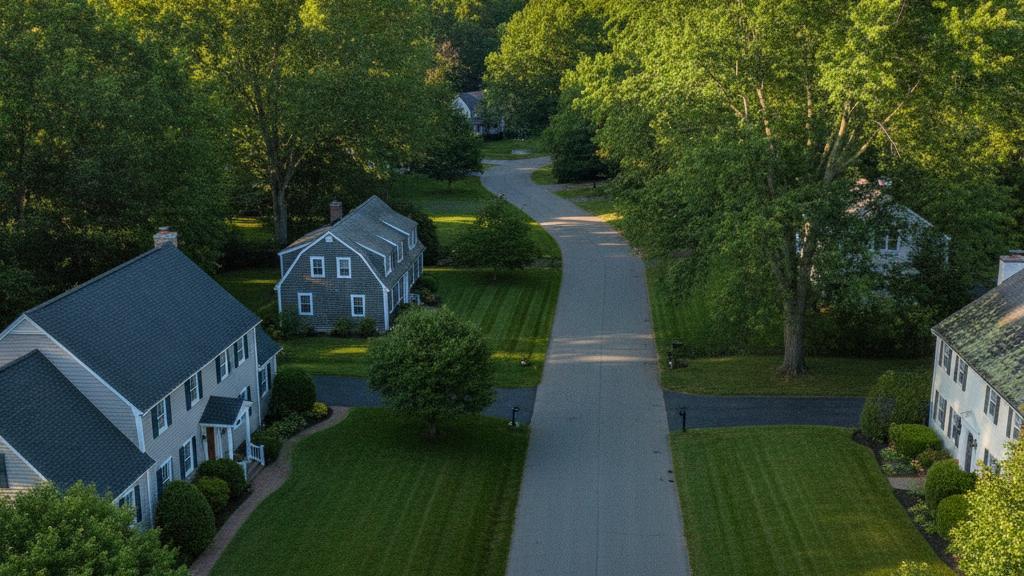
The short answer: no — not reliably. AI tools can make educated guesses about a roof’s approximate age or condition from aerial or satellite imagery by reading color, granule reflectivity, and surface texture patterns. But “educated guess” and “accurate age estimate” are very different things, and the difference matters when you’re making a replacement decision. Here’s what the technology actually does, where it breaks down for NY and CT homeowners specifically, and what Gunner’s instant satellite quote actually measures (it’s not your roof’s age).
What AI Is Really “Reading” in a Satellite Photo
When an AI model analyzes aerial or satellite imagery of a roof, it is performing image pattern recognition across a few detectable signals:
Spectral reflectivity (color/brightness). Fresh asphalt shingles absorb more heat and appear darker in visible-spectrum imagery. Older shingles that have lost granules reflect more light and appear lighter. AI can detect this shift. The problem: shingle color varies widely by product line, and a light-gray shingle installed last year looks very different from a dark-charcoal shingle installed last year — and the AI must untangle age-related fading from deliberate color choice.
Texture analysis. Healthy granule surface has consistent micro-texture. Bare, worn, or granule-stripped areas have a different visual texture. AI can flag areas of apparent surface degradation. The problem: resolution. Commercial satellite imagery used in residential tools typically runs at resolutions that make distinguishing “slightly worn granules” from “normal shingle texture” unreliable at the pixel level.
Vegetation and staining patterns. Moss, algae streaking, and lichen are visible in aerial imagery and correlate with older, wetter, or north-facing roof sections. These are real age-correlated signals, but they’re highly variable: a south-facing roof in Fairfield County, CT with full sun exposure may show minimal algae growth at 18 years, while a shaded north slope in Westchester may show aggressive growth at 8 years.
What no satellite image can read: the condition of the roof deck, the quality of the attic ventilation, the integrity of flashing at penetrations, or any sub-surface moisture damage. Age estimation from imagery is surface-only — and even the surface read is an inference, not a measurement.
The Honest Accuracy Picture
| What AI vision claims to estimate | What it’s actually detecting | Reliability for age |
|---|---|---|
| Roof age in years | Granule reflectivity + color patterns | Low — conflated with shingle color selection |
| General condition (good/fair/poor) | Surface texture + staining patterns | Moderate — useful as a coarse filter, not a decision |
| Approximate installation era | Combination of above signals | Low-to-moderate — ± several years at best |
| Remaining useful life | Inferred from the above | Not reliable — deck and ventilation invisible |
The AI’s age guess is a probabilistic pattern match, not a historical record lookup. It does not know when your house was re-roofed because that data isn’t in a satellite image — it’s in permit records, contractor invoices, or your memory. Some AI tools attempt to cross-reference public permit data, which improves accuracy meaningfully. But permit database coverage is inconsistent across NY and CT municipalities, and many older re-roof jobs in Westchester County and Fairfield County predate digital permit systems.
Why This Matters More in NY and CT
Roof age estimation errors have real financial stakes here, for two reasons:
1. Climate compresses the variance. Per InterNACHI’s Standard Estimated Life Expectancy Chart, architectural asphalt shingles have an ideal-condition baseline around 30 years. In the Northeast — summer UV and heat, August-September thunderstorm season on the edge of Atlantic storm tracks, coastal salt air in Long Island Sound-facing Fairfield towns, and hard freeze-thaw cycling from November through March — the real-world replacement horizon typically runs shorter. A roof that “looks like it has 10 years left” per an aerial AI estimate may have 4 years left if ventilation is poor. The AI sees the surface; it cannot see the ventilation.
2. Older housing stock often has multiple re-roof layers. Much of the housing stock across Westchester and Fairfield County is older, and many of those homes have been re-roofed once or twice without a full tear-off. A satellite image cannot distinguish whether the shingles on screen are the original layer, a 1998 overlay, or a 2014 replacement over two prior layers. An AI guessing “this roof appears to be approximately 15 years old” based on color and texture may be reading the 1998 layer’s condition through new shingles installed on top of it. This is a real diagnostic risk.
3. Summer is peak storm-damage season. In August, post-storm condition assessment is one of the most time-sensitive roofing decisions NY and CT homeowners face. An AI tool that estimates “minor wear” on a roof that has just taken hail impact — because hail bruising often doesn’t change aerial reflectivity readings dramatically — can cause a homeowner to miss an insurable claim window. Hail damage assessment requires a contractor physically checking impact patterns, granule displacement, and mat exposure.
What Gunner’s Satellite Quote Actually Measures (Not Age)
It’s worth being clear about what a real satellite-measured roofing quote does, because it’s genuinely useful — and it’s not a guessing game.
Companies like EagleView have built aerial measurement technology that calculates roof geometry from high-resolution aerial imagery: total area in squares (one square = 100 sq ft), pitch per facet, ridge lengths, valley lengths, hip and rake lengths, eave measurements, and perimeter. This is real geometric measurement, extracted via photogrammetry and computational geometry from overlapping aerial images. It is not a pattern-match guess — it’s a calculated dimension.
When Gunner Roofing offers a free online quote at GunnerRoofing.com, the geometry behind that quote is built on real aerial measurement of your home — not a chatbot’s estimate of how old your shingles look. That matters because:
- Roof area drives material quantity — getting it wrong in either direction costs the homeowner money.
- Pitch affects labor scope — steep-pitch work requires additional safety equipment and time.
- Geometry is objective — a satellite measurement of roof area is verifiable; an AI age guess is not.
What that satellite quote cannot tell you, even with high-accuracy geometry: whether your deck needs replacement, whether your attic ventilation is balanced, what condition your existing flashing is in, or how many years of useful life you actually have left. Those questions require a licensed contractor on the roof.
The Right Use of AI Roof Tools — and Their Limits
AI-assisted aerial analysis is genuinely useful as a coarse filter. If a tool flags a roof as showing significant wear patterns, that’s a reasonable prompt to schedule an inspection — not a replacement decision. If a tool estimates a roof is “likely 8–12 years old” and you know it was replaced 9 years ago, the estimate is consistent and you can note it. If a tool estimates “approximately 5 years old” on a roof you know is 20 years old, you’ve just discovered the tool’s error margin in your specific case.
Use AI roof estimates as one data point, not as a substitute for:
- Your own records — a contractor invoice, permit record, or home inspection report is the most reliable age source.
- A contractor’s on-site inspection — deck condition, attic access, and flashing integrity are only assessable in person.
- A satellite-measured quote — for geometry, a real aerial measurement is materially more accurate than any chatbot estimate.
The practical workflow for a NY or CT homeowner who doesn’t know their roof’s age: pull your town’s building permit records (available through your local building department in both states), which will show permit dates for any pulled re-roof permit. Cross-reference with a physical inspection from a licensed local contractor. That’s a real answer.
FAQ
Can an AI tool tell me exactly when my roof was installed?
No. A satellite or aerial image contains no installation date information. AI tools infer age from visible condition signals — color, granule wear, staining patterns — which vary widely based on product color, sun exposure, maintenance history, and climate. For actual installation year, check your permit records or contractor invoices.
Is Gunner Roofing’s online satellite quote the same thing as AI age estimation?
No — they’re different tools. Gunner’s satellite quote uses aerial imagery to measure your roof’s actual dimensions. AI age estimation infers condition from visual pattern matching. Gunner’s quote gives you an accurate material-and-scope starting point; it does not estimate your roof’s age or remaining useful life.
Why is roof age estimation harder in NY and CT than in drier climates?
Northeast climate compresses apparent age signals. Moss, algae, and lichen growth — which are age-correlated indicators — are heavily influenced by shade, moisture, and orientation in NY/CT. A shaded north-facing roof in Westchester may look older than it is; a well-maintained sun-exposed roof in a Fairfield coastal town may look younger. The climate variability makes visual age inference less reliable here than in drier, more uniform climates.
What does a licensed contractor’s inspection reveal that satellite imagery cannot?
A contractor on the roof can physically assess deck condition (soft spots, delamination, rot), attic ventilation balance, flashing integrity at every penetration, and post-storm impact damage. None of these are visible from above. Deck condition in particular — one of the most common cost drivers in a replacement — is invisible from any aerial tool.
How do I find my roof’s actual installation date?
Your local building department maintains permit records for most re-roof jobs done after digital record systems were adopted. In both New York and Connecticut, full roof replacements typically require a permit; that record gives you a date and contractor of record. For pre-digital-era work, a licensed contractor’s on-site inspection can estimate age from remaining granule depth, shingle mat condition, and flashings — still a range, but informed by physical evidence rather than pixels.
Ready to get a real measurement on your roof — not an AI age guess? Start with a free, no-obligation satellite quote or schedule an on-site estimate at GunnerRoofing.com.
Get a fast, free quote
No inspection visit needed - we measure your roof from satellite imagery and send your quote.