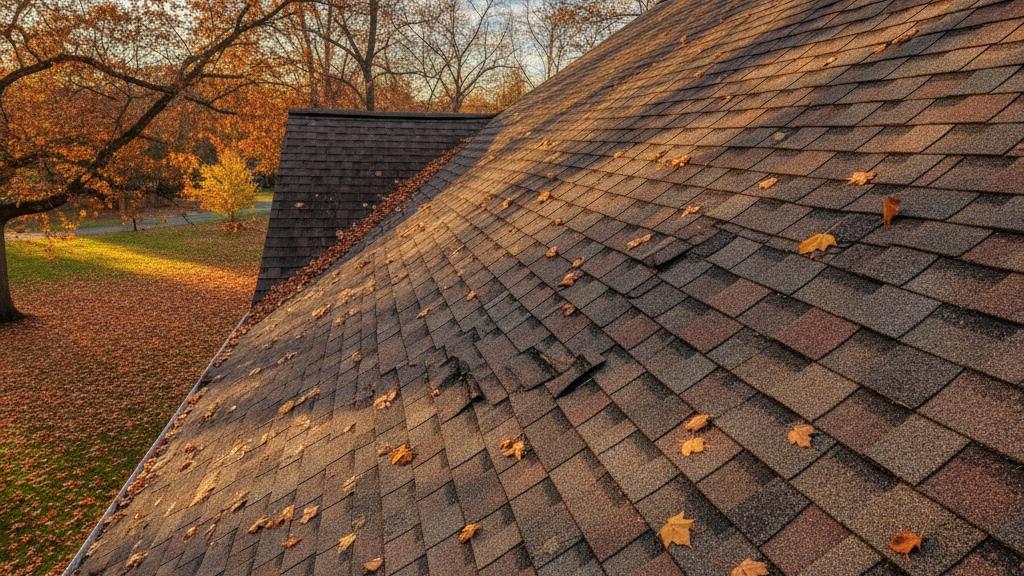
Yes — an overheated attic can meaningfully shorten the life of your asphalt shingles. The roof deck can reach temperatures well above the outdoor air temperature on a hot summer day when attic ventilation is inadequate, and that sustained thermal stress accelerates the breakdown of shingle oil, the binder that holds the granule coating together and keeps shingles flexible. The good news: fall is exactly the right time to assess and correct the problem before another summer sets in.
How an Attic Becomes a Heat Trap
An asphalt shingle is a layered product: a fiberglass or organic mat core, saturated and coated with asphalt, with mineral granules embedded on the weather face. The asphalt binder is what makes the shingle both waterproof and flexible — and it is sensitive to sustained heat.
Under the shingles, the roof deck (typically oriented strand board or plywood) absorbs radiant energy all day. When attic air can’t move freely — because soffit vents are blocked, there aren’t enough intake vents, or the ridge vent is undersized — that heat has nowhere to go. The deck temperature rises well above the outdoor air temperature, and the bottom face of every shingle on that surface conducts heat from below, in addition to the solar load on the top face.
That double-sided heat load is the core of the problem. Shingles that bake from both sides day after day through a NY/CT summer see elevated thermal cycling over their lifetime. This accelerates oil volatilization from the asphalt, which shows up as:
- Brittleness — shingles that crack under foot traffic or hail impact sooner than they should
- Granule loss — the mineral surface loosens as the asphalt softens and re-solidifies repeatedly; granules accumulate in gutters
- Premature curling — edges cup or claw as the asphalt matrix shifts
- Blistering — moisture trapped in the asphalt layer expands when heated and forms bubbles; a ventilated attic reduces this risk
None of these are cosmetic. Each condition exposes the underlying mat to UV and water infiltration — the two fastest paths to premature failure.
Does This Actually Shorten Shingle Life?
The GAF Steep-Slope Roofing Field Guide (RESGN103) addresses the relationship between attic ventilation and shingle performance, noting that proper ventilation reduces the heat buildup that stresses shingles over time. InterNACHI’s Standard Estimated Life Expectancy Chart lists asphalt architectural shingles at a 30-year ideal-condition lifespan. In the real-world conditions of Westchester and Fairfield Counties — freeze-thaw winters, humid summers, nor’easter wind loads, and the heat cycling described above — shingles routinely perform at the shorter end of the rated range when attic ventilation is deficient.
There is no single published figure that quantifies exactly how many years a poorly ventilated attic subtracts from shingle life: too many variables (shingle brand, roof pitch, tree shade, attic depth, insulation depth) make a universal number unreliable. What the field evidence does support is that adequate ventilation is one of the variables most controllable by a homeowner or contractor.
A note on warranties: Confirm the specific ventilation requirements in your shingle’s warranty documentation.
What “Adequate Ventilation” Actually Means in NY and CT
The 2020 Residential Code of New York State (Section R806, based on IRC 2018) requires a minimum 1/150 net free area ratio (net free vent area to attic floor area) in attics that are not fully insulated at the roof deck, reducible to 1/300 when at least 40% of the required venting is in the upper half of the attic space and the remaining venting is in the lower half (balanced high/low system). Connecticut’s 2021 State Building Code, based on the 2018 IBC/IRC, adopts substantially similar provisions.
What that means in practical terms:
- Intake at the soffits, exhaust at or near the ridge. Hot air rises; it needs an escape path at the top and a makeup-air path at the bottom. Without both, neither works properly.
- Soffit vents that are actually open. On many houses in Westchester and Fairfield, insulation has been blown into the attic over the years and has migrated to block the soffit baffles. The vents are physically present but functionally closed.
- A ridge vent that spans an adequate portion of the ridge. Short ridge vents or plugged ridge cap shingles can throttle exhaust even on well-designed systems.
- No cross-contamination. Bath fans, kitchen exhausts, and dryer vents that terminate in the attic instead of outside pump heat and moisture directly into the space — a ventilation system can’t compensate for active heat and humidity injection.
The Fall Timing Advantage
Heat damage to shingles is a cumulative, multi-season problem — not an acute event. That means a homeowner who corrects a ventilation deficiency this fall will still benefit from reduced thermal stress during every subsequent summer, even though summer is now over.
Fall also makes the inspection easier: cooler temperatures mean the roof deck and attic are accessible during daylight hours without heat stress, and the angle of autumn sun makes granule loss and surface texture changes on shingles easier to see from the ground. If your gutters are showing heavy granule accumulation when you clean them of leaves this fall — that is a signal worth acting on.
What Gunner Addresses on a Roof Replacement
On every roof replacement, Gunner addresses all three layers of the attic assembly — air sealing, insulation, and ventilation — and performs the attic air-sealing and insulation work directly (not just an assessment or referral). Every Gunner roof replacement also includes ice-and-water shield installed to meet or exceed code minimums, step and counter-flashing at all penetrations, and proper attic ventilation verified as part of the installation.
As a GAF Master Elite® contractor — a designation held by fewer than 3% of roofing contractors nationally — Gunner installs the full qualifying GAF system, including the ventilation components that support both WindProven® wind warranty eligibility and the shingle manufacturer’s thermal performance expectations.
What to Look For This Fall
Walk around your house while cleaning gutters and check for:
| Signal | What it may indicate |
|---|---|
| Granules in gutters (more than a small amount) | Accelerated shingle wear, possible heat/ventilation issue |
| Curling or cupping at shingle edges | Moisture or thermal cycling stress |
| Blistered or bubbled shingle surfaces | Entrapped moisture and heat |
| Visible daylight gaps at soffit | Insulation baffles may be open (good) or vents may be absent (investigate) |
| Attic that felt unusually hot this summer | Ventilation system may be undersized or blocked |
None of these findings are automatically a “replace the roof” verdict — many can be corrected on a roof that still has years of service life remaining. But they are signs worth having a roofer evaluate before another winter begins.
Frequently Asked Questions
Can poor attic ventilation actually void my shingle warranty? Gunner reviews ventilation as part of every roof assessment.
How hot does an attic get in a NY or CT summer without adequate ventilation? Attic temperatures in poorly ventilated spaces can rise substantially above outdoor air temperature on hot summer days, per the U.S. Department of Energy’s guidance on attic heat gain. A specific figure varies by roof pitch, insulation depth, and color; what matters practically is that the temperature differential is high enough to stress roofing materials over many summer cycles.
Is adding a ridge vent to my existing roof enough to fix the problem? Not always. A ridge vent without adequate soffit intake creates a negative-pressure situation that can actually draw conditioned air from the living space into the attic. A proper balanced system — intake low, exhaust high — is required. Gunner evaluates the whole ventilation balance, not just the exhaust side.
Will better attic ventilation lower my energy bills too? Reducing attic heat gain reduces the cooling load on the living floors below, per DOE guidance on insulation and attic energy performance. The exact benefit varies by home; the primary reason to address ventilation is shingle longevity and code compliance, with energy performance as a secondary gain.
When is the right time to get a roof inspection in NY or CT? Fall is an ideal window: temperatures are moderate, the roof is accessible, and any findings can be addressed before winter freeze-thaw cycles begin. Gunner offers free, no-obligation on-site estimates — including roof assessments that cover field shingles, ridge caps, valleys, flashing, gutters, and penetrations.
Ready for your free estimate? Visit GunnerRoofing.com for a no-obligation quote — on-site or online.
Get a fast, free quote
No inspection visit needed - we measure your roof from satellite imagery and send your quote.