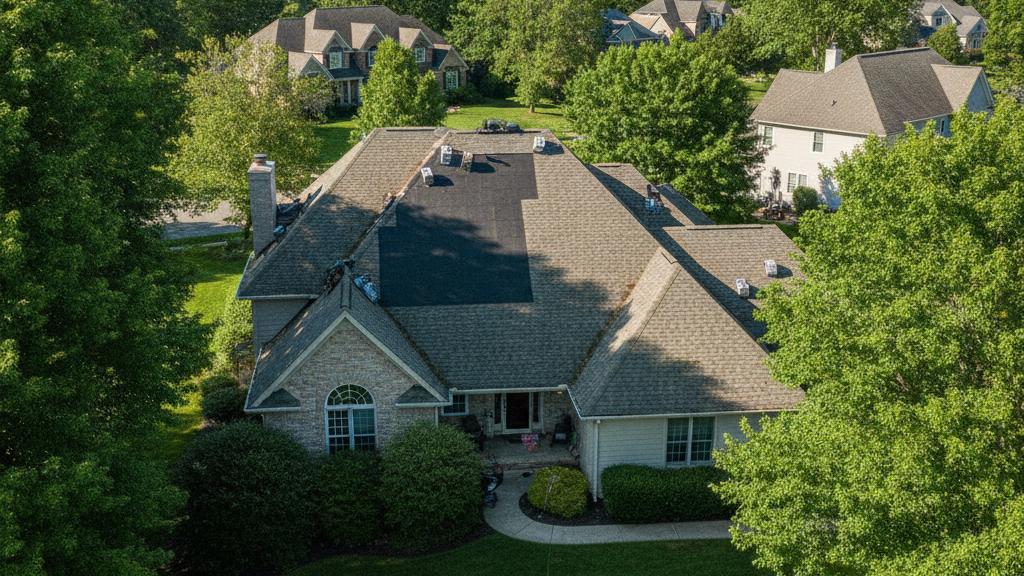
Yes, you can sometimes replace just one section of your roof — but whether it’s the right call depends on the age of the rest of the roof, how the new shingles will match, and what the inspection finds underneath. For most homes in New York and Connecticut, a partial replacement makes sense only when the damaged section is isolated and the remaining roof has meaningful life left. If the rest of the roof is already well into its service life, a partial re-roof usually costs more in the long run.
What “partial roof replacement” actually means
A partial replacement (also called a partial re-roof or sectional replacement) means tearing off and replacing the shingles, underlayment, and any damaged decking on one slope, wing, or addition — while leaving the rest of the roof in place. It’s distinct from a full tear-off, which removes all roofing layers down to the deck across the entire structure.
Common scenarios where homeowners ask this question:
- A tree limb punched through one slope after a summer thunderstorm
- A rear addition with its own lower-pitch slope failed years before the main roof
- Hail damage was confirmed on one side by the insurance adjuster
- A flat-roof section over a garage is leaking while the main pitched roof is fine
Each situation is different. The age and condition of the untouched sections matter as much as the damage itself.
The four-question test a good contractor runs
1. How old is the undamaged portion?
Per the InterNACHI Standard Estimated Life Expectancy Chart, architectural asphalt shingles carry an ideal-condition rating of around 30 years (per InterNACHI, nachi.org/life-expectancy.htm). In the Northeast — with NY and CT’s combination of summer UV, humidity, thunderstorm wind load, and coastal salt air — expect a real-world service life closer to 20–25 years for a typical installation.
If the undamaged portion is 15 years old or newer, a partial replacement can extend the roof’s life without replacing material that still has substantial life left. If it’s approaching 20 years or beyond, you’re putting new material over a deck and drainage system that will need full replacement within a few years anyway — and you’ll pay twice.
2. Will the new shingles blend?
Shingle granule color fades over time through UV exposure and weathering. A brand-new shingle run on one slope will almost never match the aged color of shingles on adjacent slopes, even with the same product line. On most homes this is a permanent visual mismatch — some homeowners accept it; many don’t.
If the roof is highly visible from the street or curb appeal matters for a near-term sale, that’s a real factor. A contractor who tells you the match will be perfect is either mistaken or overselling.
3. What does the deck inspection show?
Before any section is replaced, a thorough contractor will inspect the roof deck (typically plywood or OSB sheathing). If the deck is soft, delaminated, or showing signs of rot — which is common under a leak that’s been active for even one season in NY or CT’s humid summers — the scope of work grows regardless. Replacing shingles over compromised decking is a short-term fix that will fail again.
Per the GAF steep-slope roofing field guide (resgn103.pdf), a sound deck is a foundational requirement for any roofing installation — the shingles are only as durable as the substrate beneath them.
4. Is the rest of the roof a single contiguous drainage system?
On a simple gable or hip roof, the slopes drain independently and a partial replacement on one slope is structurally clean. On complex rooflines with multiple valleys, dormers, crickets, or where an addition ties into the main structure, the drainage from the new section interacts with flashing and valleys on the old section. If the existing flashing is aging, a partial re-roof may require replacing valley and step flashing that crosses section boundaries anyway — shrinking the cost advantage of going partial.
Gunner handles all step and counter-flashing at every penetration — dormers, chimneys, skylights, wall terminations — as a standard part of every roof replacement. When that flashing work overlaps into the “untouched” area, the line between partial and full replacement blurs.
When partial replacement is the right call
| Scenario | Partial re-roof makes sense? |
|---|---|
| Isolated storm or hail damage, roof is under 12–15 years old | Usually yes |
| Rear addition with a separate drainage plane failed early | Often yes, if main roof is in good shape |
| Insurance claim covers one slope only | Depends on remaining roof age; discuss with contractor |
| Roof is 18–20+ years old overall | Generally no — full replacement usually costs less over time |
| Deck damage found under the failed section | Evaluate scope; full inspection needed |
| Highly visible mismatch would affect sale value | Factor curb appeal into the decision |
The hidden cost of a partial re-roof done at the wrong time
The scenario Gunner’s crews see repeatedly in Westchester and Fairfield County: a homeowner patches one slope after a storm, the main roof holds for two or three more summers, then fails at 22 or 23 years old. Now they pay for a second mobilization, second tear-off, and second disposal — plus the new shingles installed in the partial are only a few years old and get torn off too. The total spend often exceeds what a single full replacement would have cost.
Summer is when this math becomes especially clear. After a July or August thunderstorm with wind gusts and hail — both routine in the NY/CT corridor — the damaged slope is obvious, but the rest of the roof took the same storm. Granule loss, lifted tabs, and compromised seals may not show as an active leak yet. A full inspection after any significant storm is worth doing even if only one area is visibly damaged.
What about a second layer of shingles (re-roof over)?
Whether you can add a second layer of shingles over an existing layer instead of a full tear-off depends on deck condition and local rules — requirements vary by municipality, so confirm with your local building department. However, this adds weight to the structure, prevents a deck inspection, and forfeits the opportunity to address ventilation or insulation issues underneath. That’s why most experienced contractors default to full tear-offs — the deck inspection alone frequently reveals problems that would have gone unaddressed.
Gunner addresses all three layers on roof replacements: air sealing, insulation, and ventilation — and performs that attic work directly, not as a referral.
What Gunner recommends
Partial replacement is a legitimate tool in the right situation. When a specific section has sustained isolated damage and the rest of the roof is genuinely young and sound, it is often the most cost-effective, least-disruptive path. When the rest of the roof is aging, when the deck shows wear, or when the full system’s drainage integrity is in question, the math usually favors a complete replacement.
Gunner Roofing is a GAF Master Elite® contractor — a designation held by fewer than 3% of roofing contractors nationally (per GAF, gaf.com) — and pulls the building permit on every project. Every Gunner roof replacement includes ice-and-water shield to meet or exceed code minimums, leak barrier through all valleys, and step and counter-flashing at every penetration.
The best starting point is a thorough inspection — not just of the failed section, but of the entire roof, attic, and adjacent flashings. That gives you real numbers instead of guesses.
Get a free, no-obligation estimate at GunnerRoofing.com.
Frequently Asked Questions
Can I replace just one slope of my roof? Yes, in many cases. If the damaged slope drains independently and the rest of your roof has significant life remaining, a partial replacement is technically sound. The key questions are age of the undamaged areas, deck condition, and whether flashing at shared boundaries needs replacement.
Will partial replacement shingles match my existing roof? Rarely a perfect match. Shingle granules fade with UV exposure, so new shingles applied alongside older material will show a color difference. This may be acceptable depending on visibility, but it’s permanent — plan accordingly if you’re preparing to sell.
How do I know if my deck needs replacement too? Soft spots, visible moisture staining, delamination, or spongy feel underfoot are indicators. The only way to know for certain is a physical inspection after the old shingles are removed — which is another reason experienced contractors do a full tear-off before assessing scope.
Does partial replacement qualify for a manufacturer warranty? Warranty terms vary by manufacturer and by how the partial section is installed. Some warranties require a full qualifying system assembly (underlayment, starter, ridge, ventilation) — the same requirements apply whether the job is partial or full. Ask your contractor what warranty coverage the partial installation will carry.
Does a partial roof replacement require a permit in New York or Connecticut? Permit requirements vary by municipality — confirm with your local building department. Gunner pulls the building permit on every project.
When is full replacement worth it even if the damage is limited? When your roof is approaching the end of its service life (typically 18–22+ years for architectural shingles in the Northeast), when the deck has widespread wear, or when the total cost of two mobilizations — partial now, full in a few years — exceeds a single full replacement today.
Get a fast, free quote
No inspection visit needed - we measure your roof from satellite imagery and send your quote.