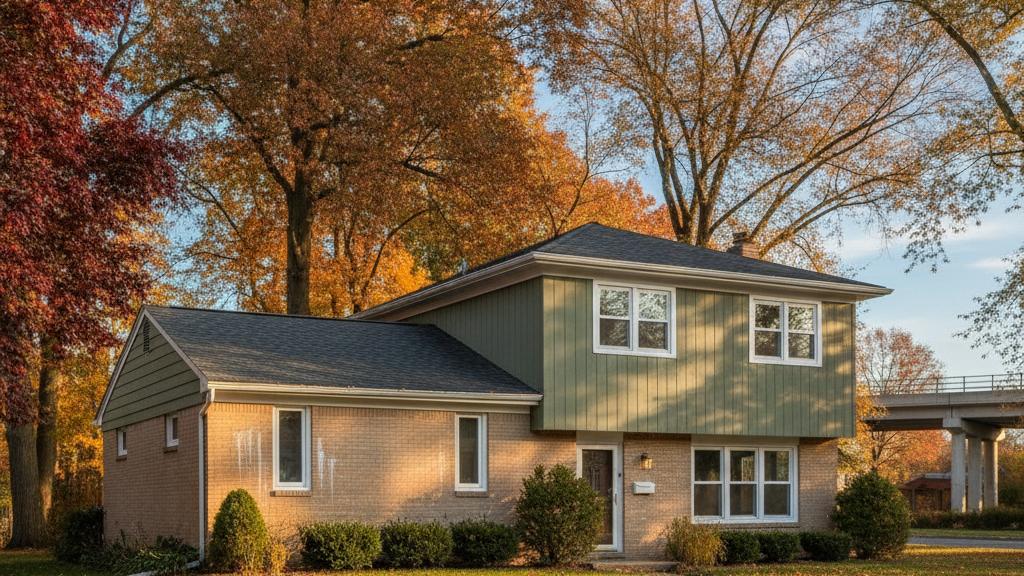
When homeowners near I-287 or the Sprain Brook Parkway ask whether new windows will quiet their house, the first answer they get is about glass — acoustic IGUs, laminated lites, asymmetric thicknesses. That’s all real, and it matters. But in Greenburgh’s parkway-adjacent hamlets, there is a second variable that often determines whether a window replacement actually delivers its rated performance: the frame.
Hartsdale, Edgemont, and Fairview built out heavily in the 1950s and 1960s, filling in land alongside existing transportation infrastructure. The housing stock from that era came with aluminum frames — thin-walled, single-pane, and original to the house. Aluminum conducts heat and sound readily, and it racks. By the time a 1960s aluminum window is 60-plus years old, the sash corners have shifted, the glazing compound has cracked or pulled away, and the perimeter seal between the frame and the rough opening has failed in at least a few spots. No glass upgrade you install in a compromised frame will perform to spec. This fall, before the heating season starts, frame condition is the question worth asking first.
Why Frame Material Matters Acoustically — Not Just Thermally
The glass does the heavy lifting on sound attenuation — but only when the frame seals correctly. Sound enters a room through three paths: through the glass, through gaps in the operable sash seal (weatherstripping, compression seal at close), and through the perimeter gap between the frame and the rough opening. Highway corridor homes near I-287 face elevated low-frequency noise from engine load and tire rumble, which penetrates perimeter gaps with less resistance than high-frequency sound.
An acoustic-grade insulated glass unit (IGU) installed in a racked aluminum frame with failing perimeter caulk and degraded weatherstripping will sound like a standard window — because the flanking paths dominate. The glass spec is only as good as the seal around it.
The NFRC label covers U-factor (heat loss) and SHGC (solar gain). It does not rate acoustic performance. STC (Sound Transmission Class) is a separate metric that manufacturers publish for specific glass configurations. Air leakage, which determines how much flanking sound gets through, is also rated separately. Both should be in the conversation when highway noise is the goal.
Frame Material Comparison: Aluminum vs. Vinyl vs. Composite
| Frame Material | Thermal Performance | Acoustic Flanking Risk | Dimensional Stability | Notes for Greenburgh |
|---|---|---|---|---|
| Original aluminum (1950s–1960s) | Poor — highly conductive | High — racks and gaps in freeze-thaw | Low | Replace, don’t reglaze |
| Standard vinyl | Good — thermal break; low conductivity | Moderate — can flex at corners in extreme cold | Moderate | Entry-level option; works well when properly installed |
| Fibrex® composite (Andersen) | Good — similar to vinyl; stiffer | Lower — dimensional stability reduces gap formation | High | Better for frames that must hold geometry through Westchester freeze-thaw cycles |
| Fiberglass | Good to excellent | Lower | High | Premium option; less common in residential replacement |
Thermal performance context: per the U.S. Department of Energy, frame materials affect both heat transfer and air-leakage rates — aluminum frames without a thermal break are among the highest conductors in residential windows.
Andersen’s Fibrex® composite material — used in the 100 Series and A-Series — is described by Andersen as significantly stiffer than vinyl and with lower thermal expansion and contraction than vinyl in temperature cycling. For a Greenburgh home that goes through hard freeze-thaw cycles from November through March, reduced dimensional movement means the frame holds its geometry and maintains compression seals more consistently over time. That has an acoustic benefit as well as a thermal one.
The Greenburgh Housing Context: Why This Is the Fall Question to Ask
A window replacement in Hartsdale or Edgemont in October is, in practical terms, a preparation for the heating season that starts next month. Aluminum-frame windows that have been racked for years are actively leaking heat and sound. Replacing them before the first sustained cold snap addresses both failure modes simultaneously — and avoids the cycle of weatherstripping tape and interior window film that many homeowners in these hamlets apply each fall as a stopgap.
Greenburgh’s parkway-adjacent hamlets are not the same as the quieter residential sections away from I-287. The constant ambient traffic load from the Sprain Brook Parkway, Bronx River Parkway, and I-287 interchange affects homes within a broad radius, not just those directly at the highway fence. For those homes, a window spec that prioritizes both frame integrity and glass acoustic performance is appropriate — not a one-size standard replacement.
What the Glass Package Still Needs to Do
Frame condition is necessary but not sufficient. The glass spec matters too, and the two choices are not interchangeable:
Standard double-pane IGU: Two lites of matched thickness, gas fill, low-e coating. Meets code; adequate thermal performance; limited acoustic improvement over original single-pane because the coincidence effect is not addressed. (The coincidence effect occurs when two panes share a resonant frequency and vibrate together, reducing attenuation in the road-noise frequency range.)
Acoustic double-pane IGU: Two lites of different thicknesses (asymmetric), at least one laminated with a PVB interlayer, gas fill, low-e coating. The asymmetric thickness breaks the shared resonance; the laminated lite adds vibration damping within the pane. This configuration specifically targets the mid-frequency range where highway noise concentrates. Ask for the STC or OITC (Outdoor-Indoor Transmission Class) rating for the specific glass package — not just the window line name.
Standard triple-pane IGU: Three lites, typically matched thickness, in a deeper sash. Excellent thermal performance. Acoustic performance is not automatically better than a standard double-pane when all three lites share the same thickness and the narrower air gaps reduce the inter-pane acoustic benefit. When triple-pane is specified with asymmetric lites and one laminated pane, acoustic performance improves — but that spec must be confirmed, not assumed.
For a Greenburgh home replacing 1960s aluminum single-pane units, the thermal improvement from any quality double-pane with low-e and gas fill is dramatic. The acoustic improvement is additive when the glass package is specified correctly and the frame seals properly.
Energy Code Requirements: Westchester Climate Zone 4
Greenburgh falls within Climate Zone 4 under the 2020 New York State Energy Conservation Construction Code. The prescriptive path for replacement windows sets a maximum U-factor of 0.32 and a maximum SHGC of 0.40 (per 2020 NYS Energy Code Table R402.1.2). ENERGY STAR v7.0 Northern zone criteria are tighter: U-factor ≤ 0.22 and SHGC ≥ 0.17 (ENERGY STAR v7.0 Final Specification, effective October 23, 2023).
Confirm the specific unit’s NFRC ratings before ordering.
Permits in Greenburgh
Window replacement requires a permit in Greenburgh. If your home is in the unincorporated Town of Greenburgh — Hartsdale, Edgemont, Fairview — permits are issued by the Town of Greenburgh Building Department, per its published FAQ and consistent with New York State Executive Law §381, which assigns Uniform Code administration to each local government within its boundaries.
If you live in one of the incorporated villages within Greenburgh, requirements vary by municipality; confirm with your local building department.
Gunner handles the building permit on every project — it is included in the job scope regardless of jurisdiction.
What Gunner Installs
Gunner Roofing is an Andersen Certified Elite contractor serving Greenburgh and Westchester County. For homes in the parkway corridors, we evaluate both frame condition and glass specification — replacing a racked aluminum frame with a properly sealed composite or vinyl unit, spec’d with the glass package that matches the noise environment and meets or exceeds the energy code.
Gunner is fully licensed, insured, and bonded in New York.
Get a free, no-obligation estimate at GunnerRoofing.com.
FAQ
Why does frame material matter for highway noise, not just glass? Sound enters a home through three paths: through the glass, through operable sash seals, and through the perimeter gap between the frame and wall. A racked or gap-prone frame creates flanking paths that allow highway noise to bypass the glass entirely. No acoustic glass upgrade performs to spec in a frame that doesn’t seal correctly. For 1950s–1960s aluminum-frame homes near I-287 in Greenburgh, frame condition is the first variable to evaluate.
Is Fibrex composite better than vinyl for Greenburgh freeze-thaw conditions? Andersen describes Fibrex® as having lower thermal expansion and contraction than vinyl in temperature cycling, which means better dimensional stability through Westchester’s freeze-thaw cycles. A frame that holds its geometry more consistently maintains its compression seals more reliably — with both acoustic and thermal benefits. Vinyl is a sound option when properly installed; Fibrex offers better dimensional stability at the cost of a higher price point.
What STC rating should I look for in a replacement window near a highway? STC is not a required label disclosure, so values vary by manufacturer and configuration. Rather than targeting a specific number in isolation, ask for the STC or OITC (Outdoor-Indoor Transmission Class) rating for the exact IGU configuration being quoted — asymmetric lites and a laminated lite are the features that drive acoustic performance, and a manufacturer can provide ratings for specific glass packages.
What U-factor do replacement windows need in Greenburgh, NY? The 2020 NYS Energy Code prescriptive path for Climate Zone 4 (Westchester County) sets a maximum U-factor of 0.32 and maximum SHGC of 0.40. ENERGY STAR v7.0 Northern zone criteria are stricter: U-factor ≤ 0.22, SHGC ≥ 0.17, effective October 23, 2023. Confirm the specific NFRC-rated unit before ordering.
Do I need a permit to replace windows in Greenburgh? Yes. In the unincorporated Town of Greenburgh (Hartsdale, Edgemont, Fairview), permits are handled by the Town of Greenburgh Building Department. In the incorporated villages, requirements vary; confirm with your local building department. Gunner pulls the permit on every project.
Does Gunner replace aluminum-frame windows in Greenburgh? Yes. Gunner Roofing is an Andersen Certified Elite contractor serving Greenburgh and Westchester County. We handle the full scope — frame removal, rough opening air sealing, permit, and installation — on every project. Fully licensed, insured, and bonded in New York.
Get a fast, free quote
No inspection visit needed - we measure your roof from satellite imagery and send your quote.