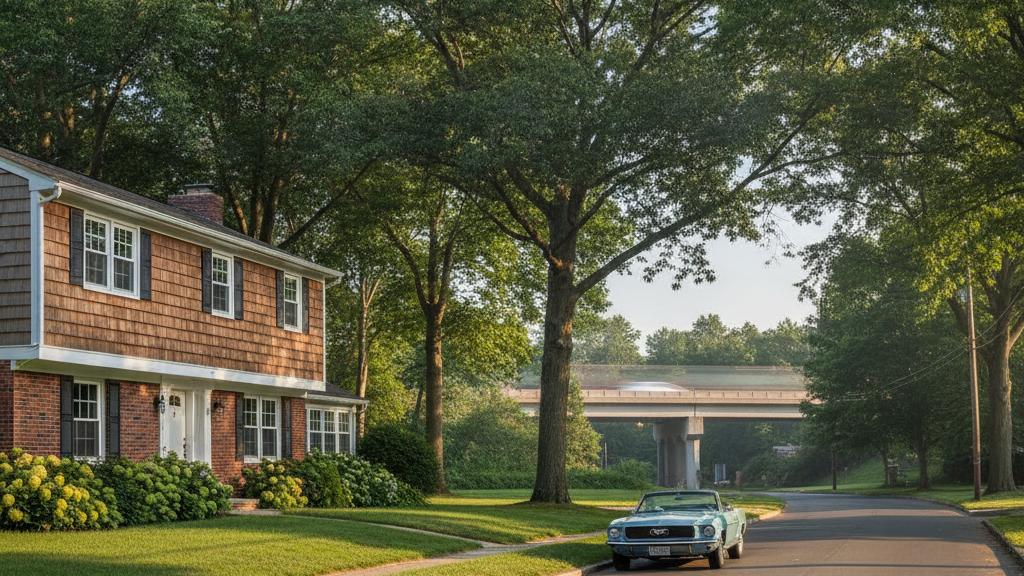
Quality replacement windows do reduce highway noise — meaningfully, in most mid-century homes. But the reduction you get depends almost entirely on how the insulated glass unit (IGU) is built, not on the brand name or the price tier. The same question homeowners near I-95 in Greenwich and Stamford ask is the one Greenburgh homeowners ask about I-287 and the parkways: does swapping out old windows actually quiet the house? The honest answer: yes, with the right glass spec. And the counterintuitive part of that spec is that a well-built acoustic double-pane IGU often reduces more highway noise than a standard triple-pane unit — even though the triple-pane costs more.
Here is what you need to know to make that evaluation.
What “Blocking” Highway Noise Really Means
No residential window eliminates traffic noise entirely. Sound reaches a room through the glass itself, through the perimeter seal between the frame and the rough opening, and through the wall assembly around the window. Replacement windows address the first two paths. They don’t treat the wall.
For a home near I-287, the Sprain Brook Parkway, or the Bronx River Parkway, a quality window replacement produces a perceptible and real reduction in daily noise levels — the kind that changes how a bedroom or home office feels during peak traffic hours. Homes directly adjacent to highway rights-of-way will still notice elevated speeds; the improvement is most pronounced in the constant ambient traffic load that accumulates across a full day.
The Three Features That Drive Acoustic Performance
The NFRC label — the standard thermal-rating label on every replacement window — covers U-factor (heat loss) and SHGC (solar heat gain). It does not rate acoustic performance. STC (Sound Transmission Class), the industry-standard noise-attenuation rating, is a separate metric that manufacturers publish for specific glass configurations. Ask for it explicitly when comparing options.
Three IGU features predict acoustic performance:
Glass mass and thickness. Heavier, thicker glass dissipates more acoustic energy. A thicker pane requires more energy from a sound wave to vibrate, so less energy transmits to the room side.
Asymmetric lite thicknesses. When two panes in an IGU are the same thickness, they share a resonant frequency — called the coincidence frequency — where they vibrate together and transmit sound with less resistance. Using two lites of different thicknesses disrupts this shared resonance, producing more consistent attenuation across the frequency range that road and engine noise occupies. This is one of the most effective acoustic improvements available within a standard IGU form factor.
Laminated glass with acoustic interlayer. A laminated lite sandwiches two glass layers around a polyvinyl butyral (PVB) interlayer. The interlayer damps vibration within the pane itself — particularly at mid- and high-frequencies where tire and engine noise concentrate. An acoustic-grade IGU typically includes at least one laminated lite, often on the exterior.
Acoustic Double-Pane vs. Standard Double-Pane vs. Triple-Pane: The Comparison
| Feature | Standard Double-Pane | Acoustic Double-Pane | Standard Triple-Pane |
|---|---|---|---|
| Lite configuration | Two matched lites | Two asymmetric lites; ≥1 laminated | Three lites, often matched |
| Coincidence effect | Present — resonance at a shared frequency | Reduced via asymmetric thickness | Partially reduced only |
| Acoustic performance | Baseline | Meaningfully above standard | Often similar to standard double-pane |
| Thermal performance (U-factor) | Meets code minimum | Typically meets ENERGY STAR v7.0 | Best in class for thermal |
| Best application | Energy-code compliance | Highway corridor / noise priority | Extreme-cold climates or maximum-energy goal |
Source: U.S. Department of Energy window glazing guidance; ENERGY STAR v7.0 Northern zone criteria (U-factor ≤0.22, SHGC ≥0.17, effective October 23, 2023).
The reason the standard triple-pane often underperforms on noise is geometry and design intent. A standard triple-pane adds a third lite to improve thermal resistance. If all three lites are the same thickness — the default for most mid-market triple-pane specs — the coincidence effect is not broken. Additionally, fitting three lites into a standard sash depth leaves a narrower air gap between each pair of panes, which reduces the acoustic benefit of the gap itself. A triple-pane unit built specifically for acoustics (asymmetric lites, one laminated, wider outer gap) can be excellent — but that spec must be requested and confirmed, not assumed.
When highway noise is the primary concern, ask the manufacturer for the STC or OITC (Outdoor-Indoor Transmission Class) rating on the specific IGU configuration — not just the glass line name.
Greenburgh’s Summer Noise Context: Why This Comparison Matters Here
Greenburgh’s highway exposure is specific in a way that makes acoustic window selection higher-stakes than in quieter adjacent towns.
I-287 runs east-west through the unincorporated town. The Sprain Brook Parkway and Bronx River Parkway bracket its interior. The hamlets closest to these corridors — Hartsdale, Edgemont, and Fairview — developed in the 1950s and 1960s, filling in land around and between existing transportation infrastructure. Most of that housing stock is now past the useful life of its original windows.
What makes the summer context specific: July and August bring not just morning and evening commute peaks on I-287, but sustained recreational traffic heading to Westchester’s parks and waterways throughout the day and into the evening. A highway corridor in Greenburgh in August carries a different daily load profile than the same road in February. For households that keep windows closed specifically to manage heat and noise in summer — and that describes most of the homes in Greenburgh’s parkway-adjacent hamlets — the acoustic spec of the replacement window matters more, not less, in the hot months.
The same question is asked by homeowners near I-95 in Greenwich and Stamford, CT — Gunner serves those corridors as well — and the answer is identical: the glass package, not the brand or the price tier, is what determines whether the upgrade actually quiets the house.
Energy Code Requirements Still Apply
Acoustic performance is layered on top of the code baseline. Greenburgh falls in Climate Zone 4 under the 2020 New York State Energy Conservation Construction Code. The prescriptive path for replacement windows sets a maximum U-factor of 0.32 and a maximum SHGC of 0.40 (per 2020 NYS Energy Code Table R402.1.2). ENERGY STAR v7.0 Northern zone criteria are tighter: U-factor ≤ 0.22 and SHGC ≥ 0.17 (ENERGY STAR v7.0 Final Specification, effective October 23, 2023).
An acoustic-grade double-pane IGU with laminated glass can meet ENERGY STAR when it’s spec’d with low-e coatings and gas fill — and the extra glass mass and laminate that help with noise also add modest thermal resistance over a standard matching-lite unit. For a mid-century Greenburgh home replacing 1960s aluminum single-pane windows, the thermal improvement alone is substantial; the acoustic improvement is additive.
Installation Quality: The Seal Is Half the Equation
The glass package does the primary work, but the installation quality determines how much of that performance reaches the room. Air gaps around the frame are a direct noise path — particularly for low-frequency road noise, which penetrates through gaps more efficiently than through glass. Proper flashing and caulking at the rough opening, quality compression or pile weatherstripping on operable sash, and a correctly shimmed and flashed install that does not distort the frame all matter.
A full-frame replacement — which is the right call when the existing frame is rotted, warped, or compressed — also allows the installer to address any air sealing at the rough opening that wasn’t done in the original installation. An insert replacement into a structurally sound existing frame can achieve comparable performance at lower cost, provided the frame-to-wall interface is properly sealed.
Permits in Greenburgh: Unincorporated Town vs. the Villages
If your home is in the unincorporated Town of Greenburgh (Hartsdale, Edgemont, Fairview, White Plains–adjacent hamlets), building permits for window replacement are issued by the Town of Greenburgh Building Department, per the Town’s published FAQ and consistent with New York State Executive Law §381, which assigns Uniform Code administration to local governments within their boundaries; for unincorporated town area, that responsibility falls to the town.
If you live in one of the incorporated villages within Greenburgh, requirements vary by municipality; confirm with your local building department or historic-district commission.
Gunner handles the permit application on every project — it is included in the job scope regardless of jurisdiction.
What Gunner Installs
Gunner Roofing is an Andersen Certified Elite contractor serving Greenburgh and the broader Westchester County area. For a highway-adjacent home, the right approach is to match the glass package to both the noise environment and the energy-code requirements — not a one-size-fits-all standard IGU.
Gunner is fully licensed, insured, and bonded in New York.
Get a free, no-obligation estimate at GunnerRoofing.com.
FAQ
Do replacement windows actually reduce highway noise near I-287 in Greenburgh? Yes — a well-specified replacement window with laminated glass, asymmetric lite thicknesses, and a tight perimeter seal makes a perceptible, real reduction in daily traffic noise. No window eliminates highway noise entirely; the wall assembly and any remaining envelope gaps also contribute. But in most 1950s–1970s Greenburgh homes, the original windows are the weakest acoustic link in the envelope, and replacing them addresses the largest single source of sound transmission.
Is triple-pane better than double-pane for highway noise? Not automatically. A standard triple-pane unit — three lites of matched thickness in a standard sash depth — often delivers acoustic performance similar to a standard double-pane because the coincidence effect is not addressed. An acoustic-grade double-pane with asymmetric lites and at least one laminated lite specifically targets noise reduction and frequently outperforms a standard triple-pane for that purpose. Triple-pane excels on thermal performance. If both noise and energy performance are the goal, ask manufacturers for STC ratings on specific glass configurations rather than assuming the triple-pane is the acoustic upgrade.
What is STC and where do I find it for replacement windows? STC (Sound Transmission Class) rates how much a partition reduces airborne sound. Unlike U-factor and SHGC, which appear on the NFRC label for every window sold, STC is not a required disclosure — manufacturers publish it for specific IGU configurations on request. When highway noise is a priority, ask your contractor or the manufacturer for the STC or OITC (Outdoor-Indoor Transmission Class) rating for the exact glass package being quoted.
What U-factor do replacement windows need to meet in Greenburgh? The 2020 NYS Energy Code prescriptive path for Climate Zone 4 — which includes all of Westchester County — sets a maximum U-factor of 0.32 and maximum SHGC of 0.40. ENERGY STAR v7.0 Northern zone criteria are stricter: U-factor ≤ 0.22, SHGC ≥ 0.17, effective October 23, 2023. Most quality acoustic-grade replacement windows meet ENERGY STAR.
Do I need a permit to replace windows in Greenburgh, NY? If you live in the unincorporated Town of Greenburgh (Hartsdale, Edgemont, Fairview), permits are handled by the Town of Greenburgh Building Department. If you live in one of the incorporated villages within Greenburgh, requirements vary by municipality; confirm with your local building department. Gunner pulls the permit on every project.
Does Gunner install acoustic windows in Greenburgh? Yes. Gunner Roofing is an Andersen Certified Elite contractor serving Greenburgh and Westchester County. We handle the permit on every project, and Gunner is fully licensed, insured, and bonded in New York.
Get a fast, free quote
No inspection visit needed - we measure your roof from satellite imagery and send your quote.