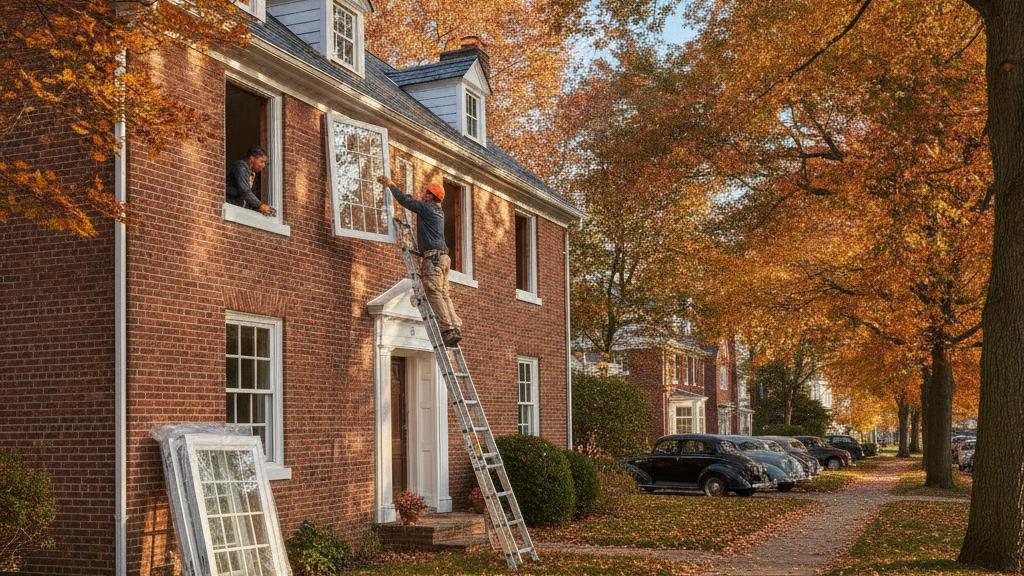
Yes, windows can be replaced in fall or winter in New York — including right now in Yonkers. The work doesn’t require warm weather; it requires the right crew, the right materials, and a plan for the opening. Waiting until spring to replace a drafty or failed window costs you months of heat loss. Here is what actually changes in cold weather and what doesn’t.
Why the “wait for spring” advice persists (and why it usually doesn’t apply)
The hesitation comes from siding and exterior painting, where caulk and paint adhesion genuinely require specific temperature minimums. Window replacement is different. The window unit itself — frame, sash, glazing — is a manufactured assembly installed into a pre-framed rough opening. The installation process is largely mechanical: remove the old unit, adjust shims and flashing, set the new unit, insulate the gap, and apply sealant.
The main material that is temperature-sensitive is the sealant at the perimeter. Most professional-grade silicone and polyurethane sealants have application temperature minimums stated on the product data sheet — installers confirm these before work begins. An experienced crew in Westchester knows to use cold-weather-rated materials and to work quickly to minimize how long a wall opening is exposed. Gunner tracks weather forecasts and sequences exterior work to avoid open openings through rain events.
On a typical Yonkers two-story, a window opening is exposed for under an hour before it is closed with the new unit. Interior finishing — trimwork, insulation in the rough opening — completes the envelope indoors.
What actually changes in cold-weather window installation
| Factor | Warm-weather install | Cold-weather install |
|---|---|---|
| Sealant application | Standard range | Requires cold-weather-rated product; check data sheet |
| Vinyl frame flexibility | Slightly easier handling | Vinyl can be stiffer; professional installers work accordingly |
| Fibrex® / composite frames | No significant change | Dimensional stability is a core Fibrex property (per Andersen) |
| Open-wall exposure time | Same target: minimize it | Contractor sequences to limit exposure; same standard |
| Interior comfort during install | Brief cold draft per opening | Same — 30–60 minutes per opening |
| Permit timeline | Varies by municipality | No seasonal change — permit processing is year-round |
The real cost of waiting
A Yonkers home from the 1920s or 1930s — and much of Park Hill, Nodine Hill, and Dunwoodie carries exactly that vintage — often still has original single-pane wood sash windows or metal storm window combinations. Single-pane glazing has a U-factor typically above 1.0 (per the NFRC scale, which runs roughly 0.20–1.20, where lower means better heat retention). A new ENERGY STAR-qualified double-pane unit for the Northern climate zone must meet a U-factor of 0.22 or lower, per ENERGY STAR Version 7.0 (effective October 23, 2023). The gap between what an original single-pane window loses and what a modern certified replacement retains is large, and every heating month you delay is real money out through the glass.
Beyond energy cost, Yonkers falls along the Hudson River corridor, which funnels northwest wind during Nor’easters and fall cold fronts. A failed window seal — visible as fogging between the panes — provides essentially no insulating dead-air space, because the gas fill has leaked out. Heading into November and December with failed IGUs (insulating glass units) or cracked weatherstripping means the problem compounds every week.
Permitting in Yonkers — what to expect
Window replacement generally requires a building permit in New York municipalities. Requirements vary by municipality; confirm the current scope with your local building department. What doesn’t change seasonally is the permit process itself — the application, review, and inspection timeline runs year-round. Gunner handles the permit on every window project in Yonkers — that’s included, not an add-on.
Choosing the right window for a cold-weather install in Westchester
Andersen’s 400 Series and A-Series are both viable for fall and winter installation in Westchester. The frame material matters here:
Andersen Fibrex® composite (used in the 100 Series and A-Series) is a proprietary wood-fiber and polymer material. Andersen documents its dimensional stability advantage over vinyl in temperature cycling — vinyl contracts and expands more significantly with temperature swings, which can affect fit over time. For a November install in Yonkers, Fibrex holds its dimensions through the season more consistently (per Andersen’s Fibrex material documentation).
Andersen 400 Series uses a Perma-Shield® vinyl exterior over wood. It installs the same way in cold weather; the key is that interior wood components should not be exposed to extended cold during staging. Professional installation handles this through normal sequencing.
Both series can meet the 2020 NYS Energy Code’s Climate Zone 4 prescriptive maximum U-factor of 0.32 for Westchester County (per Table R402.1.2). ENERGY STAR-certified configurations go further, reaching the v7.0 Northern zone threshold of U ≤ 0.22.
Yonkers housing stock: why fall timing often makes sense here
Brick Colonials and two-family homes built between roughly 1910 and 1945 in neighborhoods like Park Hill, Nodine Hill, and Wakefield frequently retain their original wood sash windows — either single-pane or with non-thermally-broken aluminum storm windows added later. These are not just aesthetically dated; they are a direct and continuous heat drain from October through March.
Getting replacements installed before the heating season is fully under way means the energy savings accrue for the entire winter, not just from whenever the spring backlog clears. Fall demand for window contractors also tends to be lower than spring — homeowners who schedule in October and November typically get faster turnarounds than those waiting for the spring rush.
What to tell your contractor before scheduling a winter install
- Confirm sealant specs. Ask that cold-weather-rated sealant is on the truck if temperatures on install day will be in the lower ranges. Professional crews already do this; it’s fine to confirm.
- Have interior workspace clear. Installers need room to work from the inside for each opening. Clear the area on the day of install.
- Plan for brief drafts. Each opening will be cold for roughly the time it takes to seat and flash the new unit. This is normal and short.
- Verify the permit is in hand before work starts. Gunner handles this, but on any project, confirm the permit is approved before the crew arrives — this is standard practice regardless of season.
FAQ
Can windows be replaced in fall or winter in New York? Yes — and in Yonkers, with the region’s pre-war housing stock and Hudson Valley wind exposure, fall is often the best time to act. Waiting until spring means heating through the winter with what you have.
Ready to see what replacement windows would cost for your Yonkers home? Get a free, no-obligation estimate at GunnerRoofing.com.
Get a fast, free quote
No inspection visit needed - we measure your roof from satellite imagery and send your quote.