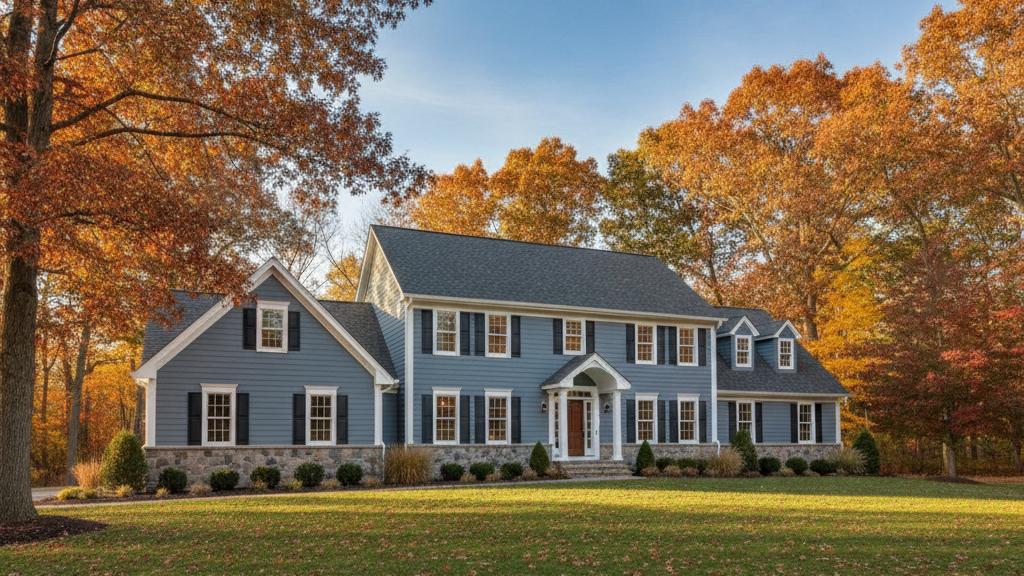
Fall is actually one of the better times to install James Hardie fiber cement siding in Westchester County — with one important caveat: the job needs to be sequenced around falling temperatures and the frost line. The fiber cement boards themselves handle cold just fine. The constraints are the finishing materials (caulk, paint, ColorPlus touch-up) and keeping uninstalled boards dry during a season when wet weather can arrive without much warning. If those two things are managed properly, a late October or early November start is realistic for most Westchester homes.
Why Westchester’s Climate Zone 4 Changes the Math
Westchester County sits in IECC Climate Zone 4, the northern boundary of James Hardie’s HZ5 product territory (per the 2020 NYS Energy Conservation Construction Code, Table R402.1.2, and the James Hardie HardieZone map). HZ5 products are specifically engineered to perform in climates with “seasonal temperature variations, freezing temperatures and snow and ice” — that description fits Westchester precisely.
That’s the good news. The subtler point is that Westchester’s fall is shorter and more unpredictable than, say, central New Jersey. By late October, nighttime lows can swing dramatically. A week of 50°F afternoons may be followed by a frost. That compressed warm window is what makes scheduling discipline — not the product itself — the deciding factor for fall installs.
What the James Hardie Installation Guide Actually Says About Cold
The HZ5 Best Practices guide doesn’t prohibit fall or cold-weather installation. What it does specify is this:
ColorPlus touch-up must be applied when air and siding surface temperatures are above 40°F (4°C). This is a hard warning in the guide, not a recommendation. ColorPlus touch-up that freezes can fail — it won’t bond correctly, and James Hardie won’t warrant the result.
For field-painted (non-ColorPlus) boards, the temperature constraint comes from the paint manufacturer’s specs, not Hardie’s. Most exterior latex paints have their own minimum application temperatures — confirm those specs with the specific product being used before scheduling a late-fall paint day.
The boards themselves? Fiber cement has “significantly greater dimensional stability than wood or vinyl-based exterior products” (per the HZ5 guide). It doesn’t absorb moisture and swell the way wood does, and it doesn’t become brittle and crack the way vinyl can in cold. Cold temperature is not an inherent problem for the boards.
The Real Risk: Keeping Boards Dry Before They Go Up
James Hardie’s guide is explicit: siding and trim products must be kept dry at all times prior to installation. If boards become saturated:
- Open joints can occur at butt joints as the material dries and shrinks.
- Difficulty in handling — saturated boards are heavier and more flexible.
- Staining — soluble salts can deposit on the surface.
Fall in Westchester brings the highest annual rain probability before the ground freezes. A pallet of Hardie boards sitting on an unprotected job site overnight during a November rain event is a problem. If stored outside, boards must be covered with a waterproof tarp and kept off the ground. Any saturated boards must dry completely before installation — which in cool fall air can take longer than in summer.
This is the number-one logistics challenge for fall siding jobs in this county, and it’s worth asking any contractor you hire specifically how they handle material storage and overnight weather protection.
What a Properly Sequenced Fall Install Looks Like
A skilled crew running a fall Hardie install in Westchester will typically:
- Check the 10-day forecast before ordering material delivery. Gunner tracks weather forecasts and sequences exterior projects to avoid leaving walls open through a forecasted rain event.
- Close the wall fast. The WRB (water-resistive barrier — required per IBC 2021 §1403.2), flashing at all penetrations and roof-to-wall junctions, and siding courses get installed in tight sequence so the house isn’t exposed for extended periods.
- Schedule caulk and ColorPlus touch-up days around temperature. Touch-up must happen above 40°F (4°C), per the HZ5 guide. In late fall, that may mean afternoon-only work windows. Plan for this rather than rushing it.
- Respect the ground-clearance requirement year-round. James Hardie requires a minimum 6-inch clearance between the siding and the ground (per the HZ5 installation guide). This applies in fall when leaves and debris pile up against the foundation just as much as it does in summer.
Fall vs. Spring: The Honest Comparison
| Factor | Fall Install | Spring Install |
|---|---|---|
| Temperature window | Closing; requires tight scheduling | Opening; easier to plan around |
| Moisture risk | High — leaf/rain season before ground freezes | Moderate — spring rain, but warming trend helps drying |
| Contractor availability | Good — often better scheduling options | Variable — peak season can mean longer waits |
| ColorPlus touch-up | Requires afternoon-window planning | Generally easier above 40°F |
| Post-install paint | Follow paint mfr. minimums; shortens daily window | Easier temperature compliance |
| Board stability | Excellent — HZ5 fiber cement handles cold | Excellent year-round |
The boards themselves are a non-factor. The project logistics — material storage, caulk cure, and paint application temperature — are the variables that determine whether fall is workable for a specific home and crew.
For most Westchester homes, if the crew can commit to proper material storage, sequencing, and a weather-aware schedule, fall is a legitimate installation window. For homeowners who want to replace siding before winter sets in — before wind-driven rain, ice dams at wall-roof junctions, and drafts become active problems — fall is often the right call, not the wrong one.
Westchester’s Housing Stock and Why This Matters Now
Westchester County’s dominant housing era — mid-century through 1980s construction — means a large share of homes still have original vinyl or aluminum siding that was installed decades ago. That original material is now at or past its useful lifespan. Vinyl can grow brittle and crack in freeze-thaw cycling, and aluminum oxidizes and dents.
Fall is when many homeowners notice: drafts along exterior walls, water infiltration at window trim, siding that’s pulling away at seams. These are signs that the wall assembly is failing, not just cosmetically dated. Waiting until spring means another winter of moisture infiltration and heat loss. A properly installed HardiePlank® lap siding system — including full WRB, correct flashing at all penetrations, and verified ground clearances — closes those vulnerabilities before the freeze sets in.
What Gunner Does Differently on Fall Siding Jobs
Gunner is a James Hardie Elite Contractor, which means crews are trained to the HZ5 installation standard. Every Gunner siding project includes full WRB installation, correct flashing at all penetrations and roof-to-wall junctions, and verified ground clearances. Gunner handles the building permit on every project, pulling and managing the permit application — which matters in fall when scheduling is already compressed. And Gunner tracks weather forecasts to sequence exterior work so that walls are not left open through a forecasted rain event.
When you’re replacing siding in October or November in Westchester County, those aren’t just nice-to-haves. They’re the difference between a clean, warrantied install and a call-back problem in spring.
Get a free, no-obligation estimate at GunnerRoofing.com.
Frequently Asked Questions
Can you install James Hardie siding in cold weather? Yes. James Hardie HZ5 fiber cement is engineered for climates with freezing temperatures and snow. The boards themselves are not temperature-sensitive during installation. The constraints are on finishing materials: ColorPlus touch-up must be applied when both air and surface temperatures are above 40°F (4°C), per the James Hardie HZ5 Best Practices guide. Field-applied caulk and paint must meet the temperature minimums specified by those manufacturers.
What’s the minimum temperature for James Hardie siding installation? The HZ5 installation guide specifies that ColorPlus touch-up must not be applied below 40°F (4°C). There is no stated minimum temperature for board installation itself, but finishing materials (paint, caulk) each carry their own manufacturer minimums that must be followed. In practice, most exterior latex paints also have minimum application temperatures — confirm with the specific product being used.
Does fall weather in Westchester affect James Hardie siding performance? Not the boards themselves. Fiber cement has significantly greater dimensional stability than wood or vinyl (per the HZ5 guide), so temperature swings don’t cause the expansion/contraction problems that vinyl siding is prone to in freeze-thaw cycling. The practical fall challenge in Westchester is keeping boards dry before installation and managing finish-work temperature windows.
Does James Hardie siding need a permit in Westchester County? Siding replacement typically requires a building permit in New York municipalities; requirements vary by locality. In Westchester, permit authority rests with each local government per NYS Executive Law §381 (per NYS Dept. of State Legal Memorandum LG03). Gunner handles the permit application on every project.
What is HZ5 and why does it matter for Westchester? HZ5 is James Hardie’s climate-specific product formulation for climate zones 1–5, covering the northern and freeze-thaw-prone regions of the US. Westchester County falls within this zone. HZ5 products are specifically engineered to handle seasonal temperature variations, freezing temperatures, and snow and ice — making them the correct product line for Westchester homes.
How long does James Hardie siding last in Westchester? The HardieZone HZ5 product warranty and ColorPlus Technology’s 15-year limited finish warranty (against peeling, cracking, and chipping) are fixed warranty terms. Real-world service life in a climate like Westchester’s — with freeze-thaw cycling, Nor’easter wind-driven rain, and summer humidity — will depend on installation quality, maintenance, and site conditions. Fiber cement generally outperforms vinyl and wood in dimensional stability over time in this climate.
Get a fast, free quote
No inspection visit needed - we measure your roof from satellite imagery and send your quote.