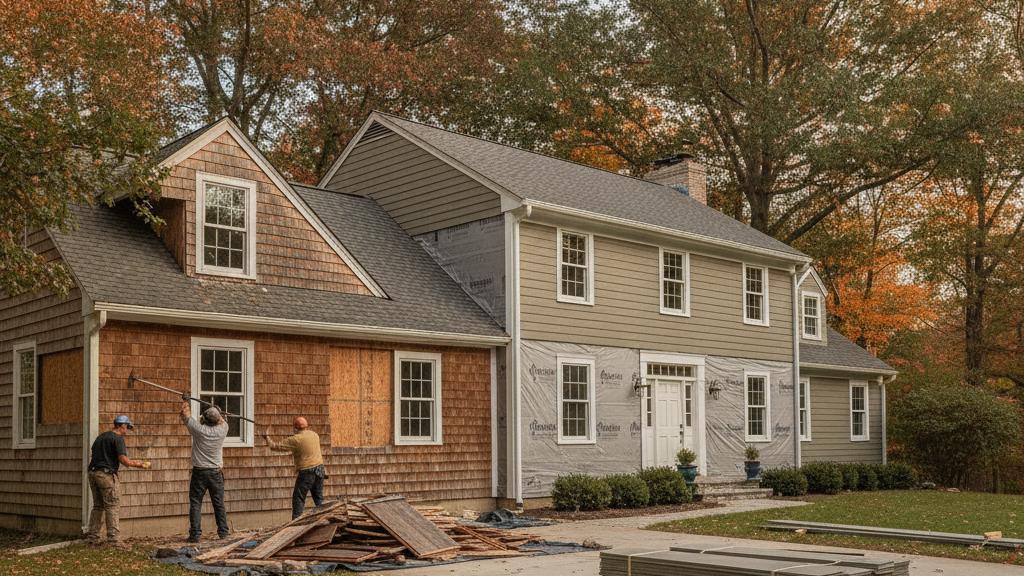
You can technically install new siding over existing siding in some situations — but for most Westchester County homes, stripping to the sheathing is the better call. The reason comes down to moisture, weight, the condition of what’s underneath, and what your local building permit requires. Here’s what to expect and how to think through the decision.
The quick answer: “over-siding” is possible, but it usually costs you more in the long run
Re-siding directly over old material — sometimes called “over-siding” — can save a day or two of demolition labor. That savings evaporates if the underlying wall has any rot, water damage, or failing house wrap, because new siding will simply trap the problem and make it worse. For Westchester County’s older housing stock, the underneath is rarely pristine.
When over-siding might be acceptable
There are situations where installing over existing siding is genuinely reasonable:
- One existing layer only. Requirements vary by municipality — confirm the specifics with your local building department or historic-district commission.
- The existing siding is flat and firmly attached. Warped, buckled, or loosely nailed siding will telegraph unevenness through the new material and may prevent proper fastening.
- No signs of moisture intrusion or rot. A thorough probe-and-tap inspection of the wall sheathing behind the existing siding is required before committing. If any spots are soft, the wall needs to be opened regardless.
- The product you’re installing allows it. This is a hard limit for James Hardie fiber cement. Per the James Hardie HardieZone 5 Best Practices Installation Guide, HardiePlank and HardieShingle products must be installed over a structurally sound, flat substrate with a compliant water-resistive barrier (WRB) — Hardie requires the WRB to be intact and correctly lapped. Installing over old siding that lacks or compromises the WRB does not meet Hardie’s installation requirements and can void the product warranty.
Why Westchester County homes often need a full strip
Westchester’s housing stock is unusually diverse, which means the “what’s under there” question carries more variance than in a newer suburb:
Hudson River corridor Victorians and early-20th-century homes (Tarrytown, Dobbs Ferry, Hastings-on-Hudson, Irvington). Many of these homes have original wood clapboard — sometimes under one or two later layers of aluminum or vinyl siding added in the 1960s–80s. Multiple layers are common, and original wood that’s been sealed under aluminum for decades can be deteriorated. A contractor who doesn’t pull the outer layers is flying blind.
Mid-century Cape Cods and Colonials with original aluminum or asbestos-cement siding. Homes built from roughly the 1940s through the 1970s in the inland Westchester suburbs frequently have either aluminum siding or, on older examples, asbestos-cement panels. Asbestos-cement siding is not dangerous when intact, but if it’s deteriorating or if your project requires cutting, drilling, or disturbing it, requirements vary by municipality; confirm with your local building department or historic-district commission. This is a separate professional-handling question from the siding installation itself — if a home inspector or contractor suspects asbestos-cement panels, the material should be tested and handled per applicable requirements before any re-side work begins.
The WRB question. Per IBC 2021 §1403.2, all exterior cladding systems require a continuous water-resistive barrier behind the siding. Homes built before the mid-1990s often have degraded or absent house wrap. When you strip to the sheathing, you can install a proper WRB — typically a self-adhered product or a good-quality housewrap. When you over-side, you can’t get to the WRB at all. Every Gunner siding project includes full WRB installation and correct flashing at all penetrations and roof-to-wall junctions.
The weight issue
Adding a second or third layer of siding increases the load on the wall framing, the fasteners holding the original siding, and ultimately the structure. Fiber cement is denser than vinyl or aluminum — James Hardie fiber cement siding is heavier per square foot than vinyl, and installing it over existing aluminum or vinyl pushes additional dead load onto whatever is below. For a newer home this is rarely a structural concern, but for older Westchester homes with aging balloon-frame construction, it’s a variable worth discussing with the contractor.
Material-by-material: what over-siding looks like in practice
| New material | Over-siding possible? | Key limitation |
|---|---|---|
| Vinyl siding | Sometimes | Requires flat, firmly attached substrate; adds minimal weight |
| James Hardie fiber cement | Generally not recommended | Hardie’s HZ5 installation guide requires a compliant WRB and proper fastening into studs or solid sheathing; over-siding typically prevents this |
| Cedar | No | Cedar requires direct fastening into framing with correct spacing; gaps from old siding create hidden moisture pockets |
| AZEK/PVC trim boards | N/A (trim, not cladding) | Used as trim over any substrate; not a re-siding scenario |
What happens with permitting
In New York State, siding replacement generally requires a building permit. Per New York State Executive Law §381 (NYS Dept. of State Legal Memorandum LG03), local governments administer the Uniform Code within their boundaries — so the authority is your municipality (village or town). Requirements vary: some municipalities may accept over-siding on a re-side permit; others require a full strip if an inspection reveals multiple existing layers. Gunner handles the building permit — pulling and managing the permit application — on every project, which means this question gets answered before work starts, not after.
The rot-risk math for fall in Westchester
September and October in Westchester County bring the first serious Nor’easters and increased rainfall before the ground freezes. If there’s any existing moisture damage behind your current siding, the fall shoulder season — when temperatures swing between warm and cold and rain is frequent — accelerates rot in wood framing and sheathing. Discovering that damage after new siding is already installed is expensive. Stripping before re-siding, especially in fall when the damage is most likely to be active, is the lower long-term risk.
What to expect from a proper Westchester re-siding job
When Gunner re-sides a Westchester County home, the standard process is:
- Strip to the sheathing. Remove all existing siding layers.
- Inspect the sheathing. Probe for rot, moisture damage, and fastener failure. Replace any compromised sections.
- Install the WRB. Self-adhered or housewrap product, lapped and taped per IBC 1403.2 and the James Hardie HZ5 installation guide.
- Flash all penetrations. Every window, door, corner, and roof-to-wall junction gets proper flashing before siding panels go on.
- Install the siding. For James Hardie products, fastener type and corrosion resistance, ground clearances, and field-cut priming follow the HZ5 guide specs.
- Pull the permit. Required in every Westchester municipality; Gunner manages the application.
FAQ
Ready to get an honest assessment of your Westchester County home’s siding? Gunner Roofing offers a free, no-obligation estimate — including an on-site review of what’s underneath. Request yours at GunnerRoofing.com.
Get a fast, free quote
No inspection visit needed - we measure your roof from satellite imagery and send your quote.