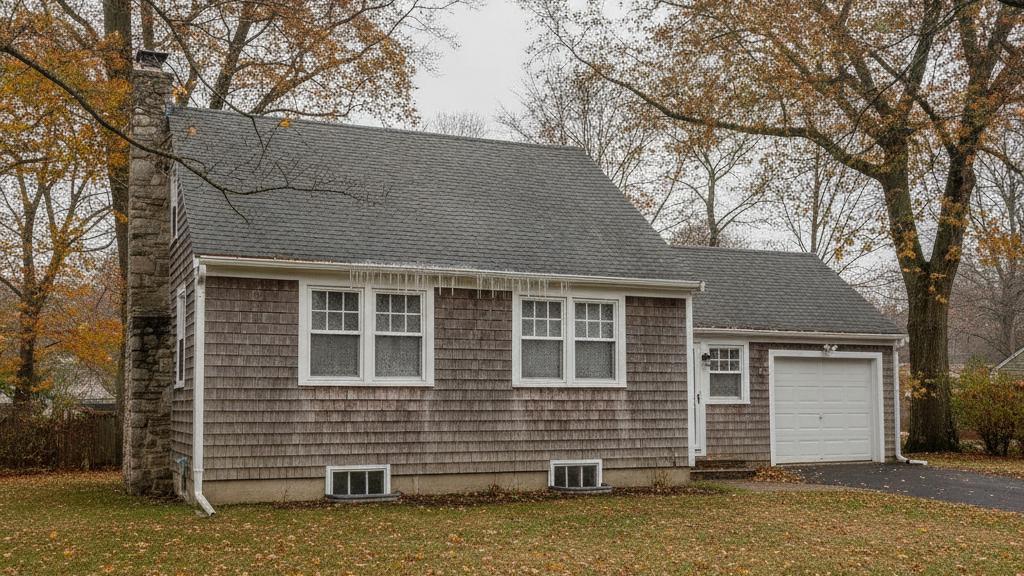
Drafty or poorly insulated windows in Greenburgh, NY can contribute to ice dam formation, but they are rarely the primary cause. The bigger driver is a warm attic — heated air escaping through the ceiling, not through window frames. That said, old single-pane or failed double-pane windows lose heat fast, and in Greenburgh’s common stock of mid-century Cape Cods and split-levels, the gap between a window frame and a shallow attic is a short path. If you have both ice dams and drafty windows, fixing the windows alone will not solve the ice dam problem — but it will cut your heating bills and may reduce one contributing heat source.
How Ice Dams Actually Form
An ice dam needs three things to happen at the same time (per InterNACHI): the upper portion of the roof surface must be above 32°F, the eave must be at or below 32°F, and there must be snow on the roof. Heat rising from inside the house warms the roof deck, melts the snow, and the meltwater runs down toward the cold eave overhang — which is not heated from below — and refreezes. The resulting ice ridge traps more water behind it, which then backs up under shingles and into the structure.
The heat source for that upper-roof warm zone is almost always the attic. Warm indoor air leaks through ceiling penetrations — recessed lights, attic hatches, plumbing chases — and directly heats the underside of the roof deck. Inadequate attic insulation lets conducted heat add to that. Window frames sit below the roof deck and their heat loss goes outward through the walls, not upward through the ceiling. So while a leaky window wastes heat, it is not physically positioned to warm the roof the way a leaky ceiling does.
Where Windows Enter the Picture
There are two scenarios where windows become genuinely relevant to ice dam risk:
1. Dormers with windows directly below the roofline. Many Greenburgh homes — particularly the Cape Cod and 1½-story Colonial styles built in the Edgemont and Hartsdale neighborhoods in the late 1940s through 1960s — have dormers where the window header sits only inches below the roof deck. In a dormer like this, a window frame that is poorly insulated or has a failed seal allows warm room air to migrate into the dormer framing cavity, which is adjacent to the roof deck. That can create a localized warm spot that contributes to melting on that section of the roof.
2. Skylights. A poorly flashed or poorly insulated skylight sits directly in the roof plane. If the curb is cold-bridging or the frame has a thermal break failure, that cold surface can accelerate ice buildup around the frame. This is a skylight installation issue, not a standard wall window issue.
For standard wall windows — even very drafty ones — the heat loss goes into the wall cavity and then out through the cladding, not up into the attic. Those windows waste energy but do not meaningfully change the thermal dynamics at your eave.
The Real Fix for Ice Dams
The durable solution is an attic that stays cold — close to outside temperature — because it is properly isolated from the conditioned living space. That means:
- Air sealing at the ceiling plane — closing off every penetration (top plates, recessed cans, hatch perimeters, duct chases) so conditioned air cannot leak into the attic.
- Adequate insulation — the 2020 NYS Energy Code (Table R402.1.2) sets prescriptive requirements for Climate Zone 4, which covers Westchester County. Confirm your attic assembly meets code minimums; older homes in Greenburgh often fall short by today’s standards.
- Balanced ventilation — soffit-to-ridge airflow flushes out any residual heat and equalizes the roof deck temperature front-to-back.
Gunner Roofing addresses all three layers — air sealing, insulation, and ventilation — on every roof replacement, performing the work directly rather than handing it off.
What to Do About Your Windows
If your windows are single-pane, have visible air gaps at the frame, or show frost on the interior surface during cold mornings, replacement is worth evaluating on its own merits — comfort, heating costs, and noise — even if it does not eliminate your ice dam.
U-factor is the number to watch. The U-factor measures how quickly a window assembly loses heat; a lower number is better (per NFRC, the scale runs roughly 0.20–1.20). The 2020 NYS Energy Code prescriptive path sets a maximum fenestration U-factor of 0.32 for Climate Zone 4 (Westchester County). ENERGY STAR’s Northern zone qualification, which applies to NY/CT, is tighter: U-factor ≤ 0.22 as of the v7.0 specification effective October 23, 2023.
A typical single-pane window has a U-factor above 1.0 — well outside both thresholds. A well-specified triple-pane or low-E double-pane unit can reach the ENERGY STAR Northern zone standard.
| Window type | Approximate U-factor | Meets 2020 NYS Code (CZ4 ≤ 0.32)? | Meets ENERGY STAR Northern (≤ 0.22)? |
|---|---|---|---|
| Single-pane (older) | 1.0+ | No | No |
| Basic double-pane (no low-E) | varies; check NFRC label | No | No |
| Double-pane, low-E glass | varies; check NFRC label | Often yes | Depends on frame/gas |
| Double-pane, low-E + argon, quality frame | varies; check NFRC label | Yes | Borderline / yes |
| Triple-pane, low-E + argon | 0.18–0.22 | Yes | Yes |
U-factor ranges are illustrative; actual values depend on glass package, gas fill, and frame material. Confirm the NFRC label on the specific unit.
Gunner installs Andersen windows — the 400 Series (wood interior, Perma-Shield vinyl-clad exterior) and the A-Series (Fibrex composite frame for period openings). Configurations in both lines are available that meet the ENERGY STAR Northern zone U-factor threshold; Gunner is an Andersen Certified Elite contractor.
Permits in Greenburgh
Window replacement in the unincorporated area of the Town of Greenburgh requires a building permit, administered by the Town of Greenburgh Building Department. If your home is in one of the incorporated villages within the Town of Greenburgh (such as Dobbs Ferry, Ardsley, Elmsford, Hastings-on-Hudson, Irvington, Tarrytown, or Sleepy Hollow), that village maintains its own building program and issues its own permits. Gunner handles the permit application on every project.
FAQ
Can my drafty windows really be causing my ice dams?
Unlikely on their own. Ice dams are driven by heat escaping into the attic through the ceiling — not through wall windows. Unless you have dormer windows or skylights directly adjacent to the roof deck, standard window air leakage is not the primary cause. Fix the attic air sealing and insulation first.
What U-factor should I look for in a replacement window in Greenburgh, NY?
The 2020 NYS Energy Code prescriptive path requires U-factor ≤ 0.32 for Climate Zone 4 (Westchester County). To meet ENERGY STAR Northern zone qualification (the more stringent target), you need U-factor ≤ 0.22. Most quality double-pane low-E windows with an insulating frame will clear the code minimum; reaching the ENERGY STAR Northern threshold often requires a well-specified low-E plus argon assembly.
Will new windows eliminate my ice dams?
No — not unless windows are part of a larger air-sealing effort that also addresses the ceiling plane. New windows reduce heat loss through the wall but do not change how much heat leaks into the attic, which is what drives ice dam formation. Address both together for the best result.
Do I need a permit to replace windows in Greenburgh?
For the unincorporated town, yes — the Town of Greenburgh Building Department handles permitting. If you are in an incorporated village within the town, your village has its own permitting program. Confirm which jurisdiction covers your address; Gunner pulls the permit on every job.
What windows does Gunner recommend for cold Westchester winters?
Gunner installs Andersen 400 Series and A-Series windows. Configurations in both lines can meet the ENERGY STAR Northern zone U-factor threshold of ≤ 0.22, which is tighter than the NYS code minimum and appropriate for Westchester’s Climate Zone 4 winters. Gunner is an Andersen Certified Elite contractor.
Ready to replace your windows before winter locks in? Get a free, no-obligation estimate at GunnerRoofing.com.
Get a fast, free quote
No inspection visit needed - we measure your roof from satellite imagery and send your quote.