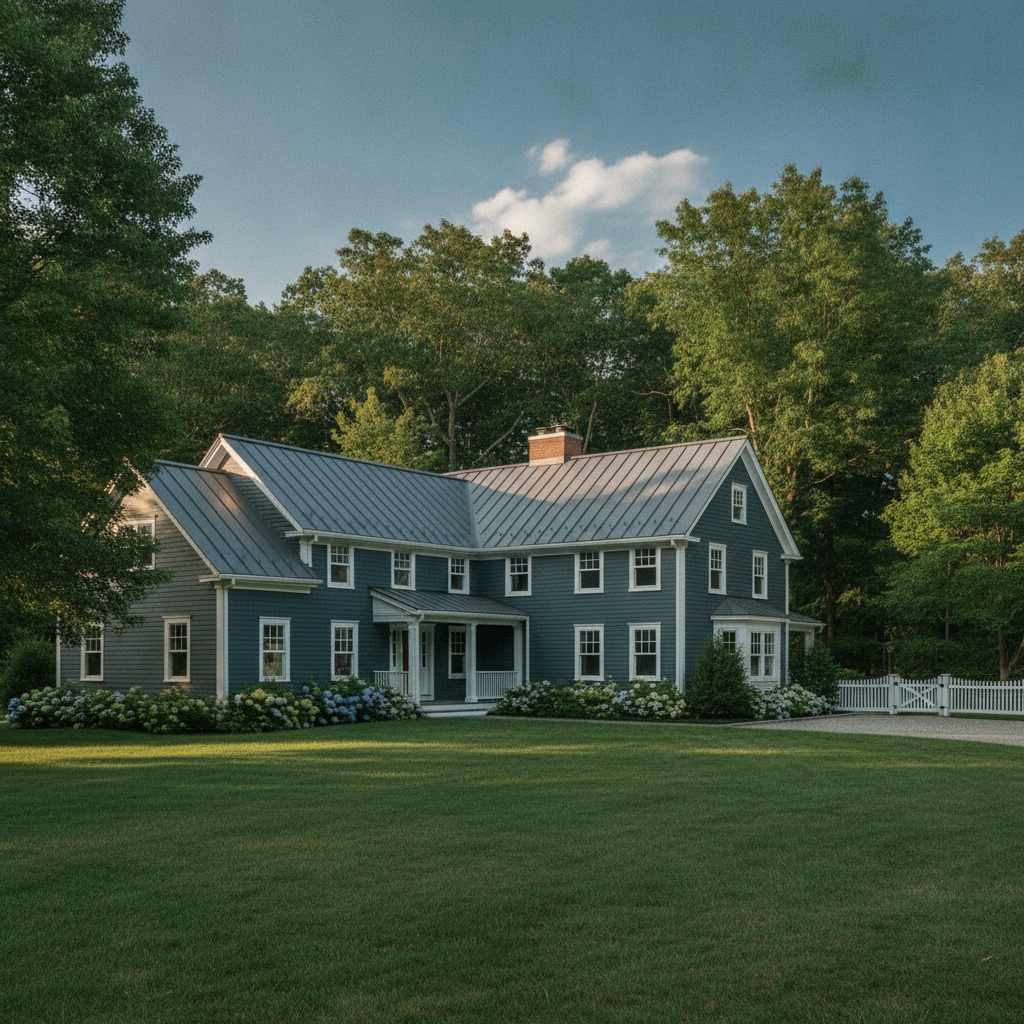
Metal roofs do interact with radio-frequency (RF) signals — including the cellular bands your phone uses — but for the vast majority of homeowners in New York and Connecticut, that interaction has no noticeable effect on day-to-day cell reception and service. Here’s why, and what to do if you’re one of the rare exceptions.
How RF and Cellular Signals Travel Into a Home
Your phone communicates with cell towers by sending and receiving radio waves. Those waves travel through the air and, once they reach your home, enter primarily through windows and doors — the largest, most RF-transparent openings in any building envelope. The roof is one of the more signal-opaque surfaces in the structure, but it is far from the only entry point, and in a typical house with multiple windows on multiple walls it is rarely the limiting factor.
Understanding this is the key to sizing the metal-roof question correctly: even if a metal roof reflects some cellular signal, your phone is still pulling signal through every window and door on the ground floor and upper floors. The roof’s effect, if any, is a marginal reduction in signal that enters from directly above — not a blockade of all incoming cellular service.
What Metal Roofing Actually Does to Cell Signal
Metal is more reflective of RF energy than asphalt shingles, wood shakes, or slate. A metal roof — whether standing seam, metal panel, or a metal tile profile — can reflect and modestly attenuate some portion of the cellular signal that would otherwise pass through the roof plane.
A few nuances matter here:
- Frequency matters. Lower cellular frequencies (700 MHz–900 MHz, used by older LTE bands) penetrate building materials more easily than higher frequencies (millimeter-wave 5G above 24 GHz). Many cellular bands fall in the mid-band range where building penetration can be meaningful regardless of roof type.
- The whole building envelope is involved. Your roof is one layer in a structure that also includes framing, insulation, interior cladding, and wall assemblies. Homes with modern spray foam insulation or reflective foil-faced underlayment already have RF-attenuating materials throughout the building; a metal roof is an incremental addition to an already imperfect RF environment, not a dramatic step change.
- Metal thickness and coating type have modest effects. A thin-gauge Galvalume steel panel and a thicker copper panel behave somewhat differently, but the variation is small relative to the dominant variable: how many cell towers are nearby and at what signal strength.
The honest bottom line: metal roofing can reduce the cellular signal coming through the roof plane. In most real-world installations in NY and CT, the effect is minor to imperceptible because signal enters from many other angles.
Why This Rarely Matters for Cell Reception in Westchester County and Fairfield County
Westchester County’s suburban density means towers are typically within a short distance in multiple directions from any given property; the same is true throughout Fairfield County. When your phone can see strong signal from multiple towers through your windows, a modest reduction in the signal trickling through the roof is unlikely to change your reception bar count — or your call and data quality.
The FCC’s broadband and coverage maps show robust LTE and growing 5G coverage across the primary NY and CT service area. In metropolitan and suburban areas with strong coverage, homeowners often don’t notice a signal difference after switching from asphalt shingles to metal.
That said, there are edge cases worth knowing about:
- Rural or fringe-coverage areas — parts of northern Westchester, the Litchfield Hills corridor, or Connecticut’s more rural towns where a single nearby tower provides the only strong signal. Here, any additional attenuation is worth planning for.
- Basements and interior rooms with no windows — in any home, these locations see weaker signal regardless of roof type.
- Very large homes with extensive metal roofs and dense insulation assemblies — cumulative RF attenuation across multiple reflective layers can add up.
Two Fixes That Fully Resolve Weak Indoor Cellular Signal
If you have (or expect to have) any cellular reception concern after a metal roof installation, two well-established solutions cover the situation completely — neither requires any change to your roof.
1. Wi-Fi Calling
Every major carrier — AT&T, T-Mobile, Verizon, and most MVNOs — supports Wi-Fi calling, which routes voice calls and text messages over your home’s broadband internet connection instead of the cellular network. When Wi-Fi calling is enabled (a setting on both iOS and Android), your phone seamlessly switches between cellular and Wi-Fi based on which is stronger. Inside the house with strong Wi-Fi, calls and texts travel over broadband; outdoors, they revert to the cellular network automatically. There is no additional equipment to buy and no service fee beyond your normal carrier plan. Per the FCC, Wi-Fi calling is available on most modern smartphones and is supported by virtually all U.S. carriers.
2. Cellular Signal Boosters
A cellular signal booster (also called a cell signal amplifier or repeater) is a compact, FCC-approved device that includes an outdoor antenna, an amplifier unit, and one or more indoor antennas. The outdoor antenna mounts on the roof or an exterior wall, picks up the cell signal before it enters the building, amplifies it, and rebroadcasts it indoors. The round-trip to the tower happens at full outdoor signal strength; the indoor coverage issue is solved regardless of what the roof is made of.
Residential boosters from brands like weBoost or SureCall are available at consumer electronics retailers; confirm that any device you purchase carries FCC certification. A reputable roofing contractor — or a licensed electrician — can route the external antenna cable cleanly through the roof or soffit at the time of installation.
Neither fix is complicated. Most homeowners who proactively install Wi-Fi calling never even think about the question again.
Metal Roofing and 5G: What to Expect
5G service is rolling out across Westchester and Fairfield counties on a mix of low-band, mid-band, and, in denser urban areas, millimeter-wave spectrum. Millimeter-wave 5G (above 24 GHz) has very limited building penetration regardless of roof type — it is essentially an outdoor technology for dense urban deployments. Sub-6 GHz 5G and LTE behave similarly to today’s 4G LTE with respect to building materials. A metal roof’s effect on 5G in the NY/CT suburbs is no different from its effect on today’s LTE: modest, and overwhelmed by the density of nearby tower coverage for most homes.
Standing Seam, Metal Panels, and Signal: Does the System Type Matter?
From an RF standpoint, standing seam and metal panel assemblies behave similarly: both are continuous metallic surfaces. The seam geometry and panel width do not meaningfully change the RF interaction compared to a flat metal sheet.
Other metal roof systems — stone-coated metal tiles, metal shakes, metal shingles — have smaller individual metal pieces with more gaps and underlayment showing between units. These may attenuate slightly less RF than a fully continuous standing seam surface, but the practical difference indoors is small.
The more meaningful variable is always the quality of local cellular coverage, not which metal roof profile you choose.
What About Other Building Materials?
For perspective, nearly all building materials interact with cellular signal to some degree:
| Material | Approximate RF Impact |
|---|---|
| Glass (clear, single-pane) | Low — signal passes through well |
| Asphalt shingles | Low — minimal attenuation |
| Wood framing + OSB | Low-moderate |
| Brick, concrete, stucco | Moderate to high |
| Low-E glass (coated) | Moderate — metallic coating reflects RF |
| Metal siding or metal panels | High |
| Metal roof (standing seam) | High (on the roof plane only) |
Sources for relative RF penetration characteristics: FCC consumer guidance on how radio waves travel; general RF propagation literature.
Metal roofs are on the higher end of this list — but so is brick, which is the dominant exterior cladding on a large share of older homes in Westchester County. Homeowners in brick Colonials and Tudor-style homes have been living with comparable RF attenuation for decades, usually without issue.
Gunner Roofing: Metal Roofing Expertise Across NY and CT
Gunner Roofing is a GAF Master Elite® 3-Star President’s Club contractor — a designation held by fewer than 3% of roofing contractors nationally (per GAF). Our crews install standing seam metal roofing and metal panel systems with the same systematic approach we bring to every roof: ice-and-water shield to code, proper step and counter-flashing at all penetrations, and correctly specified attic ventilation. Metal roofing is a long-term investment; getting the flashing, ventilation, and substrate right from day one is what makes it perform for decades.
We’re fully licensed, insured, and bonded in New York and Connecticut, and we handle permit pulling on every project.
Frequently Asked Questions
Q: Does a metal roof block cell phone reception?
A: A metal roof can reflect and modestly reduce the cellular signal that would enter through the roof plane, but it does not block cell service. Most signal enters a home through windows and doors. In densely covered areas like Westchester County, NY and Fairfield County, CT, the practical impact on call quality and data speed is typically minimal to undetectable.
Q: Will I lose cell service with a metal roof?
A: Very unlikely in the NY and CT metro area, where cellular tower density is high. If you’re in a fringe-coverage location — a rural or semi-rural area with limited tower proximity — a cellular signal booster or Wi-Fi calling can fully resolve any indoor signal concern at modest cost.
Q: Does the type of metal roof matter for cell signal?
A: Slightly, but not enough to drive a roof-type decision. Continuous standing seam and metal panel systems are the most reflective; metal tile profiles with gaps between units are marginally less so. The dominant variable is always outdoor signal strength, not the specific metal roof style.
Q: What’s the easiest fix if my metal roof causes weak cellular signal?
A: Enable Wi-Fi calling on your smartphone — it’s free, supported by all major carriers, and routes calls and texts over your home’s Wi-Fi when cellular signal is weak. If you need a dedicated solution, a cellular signal booster with an outdoor antenna is a one-time hardware purchase that solves the problem regardless of roof type.
Q: Does a metal roof affect 5G differently than 4G LTE?
A: For sub-6 GHz 5G and LTE bands (the most common in NY and CT suburbs), a metal roof’s effect is similar. Millimeter-wave 5G (used in very dense urban areas) has low building penetration by nature, regardless of roof type.
Q: Can Gunner Roofing install a cell booster antenna at the same time as a metal roof?
A: We can coordinate routing for a booster’s external antenna cable through the roof assembly or soffit during installation. Reach out during the project-scoping phase so we can plan the penetration with the same waterproofing detail we apply to any other roof penetration.
Get a fast, free quote
No inspection visit needed - we measure your roof from satellite imagery and send your quote.