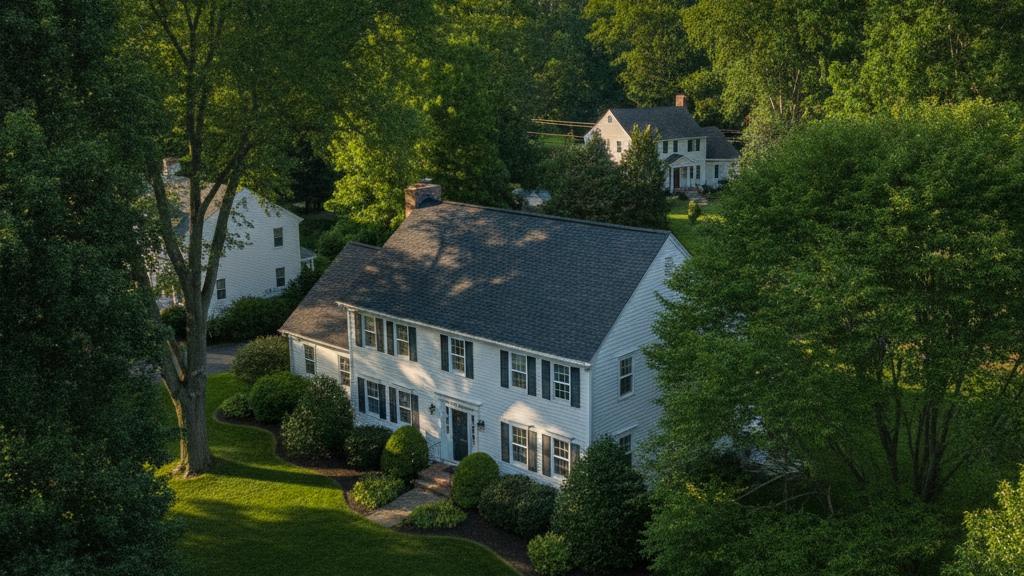
A new roof often improves how your homeowners insurer evaluates your home — but the effect on your premium depends on your carrier, the roof material, and whether your existing policy settles claims on replacement-cost value (RCV) versus actual cash value (ACV). There is no universal discount percentage, and no insurer is required to reduce your premium. What a new roof reliably does is remove the penalty of an aging one and, with the right shingles, may unlock material-specific credits at carriers that recognize them.
Why Roof Age Matters to Insurers
Homeowners insurance covers sudden, accidental loss — but insurers price risk based on how likely a claim is and how much it will cost to settle one. An old roof raises both numbers.
In the Northeast, roofs absorb real punishment: summer thunderstorms and hail, August tropical remnants, Nor’easters in the shoulder seasons, and freeze-thaw cycles that accelerate wear. Regional carriers — many of whom write heavily in Westchester County and Fairfield County — have years of claims data showing that an aging roof is a claims risk, not just a cosmetic one.
Practically, this creates two situations where a new roof changes your insurance picture:
-
You’re buying a home (or already own one) with an older roof. Many carriers in NY and CT now require proof of roof condition — and some will refuse to write or renew a policy on a roof past a certain age. A new roof clears that underwriting hurdle entirely.
-
Your policy settles on actual cash value instead of replacement cost. An ACV settlement depreciates the roof’s value based on its age at the time of a claim. A 20-year-old roof might pay out only a fraction of what a new roof costs. Replacing the roof — and confirming your policy is on RCV terms — can dramatically change what you’d actually receive after a major storm.
RCV vs. ACV: The Coverage Mechanism That Actually Moves Money
Most homeowners don’t know whether their policy is RCV or ACV until they file a claim. The distinction matters more than almost any premium discount.
| Settlement Type | What It Pays | Implication for an Older Roof |
|---|---|---|
| Replacement Cost Value (RCV) | Cost to replace the roof with like materials today | Full replacement covered less your deductible |
| Actual Cash Value (ACV) | Depreciated value — replacement cost minus age/wear | Payout shrinks as the roof ages; large out-of-pocket gap |
If your current policy is ACV, a storm that requires a full roof replacement could leave you with a settlement that covers only a portion of the actual cost. A new roof, combined with a policy review to confirm RCV coverage, is how you close that gap — availability and terms vary by insurer, so confirm with your carrier or a licensed agent.
Impact-Resistant Shingles: The Most Reliable Premium Credit Path
One path to a potential premium reduction in NY and CT is installing impact-resistant shingles. Some carriers offer a credit or surcharge reduction for these products — availability and amount vary by insurer and confirm with your carrier or a licensed agent before selecting a shingle on this basis.
For homeowners specifically interested in impact-resistance, Gunner also installs the full qualifying GAF system — LayerLock™ shingles with the required 4-nail pattern, GAF Starter Strip Shingles at eaves and rakes, qualifying Ridge Cap Shingles, and Roof Deck Protection — which supports both WindProven® warranty eligibility and, depending on the specific shingle specified, potential impact-resistance qualifications.
What drives the credit, where it exists: insurers see Class 4-rated shingles as reducing the probability and severity of hail and wind claims. In a region where hailstorms and tropical-remnant wind events happen most summers, that actuarial logic is straightforward.
What Carriers in NY and CT Actually Evaluate
Insurance underwriters reviewing a property in New York or Connecticut typically look at:
- Roof age. The older the roof, the higher the risk tier. Specific age thresholds vary by carrier and are not set by state law.
- Roof material. Asphalt shingles, metal, and synthetic materials are evaluated differently. Some materials carry favorable fire and impact ratings.
- Installation quality. A roof replaced to code — with proper underlayment, flashing at all penetrations, and documented permit completion — is more defensible in a claim than an improperly installed one. Gunner handles the building permit on every project, which provides a documented record that the work was inspected and code-compliant.
- Claims history. A home with multiple prior roof claims may see rate effects regardless of whether a new roof is installed.
The Summer Timing Window
August in NY and CT is mid-hurricane-season prep territory. Any roof with visible wear, granule loss, or compromised flashing is carrying risk through the remainder of the Atlantic hurricane season and into fall Nor’easter season. Replacing it now — before a storm event forces the issue — means you control the material choice, the contractor, and the timeline. An emergency replacement after a storm often happens under supply pressure and with less choice.
If your insurer or mortgage servicer has flagged roof condition, a summer replacement also clears that flag before a fall renewal. Many carriers in this region send inspection notices or non-renewal warnings based on aerial imagery; a documented replacement with a completed permit closes that issue cleanly.
What a New Roof Cannot Guarantee
Being direct about what a new roof does not do:
- It does not guarantee a lower premium. Insurance rates reflect many factors — your carrier’s rate filings with the NY or CT Insurance Department, your claims history, local loss trends, your deductible election, and more.
- It does not override policy type. An ACV policy with a new roof still settles on a depreciated basis until you change the policy terms.
- Specific discount amounts for impact-resistant shingles, if any, are not standardized and vary by carrier. Confirm with your insurer or a licensed agent — this is educational context, not financial or insurance advice.
- A new roof alone does not change your coverage limits, deductible, or the exclusions in your policy.
How to Have the Conversation With Your Insurer
Once a new roof is installed:
- Send documentation. Your carrier will want the permit completion record, the contractor’s invoice noting the material and installation date, and ideally the product spec sheet for the shingles installed.
- Ask specifically about impact-resistant credits. Not every agent proactively applies them; ask whether the installed shingle qualifies and what the credit, if any, is.
- Request a policy review. Confirm whether you’re on RCV or ACV terms and review your coverage limits — a new roof is a natural moment to make sure your total dwelling coverage reflects current replacement costs.
- Document everything in writing. A conversation with an agent is not a policy change; get any adjustment confirmed on your declarations page.
What Gunner Installs
Gunner is a GAF Master Elite® contractor — fewer than 3% of roofing contractors nationally reach that designation per GAF — and also a DaVinci Roofscapes Masterpiece Contractor and Brava Roof Tile Preferred Contractor. Gunner is fully licensed, insured, and bonded in New York and Connecticut. On every replacement, we pull and manage the building permit, install ice-and-water shield to meet or exceed code minimums, run leak barrier through all valleys, and complete step and counter-flashing at all penetrations. GAF Golden Pledge® and Silver Pledge™ enhanced warranties are available as upgrade options for qualifying GAF roof systems.
If you’re evaluating a new roof in Westchester County or Fairfield County — whether for insurance reasons, condition concerns, or storm prep — a free, no-obligation estimate is available at GunnerRoofing.com.
Frequently Asked Questions
Does a new roof automatically lower my homeowners insurance premium? Not automatically. A new roof removes the risk penalty associated with an aging one and may qualify for material-specific credits at some carriers, but the actual premium effect depends on your insurer, your specific policy, and the shingle material installed. Confirm any expected change with your carrier before the project.
What type of shingle is most likely to qualify for an insurance discount? Availability and amount vary by insurer — verify with your carrier before selecting a shingle on this basis.
What’s the difference between RCV and ACV homeowners insurance for a roof? Replacement cost value (RCV) coverage pays to replace the roof with like materials at today’s cost. Actual cash value (ACV) coverage depreciates the roof based on age and condition, so a 20-year-old roof might settle at a fraction of the actual replacement cost. The choice matters most when you file a major claim.
Will a new roof help if my insurer sent a non-renewal notice due to roof condition? In most cases, yes. Carriers that flag roof condition for non-renewal typically require documented proof of replacement with a permit and contractor invoice. Contact your agent immediately — there are usually specific deadlines to submit documentation before the non-renewal takes effect.
Does Gunner pull the permits on roof replacements in NY and CT? Yes. Gunner handles the building permit — pulling and managing the application — on every project in New York and Connecticut. The completed permit record provides documented evidence of code-compliant installation, which supports insurance documentation and future sale disclosure.
How does my roof’s condition affect a future home sale? Buyers and their home inspectors examine roof age and condition carefully, and lenders underwriting a purchase mortgage may require a satisfactory roof inspection. A new roof with a completed permit is a straightforward item to disclose; an aging roof can complicate a sale timeline or become a negotiating point.
Get a fast, free quote
No inspection visit needed - we measure your roof from satellite imagery and send your quote.