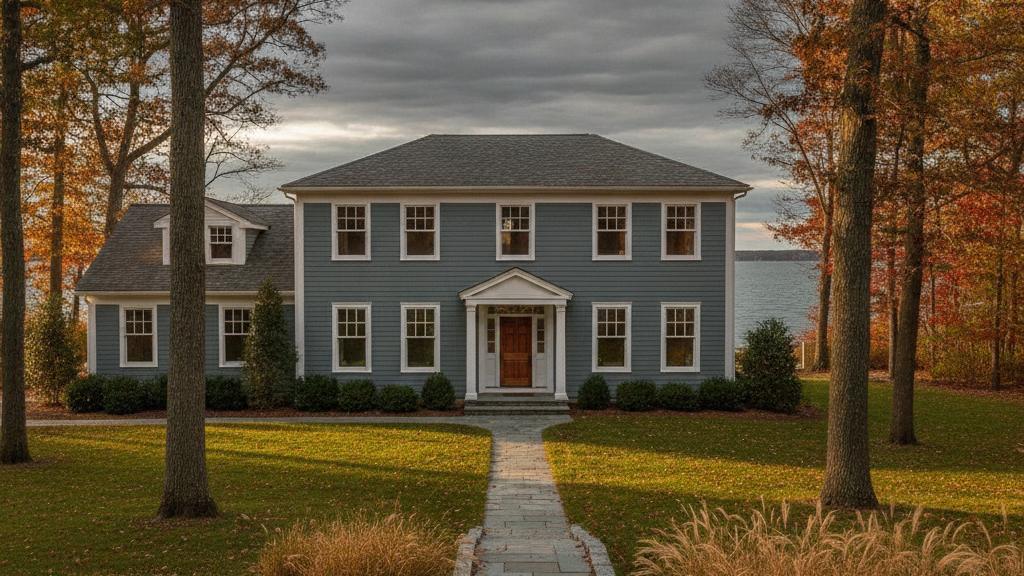
Fiber cement siding holds up well against salt-air exposure when it is installed correctly with verified clearances, a continuous water-resistive barrier (WRB), and proper flashing at every penetration. For eastern Westchester homeowners in Sound Shore communities — Rye, Mamaroneck, Larchmont, Port Chester — the coastal environment does raise real questions about material durability. The good news: James Hardie’s HZ5 fiber-cement line is specifically engineered for the Northeast’s cold, wet, salt-influenced climate, and unlike wood or steel-core products, it does not corrode, rot, or swell in response to marine air.
The important caveat is that installation quality matters as much as the material itself. Salt air amplifies any weakness in the wall assembly — a missed flashing, insufficient ground clearance, or a compromised WRB — so the system has to be right.
Why Salt Air Is a Real Issue in Eastern Westchester
Westchester County is not a monolith climatically. Inland towns like White Plains, Armonk, or Chappaqua sit well away from tidal influence. But the Sound Shore corridor — Rye, Port Chester, Mamaroneck, Larchmont, and the Harrison waterfront — faces direct marine exposure from Long Island Sound. Salt particles carried in sea air are mildly corrosive and hygroscopic (moisture-attracting), which accelerates deterioration in materials that are inherently water-absorbent, have metal cores or substrates, or rely on paint adhesion to a smooth non-porous surface.
The practical effect for homeowners: wood siding rots faster, steel-reinforced products can rust at cut edges or fastener penetrations, and standard vinyl can chalk and fade more rapidly in a combination of UV exposure and salt deposition. Fiber cement behaves differently from all three.
What Makes Fiber Cement Salt-Resistant
Fiber cement — the material in James Hardie’s HardiePlank®, HardieShingle®, and HardiePanel® products — is a composite of Portland cement, sand, and cellulose fiber. Its salt resistance stems from what it is not: it contains no metallic core, no wood substrate exposed to moisture, and no layer that corrodes in contact with chlorides.
The HZ5 product line is engineered for climate zones 1–5, which includes the Northeast: seasonal temperature swings, freeze-thaw cycles, snow and ice loads, and the ambient moisture that characterizes coastal winters (per the James Hardie HZ5 Best-Practice Installation Guide v9.1, Dec 2019). The board’s composition maintains significantly greater dimensional stability than wood or vinyl under changing moisture conditions — meaning it won’t swell, buckle, or open joints the way wood does in damp salt air (per the HZ5 Best-Practice Guide, “General Product Information” section: “Under normal environmental conditions fiber cement has significantly greater dimensional stability than wood or vinyl-based exterior products”).
Fiber cement is also rated non-combustible per ASTM E136, and James Hardie lists it as fire-resistant — a secondary but meaningful benefit for any home near a marina or waterfront area where fire risk can be elevated.
The Comparison That Matters: Fiber Cement vs. Vinyl in a Salt Environment
| Factor | James Hardie Fiber Cement (HZ5) | Standard Vinyl Siding |
|---|---|---|
| Salt-air corrosion | Not susceptible (no metallic content) | Not susceptible (PVC is inert) |
| Moisture absorption | Low dimensional change; no rot | Low absorption; can warp in extreme heat |
| Impact resistance | High per IBHS testing | Lower; can crack in cold, impact-prone |
| Paint/finish longevity | ColorPlus® 15-yr warranty (peeling, cracking, chipping) | Color is integral but can chalk/fade |
| Freeze-thaw cycling | Engineered for HZ5 (Zones 1–5) cold/wet climates | Can become brittle at very low temps |
| Clearance requirements | 6 in. from grade; 2 in. from solid surfaces (per HZ5 Guide §4.28, 4.31) | Varies by product; thermal expansion gaps required |
| Product warranty | 30-year limited transferable (HZ5 product) | Varies widely by manufacturer |
Vinyl’s advantage is cost and zero-maintenance paint (color is molded in). Fiber cement’s advantage in a salt environment is structural integrity under impact, better paint adhesion longevity with ColorPlus Technology, and no risk of the stress-cracking that vinyl can develop in the temperature swings common to coastal Westchester winters.
Installation Is Where Salt-Air Durability Is Won or Lost
The HZ5 guide is explicit: failure to maintain specified clearances “may affect performance of the building system, violate building codes or James Hardie requirements, and may void any warranty on the products.” In a coastal environment, those clearances aren’t bureaucratic fine print — they’re the front line against moisture intrusion.
Key requirements from the HZ5 Best-Practice Guide:
- Siding to ground clearance: Minimum 6 in. from finished grade (Guide §4.28). This keeps the bottom course out of the splash zone — critical on Sound Shore properties where storm surge and driven rain can saturate near-grade areas.
- Siding to solid surfaces: Minimum 2 in. clearance where siding meets roofing, decking, steps, or driveways (Guide §4.31). Without this gap, water wicks up into the board end-grain.
- Siding to flashing: Maintain a ¼-in. clearance — no caulk between siding and horizontal flashing (Guide §4.29). Flashing must slope positively to drain; pooled water at flashing is the leading cause of premature failure in any siding material.
- Water-resistive barrier (WRB): Required behind all cladding per IBC 2021 §1403.2. Gunner installs a full WRB and correct flashing at all penetrations and roof-to-wall junctions on every siding project.
- Joint flashing: James Hardie recommends 6-in.-wide flashing behind butt joints overlapping the course below by 1 in. (Guide §”Joint Flashing” section). In a wind-driven rain environment like the Sound Shore, this is not optional — it is the last line of defense against water entry at horizontal joints.
Fasteners: Stainless steel fasteners are recommended when installing James Hardie products (per HZ5 Guide, “General Fastener Requirements”). In a salt-air environment this is especially important: galvanized fasteners can corrode at the head under sustained marine exposure, leaving rust staining and reduced holding strength over time.
ColorPlus Finish: The Paint-Adhesion Story
Bare factory-primed boards must be finish-painted within 180 days of installation (per the HZ5 Guide finishing section). In practice, most Westchester homeowners choose James Hardie’s ColorPlus® Technology — a factory-applied, kiln-baked finish that carries a 15-year limited warranty against peeling, cracking, and chipping (per jameshardie.com/warranty).
The finish advantage in a salt environment is real: field-applied paint on any substrate can be compromised by poor prep or bad painting conditions (humidity, temperature). ColorPlus is applied in a controlled factory environment and baked in. Touch-up after field cuts requires a ColorPlus edge coater; the HZ5 guide warns against allowing ColorPlus touch-up to freeze and specifies it must be applied when air and siding temperatures are above 40°F (4°C). With a typical Westchester installation in fall or early spring, this temperature threshold is worth confirming on the day of any touch-up work.
What to Expect for Service Life
InterNACHI’s Standard Estimated Life Expectancy Chart lists fiber cement siding with a generous service-life range under ideal conditions. In Westchester’s real-world climate — freeze-thaw cycling, coastal moisture, Nor’easters — a realistic service life for a properly installed James Hardie HZ5 assembly is long but meaningfully depends on maintenance: keeping the paint or ColorPlus finish intact, maintaining clearances (cutting back vegetation, keeping grade away from the base), and promptly caulking any joint that shows movement.
The 30-year limited transferable product warranty on HZ5 (per jameshardie.com/hardie-zone-system) is one of the strongest in the siding category and transfers to a new owner — a meaningful consideration for the high-turnover Westchester real estate market.
The Permit Requirement in New York
In New York, a building permit is required for siding replacements (per the NYS Uniform Fire Prevention and Building Code, NYS Dept. of State Legal Memorandum LG03). Requirements vary by municipality; each Westchester town or village administers its own building program (per Executive Law §381, as described in LG03). Gunner handles the building permit — pulling and managing the permit application — on every project.
If your home is in a local historic district or falls under architectural review, exterior material changes may require additional review before work can begin. Requirements vary by municipality; confirm with your local building department or historic-district commission.
FAQ
Ready to protect your Sound Shore home before another winter? Get a free, no-obligation estimate at GunnerRoofing.com.
Get a fast, free quote
No inspection visit needed - we measure your roof from satellite imagery and send your quote.