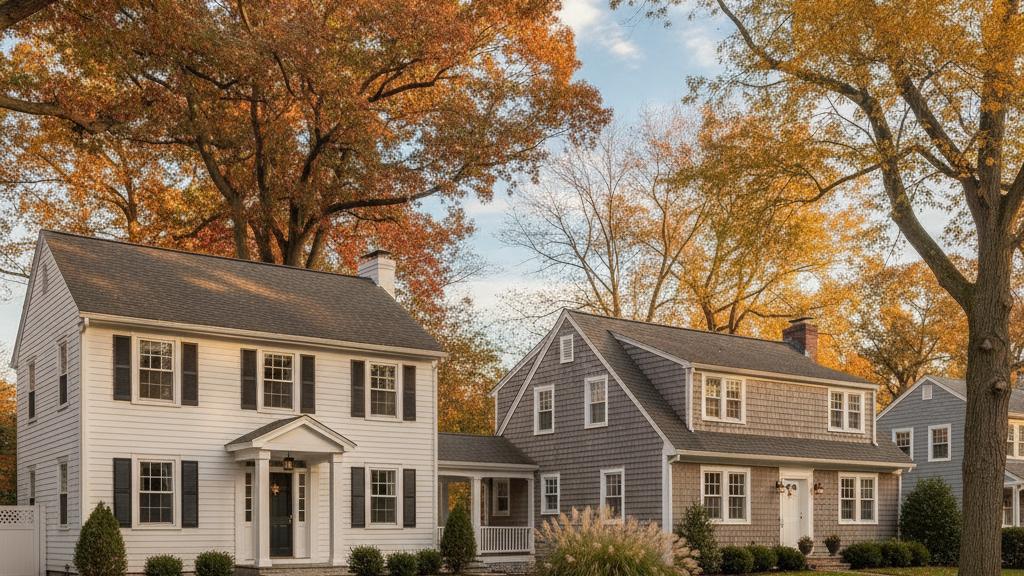
For most Westchester homeowners choosing James Hardie, the real decision isn’t fiber cement vs. vinyl — it’s which Hardie profile. HardiePlank® lap siding is the classic choice: clean horizontal lines that look natural on Colonials, four-square farmhouses, and the kind of center-hall home that fills neighborhoods from Scarsdale to Pelham. HardieShingle® mimics the staggered, hand-split cedar-shake look — the right call for Cape Cods, Craftsman bungalows, and accent gables where that texture is part of the architecture. Both are the same engineered fiber-cement substrate; the choice is entirely about visual profile, installation detail, and the specific look of your home.
Quick comparison
| HardiePlank® Lap | HardieShingle® | |
|---|---|---|
| Profile | Horizontal lap boards, smooth or woodgrain | Staggered shingle panels, cedar-texture |
| Best fit | Colonials, Georgians, farmhouses | Cape Cods, Craftsman, gable accents |
| Typical exposure | 6¼” or 8¼” (varies by product line) | Staggered 7″ per course |
| Substrate warranty | 30-year non-prorated (HZ5) | 30-year non-prorated (HZ5) |
| ColorPlus finish warranty | 15-year limited | 15-year limited |
| Relative install complexity | Straightforward lap sequence | More cuts at rakes, dormers, gables |
| Cost tier | Baseline Hardie | Modestly higher (more labor at cuts) |
Warranty terms per James Hardie HardieZone System (HZ5) and ColorPlus warranty documentation.
What is HardiePlank lap siding?
HardiePlank is James Hardie’s flagship product and the most commonly installed fiber-cement profile in the country. It comes in long horizontal boards — think of it as a direct replacement for traditional wood clapboard or painted-aluminum lap siding — and it installs in a standard overlapping sequence up the wall. The profile reads as clean and uniform from the street, which is exactly what Colonial architecture calls for.
In Westchester, HardiePlank makes up the large majority of Hardie installations. The county’s housing stock skews heavily toward pre-WWII Colonials and post-war split-levels — homes where the design vocabulary is horizontal lines, white or painted trim, and a symmetrical facade. HardiePlank’s smooth or light-woodgrain surface renders that vocabulary faithfully in a material that won’t rot, swell, or need repainting every several years the way original clapboard does.
The product is available with or without a factory-applied ColorPlus finish. The factory finish carries a 15-year limited warranty against peeling, cracking, and chipping (per James Hardie’s ColorPlus Technology Limited Finish Warranty). Primed-only boards can be site-painted to match any custom color — useful if you’re matching existing trim or complying with an HOA palette.
What is HardieShingle siding?
HardieShingle panels replicate the look of staggered cedar-shake shingles, which were the dominant exterior material on Cape Cod houses, Craftsman bungalows, and the cottage-style homes built throughout Westchester from the 1920s through the 1950s. The panels install in a staggered, offset pattern that creates the shadow lines and texture of individual wood shingles — without wood’s vulnerability to moisture, insect damage, and fire.
HardieShingle is particularly well-suited to two applications in Westchester:
- Full-coverage replacement on a Cape Cod or cottage where cedar shake or wood shingle siding was original. The profile is architecturally authentic.
- Accent gables and dormers on a Colonial. Many Westchester Colonials used cedar shake on the second-story gable ends or shed dormers as a traditional accent — HardieShingle replicates that detail cleanly in fiber cement when the original shake fails.
Because each panel mimics individual shingles, installation involves more cuts at rakes, dormers, and corners than a standard lap board run. That translates to more labor, which typically puts HardieShingle modestly above HardiePlank on cost for a full-house job.
Both profiles, same substrate — what that means for performance
The material science is identical between HardiePlank and HardieShingle. Both are:
- Rated non-combustible per ASTM E136, as documented by James Hardie’s fire resistance testing. That matters in areas with Westchester’s mix of wooded lots and close-set housing.
- Covered by the 30-year non-prorated substrate warranty under James Hardie’s HardieZone 5 system, provided the product is installed to HZ5 specifications. Westchester County falls within the HZ5 climate zone.
- Dimensionally stable compared to wood. Fiber cement does not expand and contract with humidity the way wood siding does, which is a real advantage through Westchester’s freeze-thaw cycling.
The HZ5 installation guide specifies requirements like minimum ground clearances and proper sealing at joints — details the installer must follow for the warranty to apply. Gunner installs both profiles to those specifications, and every siding project includes full water-resistive barrier installation and correct flashing at all penetrations and roof-to-wall junctions.
Matching profile to Westchester’s housing styles
Colonials and Georgians — HardiePlank, full stop. The horizontal lap profile reads historically correct and provides the clean, painted look these homes expect. A typical center-hall Colonial in Scarsdale or Bronxville will be replaced in HardiePlank with 6¼” or 8¼” exposure, matching the original clapboard rhythm.
Cape Cods — depends on what was there originally. If the cape had wood shingles on the body and smooth trim boards at the corners, HardieShingle on the body with HardieTrim® boards at corners and windows is the clean, accurate replacement. If it was all lap siding, HardiePlank works fine.
Craftsman bungalows — HardieShingle on the body and at the wide overhangs reads authentically. Craftsman detailing often included wide fascia and exposed rafter tails, which should be done in AZEK or primed Hardie trim to handle the same freeze-thaw exposure.
Split-levels and raised ranches — HardiePlank, with the option to use HardieShingle as a texture break between the upper and lower levels, which is a common Westchester update on 1950s–1960s stock.
Historic district homes — If your property is in a local historic district or subject to architectural review, confirm acceptable profiles before ordering. Requirements vary by municipality; confirm with your local historic-district or landmarks commission. Fiber cement generally accepts a wider range of review than vinyl, and both HardiePlank and HardieShingle have been used successfully on historic properties — but your commission’s specific guidance controls.
Fall timing: why this decision matters now
November in Westchester is still a viable installation window for James Hardie, provided the work is sequenced ahead of extended freezing temperatures. The HZ5 installation guide specifies temperature thresholds for caulk and paint adhesion. Gunner tracks weather forecasts and sequences siding projects to avoid open-wall exposure through rain events, which means a fall job needs to be properly scoped and started before conditions close the window.
If you’re going into winter with aging wood clapboard or failing aluminum siding, the seams and paint failures you see now will let in wind-driven rain and moisture through every Nor’easter from November through March. Getting fiber cement on before the freeze is a better outcome than another season of patching.
What Gunner installs
Gunner is a James Hardie Elite Contractor. We install both HardiePlank and HardieShingle to HZ5 specifications, and we handle the building permit on every project. Every siding job includes full water-resistive barrier installation and correct flashing at all penetrations — the complete assembly, not just the face material.
The Remodeling Magazine Cost vs. Value Report tracks fiber cement siding replacement as a strong value-recoup category in the Middle Atlantic region (Westchester is part of that benchmark); the exact percentage varies year to year and by project, so we don’t quote a specific figure here.
Want to know which profile makes sense for your home’s architecture? Get a free, no-obligation estimate at GunnerRoofing.com.
Frequently asked questions
Can I mix HardiePlank and HardieShingle on the same house?
Yes — and it’s common. The most frequent combination in Westchester is HardiePlank on the main body of a Colonial with HardieShingle on accent gable ends or shed dormer faces. Both are fiber-cement substrates from the same manufacturer and carry the same HZ5 warranty, so mixing them on one project is architecturally and technically clean.
Does HardieShingle cost more than HardiePlank?
Generally yes, modestly, on a full-house job. The substrate material cost is comparable, but HardieShingle requires more cuts at rakes, corners, and dormers, which adds labor hours. On a house where HardieShingle is used only as a gable accent, the additional cost is minor relative to the overall project.
Do both profiles qualify for the 30-year HardieZone warranty?
Yes, provided installation meets HZ5 specifications. Both HardiePlank and HardieShingle are covered by James Hardie’s 30-year non-prorated substrate warranty under the HardieZone 5 system when installed correctly. The ColorPlus factory finish carries a separate 15-year limited warranty on either profile.
Will the profile choice affect whether I need a building permit in Westchester?
The permit requirement depends on your municipality and the scope of the project, not the Hardie profile. In New York State, under Executive Law §381, each local government administers the Uniform Code within its boundaries. Requirements vary by municipality; confirm with your local building department. Gunner pulls and manages the permit on every job.
What if I’m in a historic district — can I use either profile?
Fiber cement is generally accepted in historic-district reviews more readily than vinyl, but whether HardiePlank or HardieShingle is appropriate depends on what was original to your home. Your local historic-district or landmarks commission controls; confirm before ordering.
Is fall a good time to re-side in Westchester?
Yes, early fall through mid-November is a viable window. James Hardie products install well in cool weather. The main constraint is caulk and paint-adhesion temperature thresholds specified in the HZ5 installation guide, plus avoiding open-wall exposure through forecast rain. Schedule promptly — once sustained freezing temperatures arrive, the window narrows.
Get a fast, free quote
No inspection visit needed - we measure your roof from satellite imagery and send your quote.