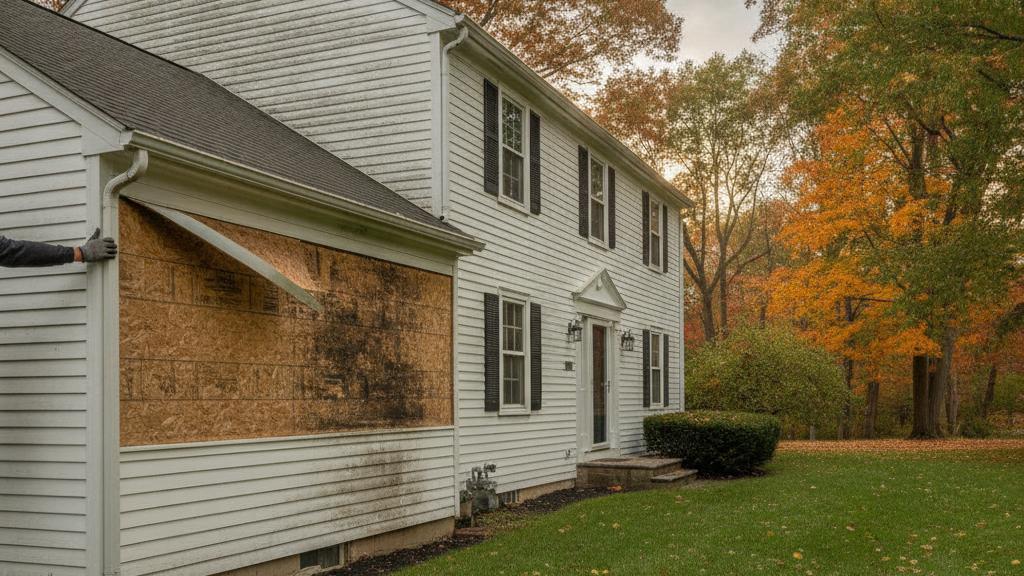
If your siding has bubbled paint, soft spots when you press on it, or a faint musty odor near an exterior wall, there’s a good chance water has been working behind the cladding. In Westchester County, that question becomes especially urgent in early fall — once the first hard freeze arrives, trapped moisture expands inside wall cavities, sheathing deteriorates faster, and a contained repair can become a gut-the-wall job. This post walks you through how to identify hidden moisture damage before winter, what to expect from a contractor’s inspection, and what full siding replacement typically costs in Westchester.
Why Westchester Homes Are Particularly Exposed
Much of Westchester’s housing stock consists of older homes — Tudors, Colonials, center-hall Capes, and early ranch-style construction spread throughout the county. That era predates modern water-resistive barrier (WRB) requirements. Per IBC 2021 §1403.2, exterior walls must include a weather-resistive barrier behind the cladding — a code standard most of these older homes were never built to, and that many renovation projects still fail to restore correctly when only the cladding is replaced.
Compound that with grade drainage: many of these homes sit on sloping lots where soil has gradually built up against the foundation, and landscaping has changed drainage flow over decades. When water cannot drain away from the base of the wall, it wicks upward into the bottom courses of siding, into rim-joist framing, and into the sheathing. You may not see it from the street.
Six Signs You May Have Moisture Damage Behind Your Siding
1. Bubbling, Peeling, or Alligatored Paint on the Siding Face
Paint failure that looks like it’s coming from behind the surface — not cracking from UV or chalking from age — usually means vapor pressure from moisture inside the wall is pushing outward. This is different from paint that simply oxidized; look for raised bubbles or sections where the paint or factory finish has lifted away from the substrate.
2. Soft or Spongy Wall Feel
Stand at arm’s length and press firmly on the lower half of any siding panel, especially within a few feet of grade, near window sills, or below flashing transitions. Rigid fiber cement or vinyl siding should feel solid. If a section gives slightly, or if you hear a dull thud instead of a solid sound, the sheathing behind it may be wet or partially rotted.
3. Warped, Bowed, or Buckling Panels
Vinyl siding expands and contracts with temperature, but mid-panel bowing that appears independent of obvious heat is often a moisture signal. For fiber cement, any warping is more serious — the material itself is dimensionally stable when properly installed per the James Hardie HZ5 Best Practices guide, so distortion usually means the substrate behind it has failed.
4. Water Stains or Discoloration at the Base of Walls
Look at interior drywall on first-floor exterior walls, particularly in finished basements and utility rooms. A horizontal waterline at roughly the height of the rim joist or the lowest siding course is a strong indicator that water is entering through the exterior assembly. You may also see this as efflorescence (white mineral deposits) on a CMU foundation wall immediately below a wood-framed wall.
5. Musty or Mildew Smell Near an Exterior Wall
Moisture inside a wall cavity feeds mold growth on framing lumber and sheathing long before any visible damage appears on the surface. If a room has a persistent damp or musty smell that you can’t attribute to plumbing or HVAC, walk the exterior at that wall carefully and probe any lower panels.
6. Failed or Missing Caulk at Penetrations and Trim Joints
Check every point where the siding terminates: window head and sill trim, door casings, electrical and HVAC penetrations, hose bibs, and roof-to-wall intersections. Cracked, missing, or incorrectly applied caulk is an open water entry point. This is easy to see and easy to miss because it often looks like “just maintenance” when it is actually an active leak path.
What a Siding Contractor Will Do in a Pre-Winter Inspection
A thorough contractor won’t just walk around the perimeter with a visual check. Expect:
- Probe testing: A moisture meter applied to accessible framing or sheathing through any gaps or at siding terminations. Readings above ambient levels in wood indicate active moisture, not historical wetting.
- Penetration review: Every location where something passes through the siding plane — pipe, wire, vent — checked for proper flashing and sealant condition.
- Flashing inspection at roof-to-wall junctions: Step flashing and counter-flashing that has lifted, corroded, or was never correctly integrated with the WRB will consistently feed moisture into the wall below.
- Grade and drainage observation: The contractor should note whether soil is in contact with siding or trim, and where downspout discharge is going relative to the foundation.
Gunner pulls the permit on every project, so if a full replacement is indicated, you won’t be managing the code process on your own.
How Much Does Siding Replacement Cost in Westchester County?
Cost varies by material, scope, and how much framing or sheathing needs to be replaced once the old siding is removed. The figures below are illustrative of market-level ranges; your actual project quote will depend on labor hours, material selection, and the condition of the wall assembly that’s uncovered.
| Material | Westchester Market Range (installed) | Ideal-Condition Lifespan | Real-World Westchester Estimate |
|---|---|---|---|
| James Hardie fiber cement | Higher end of market | Long manufacturer-rated lifespan | Varies by climate and installation conditions |
| CertainTeed vinyl | Mid-market | 20–40 years (rated, ideal) | 18–28 years typical (climate-adjusted) |
| Cedar | Super-premium | 20–40 years (rated, ideal) | 15–25 years typical in Westchester’s freeze-thaw cycle |
For cost-vs-value benchmarking, the Remodeling Magazine Cost vs. Value Report tracks national fiber cement siding replacement as a consistently strong mid-tier ROI project; Westchester figures are not broken out separately, so treat national data as directional context only.
Note on sheathing: If the inspection reveals damaged OSB or plank sheathing, that material must be replaced before new cladding goes on. Don’t accept a quote that skips sheathing repair to lower the number — it defeats the purpose of the project.
What Goes Back on the Wall: The WRB Layer Matters
Every Gunner siding project includes a full water-resistive barrier installation, correct flashing at all penetrations and roof-to-wall junctions, and verified ground clearances. This is the layer that failed in most moisture-damaged Westchester homes, and it’s the layer that protects the next 30-plus years of cladding.
Per IBC 2021 §1403.2, a water-resistive barrier behind the exterior cladding is a code requirement. Vapor-permeable means any incidental moisture that does get into the assembly can still dry outward, rather than being trapped.
For homes going with James Hardie fiber cement, the HZ5 Best Practices Installation Guide (the authoritative spec for our climate) sets specific requirements for clearances from grade, flashing integration at windows, and WRB continuity — Gunner installs to these specs as a James Hardie Elite Contractor.
Should You Repair or Replace?
Repair makes sense when damage is confined to one or two panels and the sheathing and framing behind them are confirmed dry and structurally sound. Replace a larger section or the full side of the house when:
- Moisture readings indicate widespread wet sheathing, not an isolated pocket.
- The existing siding has no WRB behind it (common in pre-1990 Westchester construction), meaning the whole system needs to be rebuilt correctly.
- Material age is near or past the real-world service-life estimate for its type — doing a targeted repair on aging vinyl or hardboard that will need full replacement in a few years is a poor investment.
- You have a roof-to-wall integration failure that requires resequencing the flashing before any cladding can go back.
A contractor who recommends full replacement when a repair would genuinely suffice is wasting your money. But a contractor who patches surface cladding without addressing the WRB and sheathing underneath is setting you up for the same conversation in three years.
Act Before the Ground Freezes
In Westchester, ground frost typically arrives in late November through December. Once wall cavities are frozen, moisture that got in during fall rains is locked in and will cycle through freeze-thaw stress over the winter. Scheduling an inspection now — before the first hard freeze — means you can address identified damage while temperatures are still in the contractor-favorable range for siding installation.
Get a free, no-obligation estimate at GunnerRoofing.com.
Get a fast, free quote
No inspection visit needed - we measure your roof from satellite imagery and send your quote.