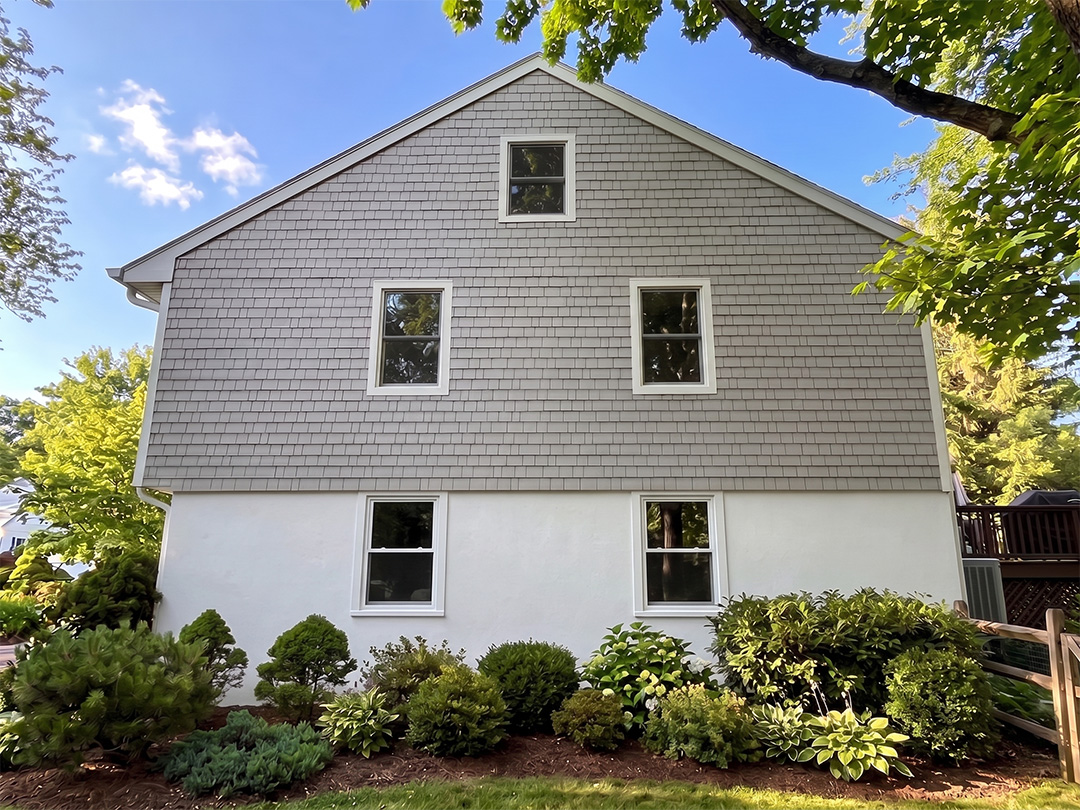
How siding protects Westchester County homes from the Northeast’s toughest weather
Siding is your home’s primary armor against the elements, and Westchester County’s climate puts every material to the test. The county runs from Long Island Sound’s coastal edge — persistent salt air and elevated humidity in Sound Shore towns like Rye, Mamaroneck, and Larchmont — to the harder inland winters of Yorktown and Somers, where freeze-thaw cycles are more severe and ice storms are a recurring event. A siding system that performs well here must handle subfreezing temperatures, Nor’easter winds, coastal humidity, summer UV, and freeze-thaw cycling that cracks or dislodges panels that aren’t properly installed.
The four weather threats Westchester siding must handle
1. Freeze-thaw cycling
Westchester County sees an estimated 100 or so freeze-thaw cycles in a typical year. Water infiltrates even small gaps in siding; when it freezes it expands, cracking caulk, splitting wood-grain surfaces, and lifting fasteners. James Hardie’s HardieZone 5 (HZ5) products are specifically engineered for “seasonal temperature variations, freezing temperatures and snow and ice” — the HZ5 guide’s exact description of this climate. Vinyl is immune to moisture absorption but grows more brittle in deep cold, which raises the risk of impact cracking — from a falling branch or hail — during hard winter freezes. Engineered wood handles freeze-thaw reasonably well when cut edges are field-primed and every seam is caulked; gaps in that execution are its primary failure mode here.
2. Wind and Nor’easters
Nor’easters can drive damaging sustained winds and strong gusts across the Northeast coast. Fastener type, spacing, and nailing pattern are the key variables. James Hardie’s HZ5 guide specifies nail placement and fastener schedules that comply with the International Residential Code (IRC). Vinyl siding’s continuous interlocking profile provides good wind resistance when installed correctly, but a single unlocked panel creates a starting point for progressive peel. The water-resistive barrier (WRB) — housewrap or vapor-permeable building paper behind the siding — is the secondary defense when wind-driven rain gets past the panels.
3. Ice dams and roof-to-wall runoff
Ice dams force meltwater behind shingles and into the wall assembly above the siding — primarily a roofing problem, but siding pays the price. The HZ5 guide calls for proper flashing at the roof/wall junction — step flashing at every shingle course and kickout flashing at the base of each roof run to divert water away from the wall. A 2-inch clearance between the siding edge and any solid surface — including roofing — prevents capillary wicking. Missing kickout flashing lets roof runoff into the wall, and the resulting rot often presents, from the outside, as siding failure.
4. Summer heat and UV degradation
Westchester summers bring sustained heat and high humidity. UV degrades paint and surface coatings; heat cycling drives expansion and contraction. Fiber cement with James Hardie’s factory-applied ColorPlus finish is backed by a 15-year limited finish warranty — the finish will not peel, crack, or chip within that term — separate from the 30-year non-prorated substrate warranty. Vinyl carries its color within the material and will not peel, but sustained heat fades lighter shades and softens the PVC enough that heavy impact can deform J-channels.
Clearances that keep water out: what the specs actually say
The James Hardie HZ5 guide sets these clearances as hard requirements — failure to meet them “may affect performance of the building system, violate building codes or James Hardie requirements, and may void any warranty on the products”:
| Location | Minimum clearance | Why it matters |
|---|---|---|
| Siding to finished grade (ground) | 6 inches | Prevents capillary wicking from soil moisture and splash-back |
| Siding to any solid surface (roof deck, steps, driveway) | 2 inches | Allows drainage and prevents moisture pooling against the panel edge |
| Siding to horizontal flashing | 1/4 inch (uncaulked) | Creates a drainage gap; flashing must slope for positive drainage |
| Siding to masonry / mortar | Flashing required | Direct contact allows moisture to wick from the masonry into the fiber cement |
| Trim under covered area (porch) | 1/4 inch | Even sheltered areas must allow for drainage |
These are manufacturer requirements from the James Hardie HZ5 guide; meeting them is what keeps the installation within warranty.
Water-resistive barrier: the critical layer behind the siding
No siding material is waterproof at every seam and penetration. The water-resistive barrier (WRB) — installed over the sheathing before the first panel — catches what gets through. The International Building Code requires it: IBC Section 1403.2 mandates a water-resistive barrier behind the exterior veneer, plus a means of draining water that enters the assembly back to the exterior.
The common failure point is penetrations — windows, doors, hose bibs, vents, electrical boxes. Every penetration needs flashing that laps over the WRB in correct shingle order (upper layer laps over lower) so water always routes outward. Penetrations are where wall-cavity moisture damage tends to begin.
How Westchester’s geography changes the calculation
Sound Shore towns (Rye, Mamaroneck, Larchmont, New Rochelle, Port Chester, Pelham) sit within a few miles of Long Island Sound. Salt air is a mild corrosive factor for metal fasteners and painted surfaces. Fiber cement and vinyl both handle it well. Use corrosion-resistant fasteners for any wood trim component at coastal locations.
Northern Westchester (Yorktown, Somers, Cortlandt, Peekskill) sees colder, drier winters with more pronounced freeze-thaw cycling and less moderating maritime influence. Fiber cement’s dimensional stability under wide temperature swings is its clearest advantage here.
Older housing stock. Much of Westchester’s housing stock is older — Colonials, Tudors, Capes, and bungalows, many with original clapboard or cedar-shingle siding at or past end of service life. Re-siding in Tarrytown, Sleepy Hollow, Irvington, and Dobbs Ferry often intersects with historic district requirements where material and profile must replicate the original. Fiber cement lap siding and HardieShingle panels are frequently accepted in these districts because they can be detailed to match original profiles — but approval varies by district, so confirm with the local historic preservation commission before ordering.
Ground clearance on older homes. James Hardie requires a 6-inch clearance between the siding and finished grade. On older homes where the foundation sits low relative to the surrounding grade, achieving that clearance can require regrading or other adjustment before installation.
Siding material comparison for Westchester weather
| Material | Freeze-thaw resistance | Wind/impact resistance | Moisture resistance | Typical Westchester lifespan |
|---|---|---|---|---|
| Fiber cement (HZ5) | Excellent — cement substrate does not absorb water | Excellent — stiff panels, IRC-compliant fastening | Excellent when primed and painted; cut edges must be sealed | 35–45 years |
| Vinyl | Good — waterproof; grows more brittle in deep cold | Good when continuous interlock is intact | Excellent — no moisture absorption | 25–35 years |
| Engineered wood (LP SmartSide) | Good when properly installed; cut edges and seams are the failure point | Good | Good — seams and cut edges must be field-primed and caulked | 20–25 years |
| Original cedar | Fair to poor — moisture absorption leads to splitting, rot over time | Fair | Poor without regular painting and treatment | 15–20 years (without ongoing maintenance) |
Lifespan figures are real-world Westchester County estimates. Ideal-condition published ranges from InterNACHI (fiber cement, vinyl, and cedar) run higher; the LP SmartSide figure is a real-world Northeast estimate (LP backs the product with a 5/50-year limited warranty; the InterNACHI chart does not list it by brand). Westchester’s freeze-thaw cycling, coastal humidity, and storm frequency bring actual service life lower for all materials. Warranty terms from manufacturers are quoted exactly as stated and are never shortened in these estimates.
Frequently asked questions
How many freeze-thaw cycles does Westchester County typically see per year?
An estimated 100 or so annually — days when temperatures cross 32°F. Higher in northern Westchester (Yorktown, Somers); lower along the Sound Shore, where the Long Island Sound moderates swings. Those cycles are among the biggest drivers of siding wear in the county.
What is the best siding for a Sound Shore home in Westchester?
Fiber cement and vinyl are both strong choices. Both resist salt-air corrosion of the panel itself. Fiber cement offers a longer typical lifespan (35–45 years); vinyl is lower cost and maintenance-free (25–35 years). Use corrosion-resistant fasteners for any wood trim component.
Does Westchester County require a permit for siding replacement?
Permit requirements for re-siding vary by municipality, so confirm with your local building department before starting a full re-siding. Some jurisdictions require an energy code review under New York’s 2020 ECCC. Gunner Roofing handles the permit application on every project.
What causes siding to fail early on older Westchester homes?
Missing kickout flashing at roof-to-wall junctions, inadequate siding-to-ground clearance, and unsealed cut edges on engineered wood or fiber cement. All three allow water into the wall assembly; freeze-thaw cycling then expands the infiltrated moisture until it forces the damage wider.
Is James Hardie fiber cement approved in Westchester historic districts?
It is frequently accepted, because fiber cement can be detailed to closely replicate original clapboard, wide-board, or shingle profiles. Approval varies by district — confirm with your town’s building department and historic preservation commission before ordering.
How does Gunner Roofing approach siding in Westchester?
Gunner Roofing is a James Hardie Elite Contractor and is fully licensed, insured, and bonded in New York. Every project includes permit pulling, full WRB installation, correct flashing at all penetrations and roof-to-wall junctions, and verified ground clearances. Gunner installs James Hardie fiber cement and other siding systems across Westchester County.
Get a fast, free quote
No inspection visit needed - we measure your roof from satellite imagery and send your quote.