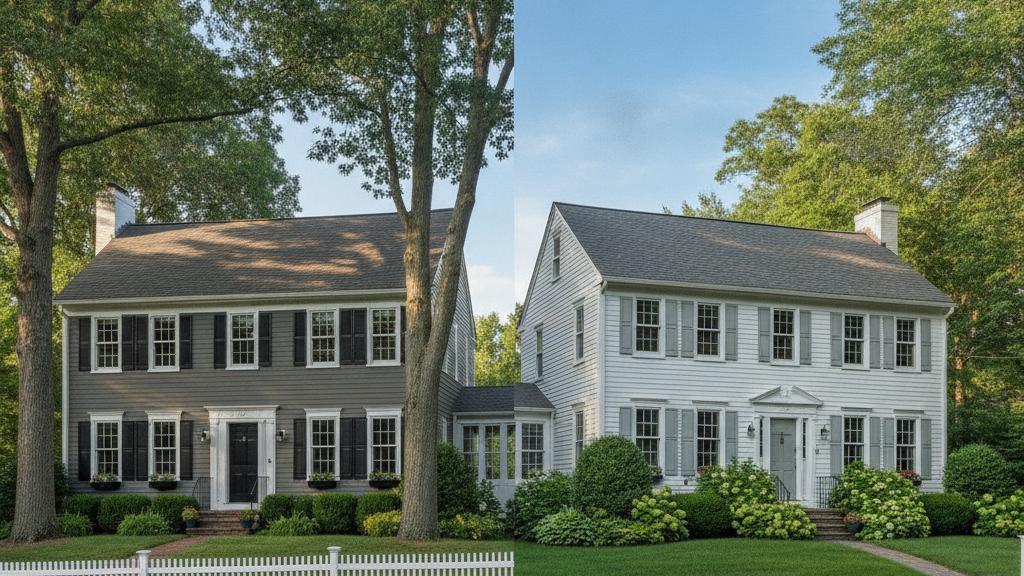
Both James Hardie fiber cement and CertainTeed vinyl are well-proven siding options for Fairfield County homes — and Gunner Roofing installs both. If one variable separates them in this county, it’s storm-season exposure: fiber cement’s rigid panels (rated non-combustible to ASTM E136) and corrosion-resistant fastening system hold their geometry through high-wind, rain-driven conditions; vinyl’s lighter profiles carry a higher risk of wind uplift under extreme events and cannot be repainted after storm-related UV or physical damage. The short answer: James Hardie for storm-exposed coastal positions; CertainTeed vinyl for inland, maintenance-free projects. Here’s how the two materials compare when a Nor’easter or tropical remnant rolls up the coast.
| James Hardie Fiber Cement (HZ5) | CertainTeed Vinyl | |
|---|---|---|
| Rated lifespan — ideal conditions (InterNACHI) | 100+ years | 60 years |
| Typical CT service life | 40–50+ years | 35–45 years |
| Storm/wind uplift resistance | Rigid panel; fastener spec per HZ5 guide | Lighter panel; susceptible to uplift at high wind |
| Post-storm color repair | Repaintable | Replacement required |
| Maintenance | Repaint every 15+ yrs; ColorPlus 15-yr finish warranty | None — color integral |
| Coastal salt-air fit | Excellent — inorganic substrate | Good — UV/salt chalking over time |
| CT permit required? | Yes, in most municipalities | Yes, in most municipalities |
| Gunner installs? | Yes — our premium siding lead | Yes — our recommended vinyl option |
Lifespan figures: InterNACHI Standard Estimated Life Expectancy Chart (nachi.org/life-expectancy.htm). CT service-life estimates are real-world climate adjustments, not manufacturer warranties.
Why storm season matters specifically in Fairfield County
Fairfield County’s coastline runs along Long Island Sound from Greenwich to Stratford — and the I-95 corridor that traces it is a well-established track for Atlantic tropical systems and Nor’easters moving northeast along the Eastern Seaboard. Late summer and early fall is when tropical moisture is most active; Nor’easters ramp up from October through spring. In practical terms, this means Fairfield County homes see a meaningful number of wind-driven rain events each year that test the full siding assembly — not just the cladding surface, but the water-resistive barrier behind it and the quality of every window and penetration flashings.
This is the variable that makes storm-season performance a Fairfield County-specific siding consideration. The coastal strip — Greenwich, Stamford, Norwalk, Westport, Fairfield town, Bridgeport, Stratford — takes the full brunt of onshore wind events. Inland towns (Danbury, Ridgefield, Monroe, Newtown) are more sheltered but still exposed to significant Nor’easter rainfall and periodic wind gusts that test cladding attachment.
How each material performs in high-wind and rain events
James Hardie fiber cement
Fiber cement is a composite panel — Portland cement, ground sand, and cellulose fiber. The panel is rigid and dense. In a wind event, a properly fastened fiber cement panel is resistant to uplift and flutter because it has significant mass and does not flex the way lighter materials can.
The fastener specification matters here. The James Hardie HZ5 Best Practices Installation Guide (v9.1, December 2019) specifies corrosion-resistant fasteners throughout — a requirement that is especially critical in Fairfield County coastal towns where salt air can compromise standard galvanized fasteners over time. A corroded fastener loses holding power before it’s visible from the outside; corrosion-resistant (typically stainless steel in coastal applications) fasteners maintain their grip through the siding’s full service life.
Another storm-specific detail: field-cut edges on fiber cement must be primed before installation. The HZ5 guide is explicit on this. Any panel cut on-site that isn’t sealed at the cut edge can absorb moisture at that point — which under repeated storm wetting cycles accelerates localized deterioration. Done right, it’s a non-issue. Done wrong, it becomes the failure point that eventually shows up as staining or edge swelling.
After a storm causes any localized surface damage — a scrape, a crack in the paint film — fiber cement can be repainted on-site to restore the finish. The panel remains in place; only the coating needs attention. This matters for Fairfield County homes that take storm debris impacts (branches, airborne materials) during summer and fall events.
CertainTeed vinyl
Vinyl is lighter than fiber cement — which is an advantage for ease of installation but a physical disadvantage under sustained high-wind conditions. Standard vinyl siding panels are designed to flex and release rather than resist rigidly, and in most wind events that’s fine. Under high-sustained winds, lighter-gauge panels on exposed elevations can rattle, and in extreme conditions are more susceptible to uplift than heavier cladding materials.
For vinyl, correct fastening — proper overlap and nailing per the manufacturer’s installation specs — drives storm performance more than panel grade alone. But unlike fiber cement, vinyl color is integral to the panel — a storm impact that scuffs or cracks the surface cannot be spot-repainted. The damaged section must be replaced. For coastal elevations that face southwest into the prevailing storm track, that’s a practical consideration.
Vinyl doesn’t corrode and won’t absorb moisture through the panel itself — advantages that remain real in any weather. The long-term storm-season variable for vinyl is cumulative UV exposure from summer coastal light and the fact that color refresh requires panel replacement rather than repainting.
The installation layer that matters most in every storm: the WRB
Both materials — fiber cement and vinyl — are the outermost layer of a rain-management system. The material’s own performance matters, but what happens to the wall when water gets behind the cladding (through a storm-driven seam, a missed flashing, or a fastener gap) is determined by what’s behind it.
Under IBC 2021 §1403.2, adopted in Connecticut via the 2021 CT State Building Code, exterior walls must include a water-resistive barrier behind the cladding. This requirement applies regardless of which cladding material is selected.
Every Gunner siding project in Fairfield County includes: – Full WRB installation across all wall surfaces – Correct step and kickout flashing at all roof-to-wall junctions – Properly flashed and sealed window and door openings – Verified ground clearances per the James Hardie HZ5 guide (minimum clearance from grade, minimum clearance from concrete slab)
A storm that drives wind and rain into any gap — a window head without kickout flashing, a rake without a proper termination — can introduce water behind even a perfectly-installed fiber cement or vinyl panel. The WRB catches that water and drains it out. This is why Gunner specifies and installs the full assembly on every project: the cladding is only as good as what’s behind it.
Gunner handles the building permit application on every siding project in Connecticut — so navigating municipal permit requirements is handled.
Summer timing: replacing siding during storm season
Late summer in Fairfield County is the busiest scheduling window for exterior renovation — but it also overlaps with peak Atlantic storm activity. For homeowners planning a siding replacement, a few practical notes:
- Open wall time: fiber cement and vinyl both require the wall to be open (existing siding removed, WRB installed) for a period during installation. Scheduling with your contractor to minimize open-wall exposure during an active tropical weather week is common sense.
- Active projects and weather delays: reputable contractors track weather windows. Gunner monitors forecasts and sequences projects to avoid leaving walls exposed to rain events. This is standard practice, not an exception.
- Post-storm damage assessment: summer storms that damage existing siding are often the trigger for a replacement project. If a wind event has loosened panels or damaged multiple sections, that’s the time for a full assessment — piecemeal repairs on aging siding often reveal that a full replacement is the better long-term investment.
What Gunner recommends for Fairfield County
For homes in the coastal Fairfield County towns — Greenwich, Stamford, Norwalk, Westport, Fairfield town, Bridgeport, Stratford — Gunner’s primary recommendation is James Hardie HZ5 fiber cement. The material’s panel rigidity, corrosion-resistant fastener system, non-combustible substrate (ASTM E136), and repaintability make it the lower-risk choice for storm-exposed positions and homes where long-term ownership is the plan. Gunner is a James Hardie Elite Contractor.
CertainTeed vinyl is Gunner’s recommended vinyl option and a genuine choice — not a fallback — for inland Fairfield County towns where storm exposure is lower and the homeowner’s primary goal is a durable, maintenance-free exterior. Premium CertainTeed vinyl profiles perform reliably in Connecticut’s climate, and for projects where historic-district review is not a factor and the priority is minimizing long-term upkeep, vinyl makes sense.
Both products are installed by Gunner with the same WRB, flashing, fastener, and clearance standards. The installation quality is what turns either material into a long-term performer.
Get a free, no-obligation estimate at GunnerRoofing.com — Gunner can review your site conditions, storm exposure, and home profile to recommend the right fit.
FAQ
Which siding holds up better in a storm — James Hardie or vinyl? For high-wind conditions, James Hardie fiber cement has the edge: the panel is rigid and dense, fastened per the HZ5 installation guide, and can be repainted on-site if a storm impact damages the surface. Premium vinyl performs well in most storms but is a lighter panel and cannot be repainted after surface damage — a cracked or scuffed section requires panel replacement. For storm-exposed coastal positions in Fairfield County, fiber cement is the lower-risk material.
Does vinyl siding blow off in high winds? Standard vinyl is designed to flex and release in wind — which helps it avoid cracking but can lead to panel displacement under sustained high winds. The fastening system (correct overlap and nailing per installation specs) is the most important variable in wind resistance for any vinyl product.
What is the James Hardie HardieZone 5 warranty for Connecticut homes? The James Hardie HZ5 product carries a 30-year limited, transferable product warranty (per jameshardie.com). The ColorPlus Technology factory-applied finish carries a separate 15-year limited warranty against peeling, cracking, and chipping (per the James Hardie ColorPlus warranty documentation). Both warranties apply only when the correct HardieZone formulation for the region is installed — HZ5 is the Northeast climate zone product.
Do I need a building permit to replace siding in Fairfield County, CT? In most Connecticut municipalities, yes — exterior siding replacement requires a building permit. The 2021 Connecticut State Building Code (based on the 2018 IBC/IRC) applies statewide, and local municipalities administer permit requirements within their jurisdictions. Requirements vary by town; confirm with your local building department. Gunner handles the building permit application and management on every siding project in Connecticut.
Can CertainTeed vinyl be repainted after storm damage? No. Vinyl’s color is integral to the panel — it cannot be field-painted. A surface that is scuffed, faded, or cracked by storm debris or UV exposure requires panel replacement to restore appearance. Fiber cement, by contrast, can be repainted on-site, which is why it’s the more resilient option for storm-track positions where periodic impact damage is a realistic possibility.
Does Gunner install both James Hardie and CertainTeed siding in Fairfield County? Yes. Gunner Roofing installs both James Hardie HZ5 fiber cement and CertainTeed vinyl siding throughout Fairfield County. Every project includes full WRB installation, correct flashing at all penetrations and roof-to-wall junctions, and verified ground clearances — the same installation standards regardless of cladding material. Gunner is a James Hardie Elite Contractor and is fully licensed, insured, and bonded in Connecticut.
Get a fast, free quote
No inspection visit needed - we measure your roof from satellite imagery and send your quote.