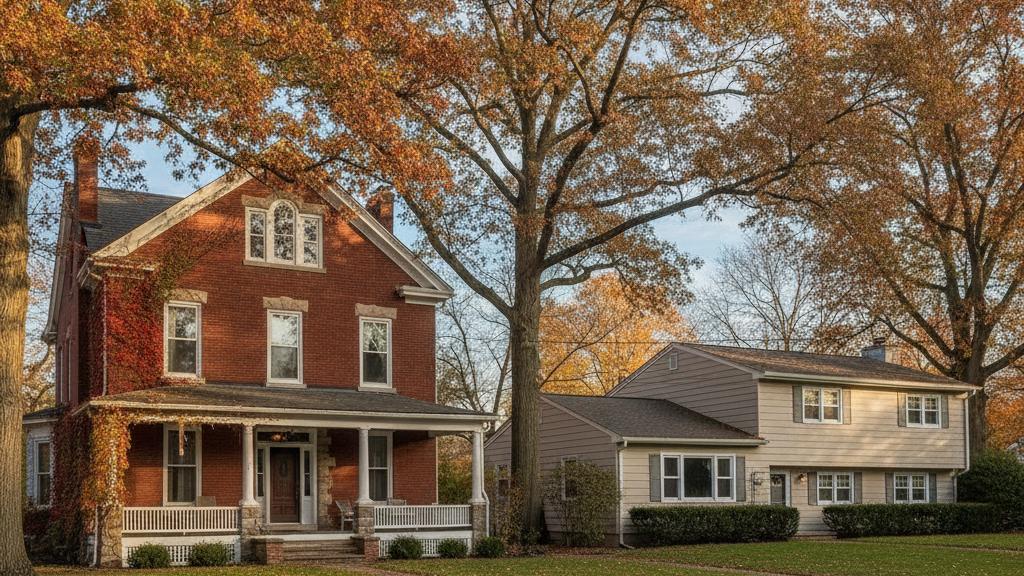
If you’re replacing windows in Greenburgh, NY, the right Andersen series depends heavily on which part of Greenburgh you live in. For pre-1930 homes in the incorporated riverfront villages — Irvington, Tarrytown, Dobbs Ferry, and Hastings-on-Hudson — the A-Series typically fits better: its fiberglass/composite exterior, slim sightlines, and broader custom-sizing range address the non-standard openings, masonry surrounds, and historical proportions common in older construction. For the 1950s–70s Colonials, split-levels, and cape cods across Hartsdale and Edgemont, the 400 Series covers most openings at a more accessible price point. The decision isn’t brand loyalty — it’s what the opening and the era of construction actually require.
Quick comparison: Andersen 400 Series vs. A-Series for Greenburgh homes
| Feature | Andersen 400 Series | Andersen A-Series |
|---|---|---|
| Frame exterior | Perma-Shield vinyl cladding | Fiberglass/composite |
| Frame interior | Pine (paintable/stainable) | Pine or all-composite |
| Custom sizing | Standard + extended sizes | Broader range; built for period openings |
| Thermal stability in freeze-thaw | Vinyl contracts/expands more in cold | Fiberglass nearly matches glass expansion rate |
| ENERGY STAR Northern zone | Available configurations qualify | Available configurations qualify |
| Best Greenburgh fit | Hartsdale/Edgemont postwar housing | Riverfront village Victorians with non-standard openings |
| Relative installed cost | $$ | $$$ |
Why Greenburgh’s housing stock drives this choice
Greenburgh is unusual in Westchester in that a single town boundary contains two very different housing eras with almost no geographic overlap.
The riverfront villages. Irvington, Tarrytown, Dobbs Ferry, and Hastings-on-Hudson sit along the Hudson and developed primarily in the late 19th and early 20th century. Irvington’s NRHP-listed historic district includes 212 contributing buildings, with housing stock that dates largely from 1859 to 1930 (per the National Register listing). Tarrytown’s historic districts reflect a similar era of older construction. These homes were built when window openings were sized to wood or masonry construction techniques of the time — taller and narrower than today’s standard rough openings, often with brick or stone surrounds and original wood sill profiles.
Hartsdale and Edgemont. East of the Bronx River Parkway, the unincorporated hamlets of Hartsdale, Edgemont, and Fairview developed in the post-WWII suburban boom. Ranch homes, cape cods, and two-story Colonials from the 1950s through 1970s make up the bulk of this housing stock. These homes were built to the dimensional standards of their era — which align much more closely with the standard rough-opening sizes that today’s window lines are optimized for.
The practical result: the same product spec that fits perfectly in a 1963 Hartsdale Colonial can require significant modification to work well in an 1895 Irvington farmhouse.
Riverfront village homes: the case for A-Series
Non-standard opening dimensions. Pre-1930 window proportions typically run taller and narrower than modern standard sizes. The A-Series was designed with a broader custom-sizing range than the 400 Series (per Andersen’s published product line), making it better suited to fit original openings without requiring filler strips, oversized exterior casing, or frame modifications that can affect the appearance and weather tightness of the installation.
Masonry surrounds and frame movement. Many Irvington and Tarrytown homes have brick or stone surrounds with original stone sills. Vinyl-clad frames (as on the 400 Series) expand and contract more than the glass and masonry around them as temperatures cycle through a Westchester winter and summer. The A-Series uses a fiberglass/composite frame material that expands and contracts at nearly the same rate as the glass itself, per the U.S. Department of Energy’s guidance on window frame materials — reducing long-term stress on the sealant joint between the frame and masonry.
Interior character. Pre-war homes in these villages often have detailed interior trim that homeowners have maintained or refinished. The A-Series offers an all-composite interior option that holds paint consistently and avoids the wood grain of a pine interior where that’s not appropriate to the existing trim profile.
Historic review — a word of caution. Homes in or near Tarrytown’s historic districts require review by the village’s Architectural Review Board before window replacement. Under the Village of Tarrytown Village Code (Ch. 9 and Ch. 191), construction or alteration affecting a building’s exterior appearance visible from a public street is subject to ARB review, and changes in a historic district require a certificate of appropriateness. For homes in other riverfront villages, requirements vary by municipality — confirm with your local building department and historic-district or landmarks commission before ordering windows. The profile, muntin pattern, and exterior finish that a review board requires can narrow your product options before you choose a series.
Hartsdale and Edgemont: when the 400 Series is the right call
Postwar homes in Hartsdale and Edgemont typically have standard-sized openings that the 400 Series addresses well. A few reasons the 400 Series often makes sense for this housing stock:
Standard sizing. Ranch homes, cape cods, and two-story Colonials from the 1950s–70s were built with window openings sized to conventions of that era, which overlap closely with the extended-size range of the 400 Series. There’s no custom-sizing premium for most replacements in this housing type.
Wood interior. The 400 Series uses a pine interior that takes stain or paint, which works well with the painted woodwork common in postwar Colonials. If the existing trim is standard-painted wood, there’s no strong reason to pay for a composite interior.
Budget. The cost difference between a 400 Series and A-Series order across a whole house is real. For homes where the openings are standard and there’s no historic review requirement, the 400 Series meets ENERGY STAR Northern-zone performance requirements in available configurations without the A-Series premium.
Energy code for Greenburgh: what both series must meet
All of Westchester County — including every part of Greenburgh — sits in IECC Climate Zone 4. Under the 2020 NYS Energy Conservation Construction Code (Table R402.1.2), replacement windows must meet a maximum U-factor of 0.32 and a maximum SHGC of 0.40. That is the permit-minimum code floor.
The practical target is stricter: ENERGY STAR Version 7.0 Northern zone criteria require a U-factor of 0.22 or lower and a minimum SHGC of 0.17, in effect since October 23, 2023. Both the 400 Series and A-Series are available in configurations that qualify for ENERGY STAR Northern zone — but not every configuration in either line meets the v7.0 threshold. Per the National Fenestration Rating Council (NFRC), the authoritative performance number is the U-factor on the NFRC label of the specific unit you order, not the series name.
For older Greenburgh homes — particularly the riverfront village stock where windows may still be original or only one generation replaced — the gap between a single-pane original and a low-E double-pane ENERGY STAR unit is significant from the first heating season.
Permits and fall timing in Greenburgh
Window replacement requires a building permit in Greenburgh. Per the Town of Greenburgh Building Department FAQ and New York’s Uniform Code administration (Executive Law §381; NYS DOS Legal Memorandum LG03), the Town of Greenburgh Building Department handles permits for the unincorporated town; each incorporated village within Greenburgh — Irvington, Tarrytown, Ardsley, Dobbs Ferry, Hastings-on-Hudson, and Elmsford — maintains its own building department and permit program. Apply to the correct jurisdiction for your property.
Fall is the right time to act for two practical reasons. A-Series orders for non-standard sizes may carry longer lead times than stock configurations — ordering early gives the unit time to arrive and be installed before cold weather makes exterior flashing and air-sealing work harder to do well. And permit processing takes real calendar time; submitting before November reduces the chance that approval lands in a holiday queue that pushes installation into deep winter.
Gunner Roofing handles the permit application on every project — pulling and managing the permit is included on every window job, regardless of which Greenburgh jurisdiction applies.
Frequently asked questions
Which Andersen series is better for a pre-1930 Irvington or Tarrytown home? For pre-1930 homes in Greenburgh’s riverfront villages, the A-Series is typically the better fit. Its broader custom-sizing range handles the taller, narrower openings common in pre-1930 construction, and its fiberglass/composite exterior expands and contracts at nearly the same rate as glass and masonry — reducing long-term sealant stress at the frame-to-masonry interface. If the home is in or near a historic district, the review board’s material requirements may further narrow the choice before you select a series; confirm with your local historic-district or landmarks commission.
Is the Andersen 400 Series enough for a 1960s Hartsdale Colonial? For most postwar Colonials in Hartsdale and Edgemont, yes. Standard opening dimensions, a pine interior compatible with painted woodwork, and available ENERGY STAR Northern-zone configurations make the 400 Series a strong fit for that housing type without paying the A-Series custom-sizing premium.
Does window replacement require a permit in Greenburgh, NY? Yes. The permit jurisdiction depends on your property’s location within Greenburgh. The Town of Greenburgh Building Department handles permits for the unincorporated town (Hartsdale, Edgemont, Fairview); each incorporated village — Irvington, Tarrytown, Ardsley, Dobbs Ferry, Hastings-on-Hudson, Elmsford — administers its own permit program. Gunner handles the permit on every project.
What U-factor do windows need to meet in Greenburgh? The 2020 NYS Energy Conservation Construction Code (Table R402.1.2) sets a prescriptive maximum of U-factor 0.32 and SHGC 0.40 for Climate Zone 4 (all of Westchester County). ENERGY STAR Version 7.0 Northern zone tightens that to U-factor 0.22 or lower, effective October 23, 2023. Both the Andersen 400 Series and A-Series have configurations that meet the ENERGY STAR Northern zone standard; confirm the U-factor on the NFRC label of the specific unit you order.
Does Tarrytown’s Architectural Review Board apply to window replacement? Under the Village of Tarrytown Village Code (Ch. 9 and Ch. 191), alterations affecting a building’s exterior appearance visible from a public street require ARB review, and changes in a historic district require a certificate of appropriateness. If your home is in or near one of Tarrytown’s protected districts, consult the board before finalizing a window order — the approved profiles and materials can affect which series is appropriate.
Does Gunner Roofing install windows in Greenburgh, NY? Yes. Gunner Roofing is an Andersen Certified Elite contractor and installs windows throughout Greenburgh, including the riverfront villages and unincorporated hamlets. Gunner is fully licensed, insured, and bonded in New York and pulls the required building permits on every project.
Ready to find out which windows fit your Greenburgh home? Get a free, no-obligation estimate at GunnerRoofing.com.
Get a fast, free quote
No inspection visit needed - we measure your roof from satellite imagery and send your quote.