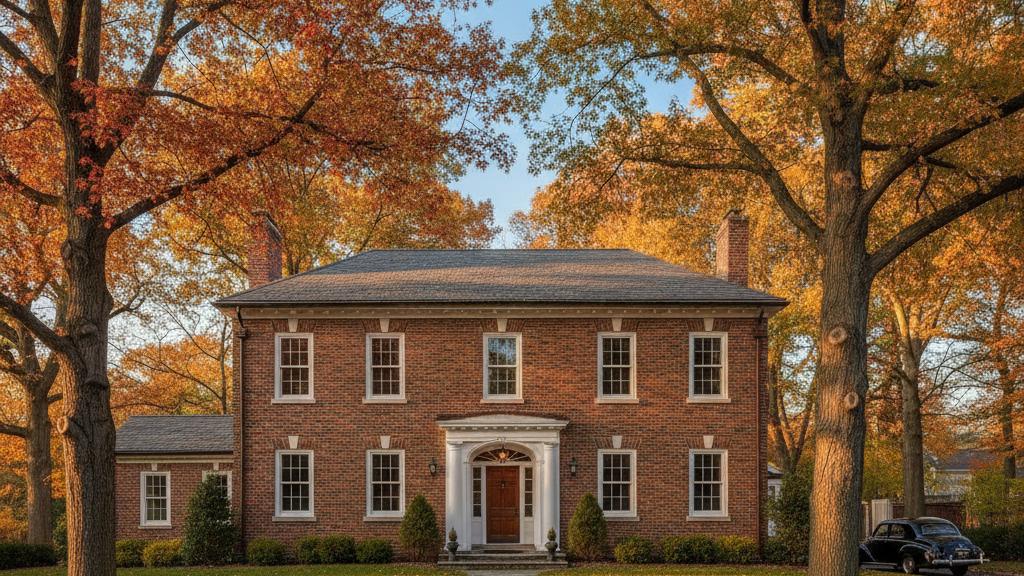
Replacing windows in a pre-war Colonial or Tudor in Yonkers is not the same project as replacing windows in a 1960s split-level in Crestwood. The tall, narrow openings, masonry surrounds, and — in some neighborhoods — historic-district considerations add layers that standard replacement windows don’t automatically address. If you’re planning this project for fall, you have a narrow window (so to speak) before freeze-up makes caulk and flashing work harder and before permit processing slows ahead of the holidays.
Here’s what changes when the home is older and what to plan for.
What makes older Yonkers Colonials and Tudors different
Yonkers’ southern and central neighborhoods — Park Hill, Dunwoodie, McLean Heights, and the hillside streets above the Hudson waterfront — contain a dense concentration of pre-war brick Colonials and Tudor revivals built roughly from the 1900s through the 1940s. A few distinguishing factors:
Narrow, taller-than-standard openings. Pre-war window proportions often run taller and narrower than the standard rough-opening dimensions modern window lines are optimized for. Ordering a stock double-hung and shimming it to fit can compromise the frame-to-masonry seal, affect weather tightness, and look proportionally wrong against the masonry surround.
Masonry surrounds. Many of these homes have brick or stone surrounds with original stone sills. The surround doesn’t flex the way wood-frame construction does. Window units that expand and contract differently from the masonry can stress the sealant joint over time; the frame material matters here.
Interior wood character. Original windows in these homes often had painted wood interiors matching interior trim profiles. Homeowners who’ve refinished their woodwork typically want the replacement to match — meaning a wood or wood-interior frame, not an all-vinyl interior.
Air sealing on the interior. In pre-war construction, the window rough opening and the wall cavity behind it were often less carefully air-sealed than modern construction. A window replacement that doesn’t address interior air sealing (around the jamb extension, at the sill) will leave cold air infiltration paths intact even with a high-performance glass package in the new unit.
Do you need a permit in Yonkers?
Yes. Window replacements in Yonkers require a building permit under New York State’s Uniform Fire Prevention and Building Code, which each local government administers within its jurisdiction per NYS Executive Law §381 (per the NYS Dept. of State Legal Memorandum LG03). Requirements vary by municipality; confirm specifics with your local building department before ordering windows.
Gunner handles the permit application on every project — pulling and managing it is included in the job, not an add-on.
Does your neighborhood have historic-district or landmarks review?
This is the step that surprises many Yonkers homeowners. Some older residential areas in Yonkers fall under historic-district designation or landmarks review requirements that may govern exterior alterations, including window replacements visible from a public street.
Requirements vary by neighborhood and designation status. If your home is in a designated historic district or landmarks area, confirm with your local historic-district or landmarks commission before ordering windows — the review process may govern material choice (wood vs. composite vs. vinyl), profile depth, muntin pattern, and exterior color in ways that affect which unit you can legally install.
For homes outside any designation, permits are the main gate, and the choice of window is primarily a performance and appearance decision.
Choosing the right window for a pre-war Yonkers home
The core tension: standard vinyl replacement windows are inexpensive and low-maintenance, but they typically don’t match the profile depth, interior character, or custom sizing that older Yonkers Colonials and Tudors need. Gunner’s recommended window line is Andersen, and for these homes, the choice is usually between the 400 Series and the A-Series (Architectural Collection).
| Andersen 400 Series | Andersen A-Series | |
|---|---|---|
| Exterior material | Perma-Shield vinyl cladding | Fiberglass/composite |
| Interior | Pine (paintable/stainable) | Pine or all-composite |
| Profile character | Traditional residential | Slim, architecturally precise |
| Custom sizing range | Standard + extended sizes | Broader; designed for period openings |
| Frame thermal stability | Vinyl expands/contracts more | Fiberglass nearly matches glass expansion |
| ENERGY STAR Northern zone | Available configurations qualify | Available configurations qualify |
| Relative installed cost | $$ | $$$ |
For pre-war Colonials and Tudors, the A-Series typically performs better against what these homes actually need:
- Slim profiles that fit tall, narrow masonry openings without looking undersized or requiring oversized exterior casing to cover the gap.
- Fiberglass/composite exterior that expands and contracts at nearly the same rate as the glass itself (per the U.S. Department of Energy’s window-types guidance on frame-material thermal behavior). This reduces stress on the sealant joint between frame and masonry surround over decades of Westchester’s freeze-thaw cycling.
- Precise sizing for non-standard rough openings, available in a broader configuration range than the 400 Series.
The 400 Series remains the right choice for homes where the opening dimensions are closer to standard, the budget is a real constraint, or the home is mid-century rather than pre-war.
Energy code requirements for Yonkers
Yonkers sits in IECC Climate Zone 4. Under the 2020 NYS Energy Conservation Construction Code (Table R402.1.2), replacement windows must meet a maximum U-factor of 0.32 and maximum SHGC of 0.40 — this is the permit-minimum code floor. The practical target is higher: ENERGY STAR Version 7.0 Northern zone requires a U-factor of 0.22 or lower and a minimum SHGC of 0.17 (in effect since October 23, 2023, per the ENERGY STAR final specification). Both the 400 Series and A-Series are available in configurations that qualify for ENERGY STAR Northern zone.
Per the National Fenestration Rating Council (NFRC), the label on each specific window configuration is the authoritative performance number — not the series name. Confirm the U-factor and SHGC on the NFRC label of the exact unit you order.
For the west-facing windows common on Yonkers’ north-south hillside streets above the Hudson, a lower SHGC (solar heat gain coefficient) reduces afternoon solar heat load through September and October — useful during the shoulder season before the heating-dominated winter takes over.
Why fall is the right window for this project
September and October are the practical planning months for a pre-winter window replacement in Yonkers. A few reasons:
Lead time. Custom or near-custom-sized units — common in A-Series orders for pre-war openings — carry longer lead times than stock windows. Ordering in September gives the window time to arrive and be installed before temperatures drop to the point where exterior sealant and flashing work become difficult.
Permit processing. Building permit applications in Yonkers take real calendar time. Submitting in September rather than November reduces the chance that permit approval falls into a holiday slow-down that pushes installation into December or later.
Air sealing conditions. Air-sealing work around jamb extensions and rough openings is more effective at moderate fall temperatures than in near-freezing conditions. Getting the installation done in October rather than waiting for November means that work can be done properly, and you go into the heating season with the air sealing already performing.
Energy payback starts immediately. A fall installation means the first full heating season under the new windows. If the existing windows are original or near-original — single-pane or failed double-pane with fogged glass — the change in infiltration and heat loss can be substantial from day one.
What Gunner Roofing installs
Gunner Roofing is an Andersen Certified Elite contractor and installs both the 400 Series and A-Series across Westchester County, including Yonkers. Gunner is fully licensed, insured, and bonded in New York, and handles the permit application on every window project — pulling and managing the permit is included, not an add-on.
For a free, no-obligation quote on your Yonkers window replacement, visit GunnerRoofing.com.
Frequently asked questions
Do I need a permit to replace windows in Yonkers? Yes. Window replacements require a building permit under the NYS Uniform Fire Prevention and Building Code, administered locally. Requirements vary; confirm details with your local building department. Gunner handles the permit application on every project.
Does my older Yonkers home need historic-district approval for window replacement? It depends on whether your neighborhood has a historic-district or landmarks designation. If it does, exterior alterations including window replacements visible from a public street may require review and approval before ordering or installing new windows. Confirm with your local historic-district or landmarks commission if you’re unsure about your property’s status.
What window series fits a pre-war brick Colonial in Yonkers? For most pre-war Colonials and Tudors in Yonkers, the Andersen A-Series (Architectural Collection) is the better fit: slim profiles for tall, narrow masonry openings, a fiberglass/composite exterior that expands and contracts at nearly the same rate as the glass, and broader custom-sizing options. The 400 Series is the right call for more standard-size openings or where budget is a primary driver.
What is the energy code minimum for window replacements in Yonkers? Under the 2020 NYS Energy Conservation Construction Code (Table R402.1.2), Westchester County is IECC Climate Zone 4: the prescriptive minimum is U-factor ≤ 0.32 and SHGC ≤ 0.40. The ENERGY STAR Version 7.0 Northern zone standard is U-factor ≤ 0.22 — a significantly tighter target worth specifying for any replacement project.
Why replace windows in fall rather than spring? Ordering in September–October gives lead time for custom-sized units to arrive before cold weather, allows permit processing before holiday slowdowns, and ensures air-sealing work can be done at moderate temperatures. You also start the heating season with the new windows already in place.
Is vinyl a valid option for a pre-war Yonkers Colonial? For homes inside a historic-district designation, the commission’s guidelines may restrict or prohibit vinyl on street-facing elevations — confirm with your local commission. For homes outside a designation, vinyl can be a cost-effective option for rear or side elevations where profile and color matching are less critical. For primary street-facing elevations on period homes, Gunner recommends Andersen’s wood-interior or composite-frame options for the profile and interior character they provide.
Get a fast, free quote
No inspection visit needed - we measure your roof from satellite imagery and send your quote.