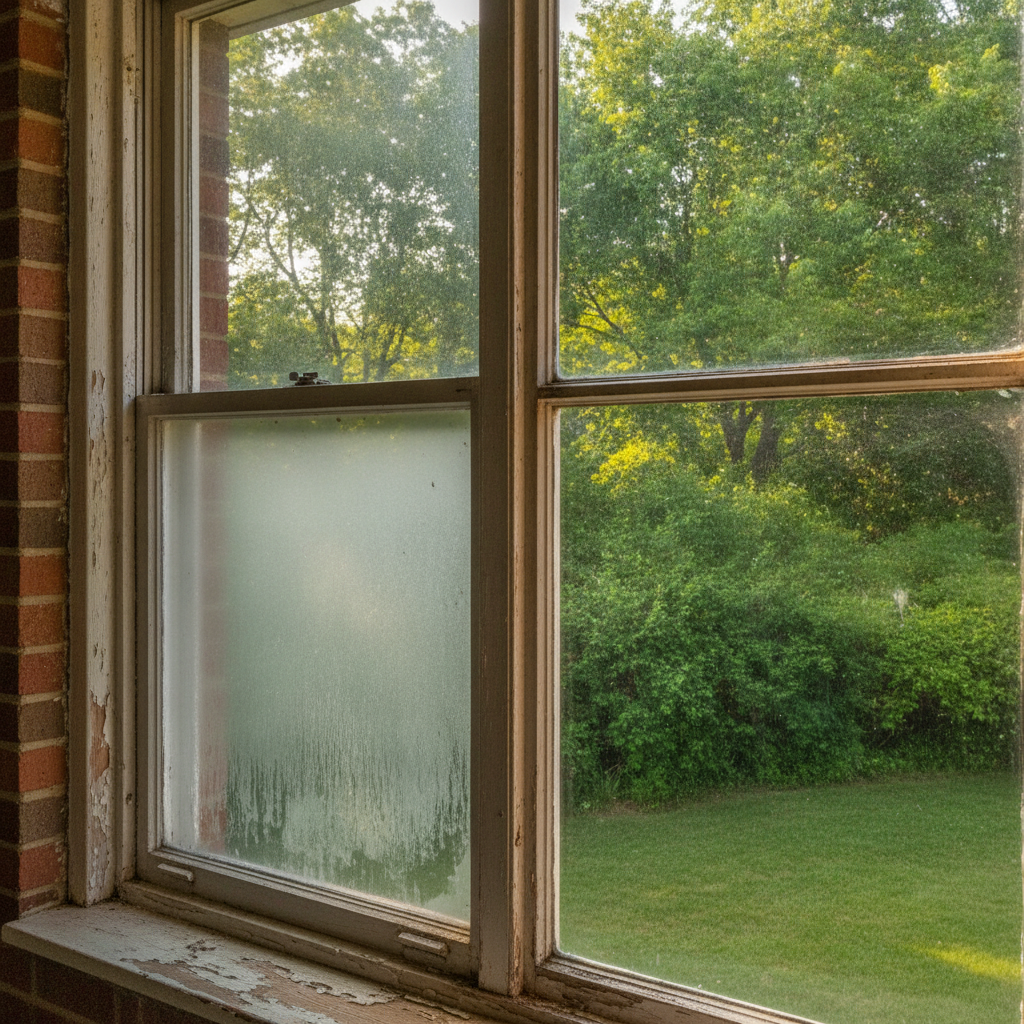
If your Yonkers home’s windows are drafty in summer thunderstorms, foggy between the panes, or driving up your Con Edison bill, they may have already given you most of what they can. Here are seven concrete signs it’s time to replace them — plus what the investment actually buys you in Westchester County’s climate.
1. Condensation or Fogging Between the Glass Panes
The most definitive sign of a failed window is inter-pane fogging — that milky or streaky moisture that forms between the glass layers, not on the interior surface. It means the seal on the insulating glass unit (IGU) has failed, allowing humid air to enter the space between the panes. Once that seal is gone, the inert gas fill (typically argon) has escaped and the window no longer performs as rated.
Per Andersen Windows, condensation on the interior surface of a window can be a humidity management issue in the home, but fogging between the panes is a structural failure of the unit — it cannot be cleaned off and the performance cannot be restored without replacing the IGU or the sash (per Andersen’s condensation guide).
In Yonkers, summer heat and humidity push warm, moist air against cool, air-conditioned glass constantly from June through September. Homes with older windows — many of Yonkers’ pre-1960 stock of brick row houses, Tudor revivals, and Colonials in neighborhoods like Park Hill, Nepperhan, and Dunwoodie — often have original single-pane or early double-pane units that are well past their seal life.
2. Noticeable Drafts Around the Frame
Run your hand around the perimeter of a closed window on a humid, breezy summer afternoon after a storm rolls up the Hudson from the south. Any air movement you feel is conditioned air escaping and outside heat entering. Drafts indicate one of three things: the weatherstripping has worn away, the frame has warped or shrunk over time, or the window was never properly air-sealed at installation.
Warping is especially common in wood-frame windows. Older wood double-hungs — still prevalent in Yonkers’ Victorian-era and early-20th-century housing stock — expand and contract with seasonal humidity swings. After enough cycles, the sash no longer closes tightly against the stop.
Weatherstripping can be replaced as a stopgap, but if the frame itself has racked or the glazing compound has cracked, replacement is the correct fix.
3. Difficulty Opening, Closing, or Locking
A window that requires significant force to open, won’t stay open, or won’t latch shut is a functional and safety failure, not just a convenience issue. New York State building code (2020 RCNYS) requires that egress windows in sleeping rooms meet specific minimum opening dimensions so occupants can escape in a fire — a window that won’t open freely defeats that protection.
If you can’t get a clean lock on a sash, the window is also a security gap. Sticking and binding in hung and casement windows is usually caused by frame distortion, paint buildup, or hardware failure — all of which worsen over time. At some point the cost of repeated repairs exceeds the cost of a quality replacement.
4. High Energy Bills (and a High U-Factor)
The U-factor measures how quickly heat passes through a window assembly — the lower the number, the better the insulation. Single-pane windows common in pre-1980 Yonkers homes carry a U-factor around 1.0 or higher. Current ENERGY STAR requirements for the Northern climate zone (which covers Westchester County) require a U-factor ≤ 0.27 for windows to earn certification, per the ENERGY STAR program requirements.
That gap — from ~1.0 down to ≤0.27 — represents a dramatic reduction in heat transfer. The U.S. Department of Energy notes that heat gain and heat loss through windows are responsible for 25–30% of residential heating and cooling energy use (per energy.gov). In Yonkers’ hot, humid summers, where the urban heat island effect keeps overnight lows elevated, windows with poor solar heat gain coefficient (SHGC) ratings compound the problem by admitting solar radiation that a low-E coating would otherwise reflect.
If your Con Edison bills spike significantly in summer compared to similar-vintage neighbors, ask your installer to pull a rough heat-load estimate — windows are often a primary culprit in older Westchester homes.
5. Water Infiltration or Rot Around the Frame
Any water staining on the interior sill, soft spots in surrounding drywall or plaster, or visible rot in a wood frame means moisture is bypassing the window-to-wall junction. This is not a caulk-gun fix if the frame or the rough opening has been compromised.
Left unaddressed in Yonkers’ humid summers, rot spreads quickly — wood-destroying fungi thrive in the warm, wet conditions that follow July and August thunderstorms. By the time rot is visible on the interior, it has often traveled further than the visible damage suggests. A proper replacement addresses the opening, the flashing, and the surrounding structure, not just the sash.
6. Exterior Noise Is Unusually Loud
A meaningful acoustic benefit of modern double- and triple-pane windows is sound attenuation — relevant in Yonkers, which sits along Metro-North’s Harlem and Hudson lines, the New York State Thruway (I-87), and the Saw Mill River Parkway. If traffic, train noise, or the ambient hum of a dense residential neighborhood is clearly audible through a closed window, the glazing assembly is thin or compromised. Laminated glass and thicker insulating units measurably reduce sound transmission; single-pane glass provides almost none.
7. The Windows Are More Than 25–30 Years Old
Even well-maintained windows have a practical service life. The U.S. Department of Energy notes that upgrading older single-pane or early double-pane windows can meaningfully cut the heat gain and loss those units allow (per energy.gov). In Yonkers’ climate — humid summers, cold winters, coastal storm exposure from the Hudson corridor — the lower end of that range (25 years) is a realistic planning horizon for older units with wood frames, painted-over hardware, and no low-E coating.
Age alone is not a disqualifier if the windows are structurally sound, properly sealed, and thermally adequate. But age combined with any of the above signs is a strong indicator that replacement is overdue.
What to Look for in a Replacement Window for Yonkers
ENERGY STAR Northern Zone Certification
Choose windows certified for the Northern climate zone, which requires U-factor ≤ 0.27 and no SHGC restriction (per ENERGY STAR). For homes with significant west-facing or south-facing glass — common on Yonkers streets that run north-south up the Hudson bluffs — a lower SHGC helps reduce summer solar heat gain.
Frame Material and Neighborhood Fit
Yonkers has a genuinely varied housing stock. The riverfront and south Yonkers neighborhoods feature brick multi-families and early-20th-century row houses; central Yonkers climbs to Tudor-revival and Colonial detached homes; the north end grades into larger lots with mid-century ranches and Capes.
- Fiberglass frames are dimensionally stable and hold paint well — a good fit for the period homes in Park Hill and Dunwoodie.
- Composite and clad-wood frames suit historic-character homes where the sightline and profile matter.
- Vinyl frames perform well thermally and require no painting; the right choice for utility-focused replacements on mid-century stock.
If your home is in a locally designated historic district, requirements for window replacement vary — confirm with your local historic-district or landmarks commission before ordering materials.
Permit Requirements
Permit requirements for window replacement vary by municipality; confirm with the City of Yonkers Building Department. Gunner handles the permit on every project — pulling and managing the application is included on all jobs.
Gunner Roofing and Windows in Yonkers
Gunner Roofing is an Andersen Certified Elite installer and is fully licensed, insured, and bonded in New York. Gunner serves Yonkers and all of Westchester County.
Frequently Asked Questions
Q: How do I know if my windows need replacing or just resealing?
A: If the fogging is between the panes, no amount of resealing will fix it — the insulating glass unit has failed and must be replaced. If the issue is exterior-surface condensation or minor air infiltration, weatherstripping or caulk may extend the window’s life a few years. When frames are rotted, warped, or the hardware is failing, full replacement is the more cost-effective path.
Q: What U-factor should I specify for Yonkers windows?
A: ENERGY STAR’s Northern zone requirement is U-factor ≤ 0.27. Many quality replacement windows in that zone hit 0.22–0.25, which provides meaningful comfort improvement over older single- or early double-pane units at around 0.50–1.0.
Q: Do I need a permit to replace windows in Yonkers?
A: Permit requirements for window replacement vary by municipality; confirm with the City of Yonkers Building Department. Gunner pulls and manages the permit on every job.
Q: How long do replacement windows last in Westchester County?
A: Quality double-pane vinyl or fiberglass windows are designed for long service lives. In Westchester’s climate — with seasonal temperature swings, humidity, and storm exposure — planning for a 25-year replacement horizon is a reasonable baseline. Frame material, installation quality, and maintenance all affect how close to the rated life a window actually reaches.
Q: Is summer a good time to replace windows in Yonkers?
A: Yes. Summer is one of the better seasons for window replacement — moderate temperatures make installation cleaner than mid-winter, and replacing before fall means the windows are properly sealed and tested before heating season begins. Scheduling summer work also avoids the spring backlog many contractors see in April and May.
Q: What does Andersen Certified Elite mean?
A: Andersen’s Certified Elite designation is a tier within Andersen’s contractor network indicating a contractor has met Andersen’s installation and training requirements. Gunner Roofing holds Andersen Certified Elite status.
Get a fast, free quote
No inspection visit needed - we measure your roof from satellite imagery and send your quote.