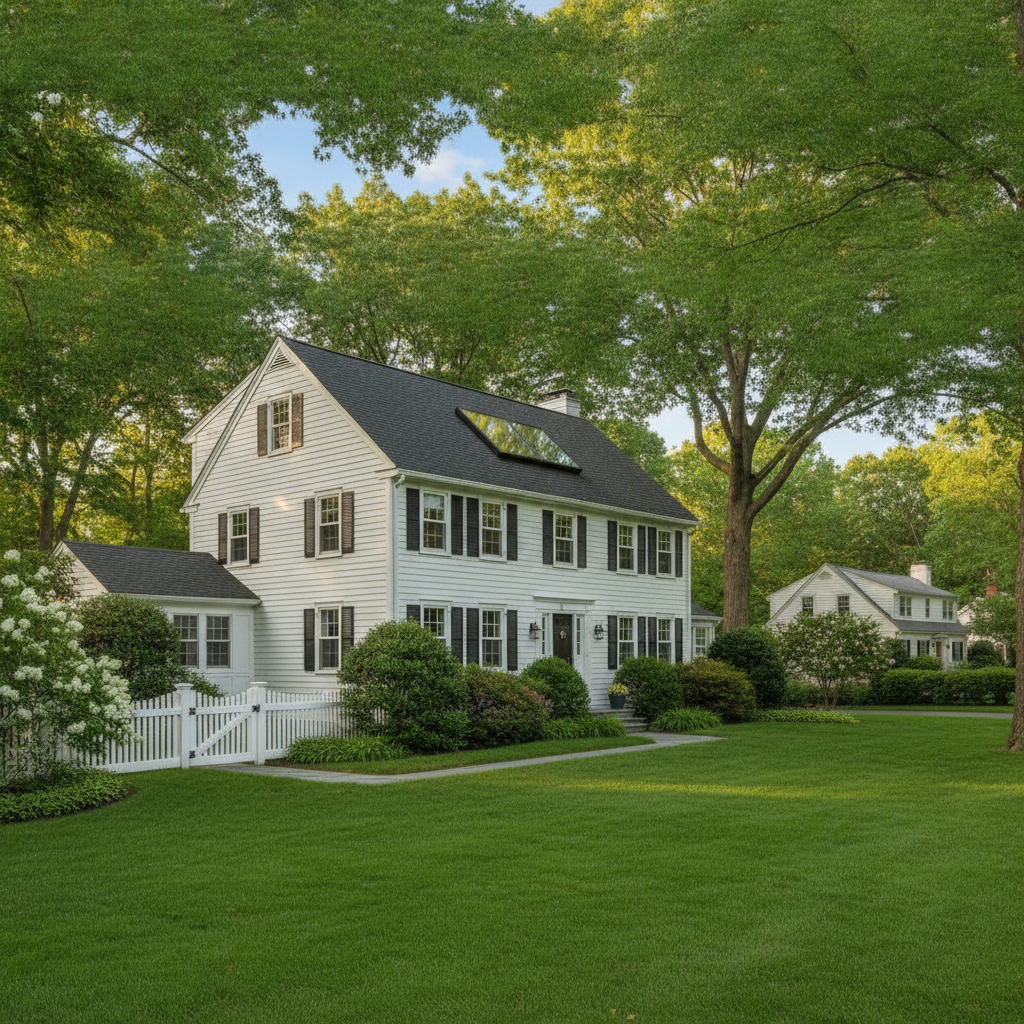
A skylight or roof window is one of the few upgrades that pays back every single day — morning light through a vaulted ceiling, a bedroom that feels twice its size, natural cross-ventilation on a warm July night. Done right, they last for decades without a drop.
Gunner installs VELUX skylights and roof windows across New York and Connecticut, and we handle every layer of the job — the unit, the flashing kit, the step flashing at the curb, and the interior finish. Here is what you need to know before you buy.
Deck-Mount vs. Curb-Mount: Which One Is Right for Your Roof?
The first decision is how the unit attaches to the roof deck.
Deck-mounted skylights (VELUX A21 series — models FS, VS, VSE, VSS) sit directly on the roof sheathing and are integrated into the shingle plane with purpose-built step-flashing kits. They work on slopes between roughly 15° and 85° (a wide range that covers most residential pitches in NY and CT). The unit itself sits lower, so the profile is clean. This is the most common choice for standard asphalt-shingle roofs.
Curb-mounted skylights (VELUX A21 series — models FCM, VCM, VCE, VCS) sit on a framed curb that the roofer builds up from the deck. Curb-mount is the right call when the roof pitch is low — generally below the minimum for deck-mount — or on flat/low-slope roof sections, and on standing-seam metal roofs where integrating step flashing is more complex. Curb-mounted units also leave more glass visible above the roofline, which gives a stronger interior view.
Sun Tunnel® Skylights are a third category: a smaller-diameter light tube that runs from a roof dome through the attic to a diffuser in the ceiling. They’re ideal for interior rooms with no direct roof access — a hallway, a bathroom, a walk-in closet. Rigid and flexible tunnel versions are available.
The Flashing Is the Job
If you’ve ever dealt with a leaking skylight, there’s a very good chance the problem wasn’t the unit — it was the flashing. Skylights are roof penetrations, and any penetration is only as good as the water management around it.
VELUX sells purpose-matched flashing kits for every unit and roof type:
- EDL / EDM step-flashing kits — deck-mounted units on asphalt shingles. The step flashing integrates course-by-course into the shingle, the same way chimney step flashing is done. The EDM is a self-adhesive membrane version for simpler integration.
- ECL / ECW curb-flashing kits — for curb-mounted units; the ECL is a self-adhesive “peel-and-stick” deck-applied system.
- EKL / EKW kits — for low-pitch and tile applications.
Using VELUX’s own matching flashing kit (rather than a generic counter-flashing) is what triggers the no-leak installation warranty (see below). It also means the flashing geometry is engineered for the unit’s dimensions — no field-cutting guesswork.
At Gunner, every skylight installation includes step and counter-flashing at the entire skylight perimeter, plus ice-and-water shield run under and around the opening — part of our standard approach on all roof penetrations.
Summer in NY and CT: Heat, Glare, and the Right Glass
In July and August, the biggest performance question isn’t warmth — it’s solar heat gain. A south- or west-facing skylight without proper glazing can significantly increase cooling loads on hot afternoons.
VELUX addresses this with a laminated Low-E glass package standard on most residential units. Low-E coatings reflect a portion of infrared radiation (heat) while still transmitting daylight. For NY and CT homeowners looking for ENERGY STAR qualification, VELUX’s qualifying residential skylights must meet the Northern climate zone U-factor of ≤ 0.55 and SHGC of ≥ 0.27 (per ENERGY STAR v7.0 skylights criteria — note skylight thresholds differ from vertical window thresholds).
If glare or afternoon heat is a primary concern, VELUX offers a full range of interior blinds — light-filtering, blackout, and venetian — as well as exterior awning blinds that block solar gain before it enters the glass. Solar-powered and electric-motorized operators are available, and the rain sensor (an available accessory) will auto-close an operable unit if it detects rain — useful in summer when you leave units open for ventilation.
For a bedroom or home office where you want control over light without sacrificing ventilation, a VELUX VS (venting, deck-mounted) with a blackout blind and solar operator gives you exactly that: fresh air on demand, darkness on demand.
What the VELUX No-Leak Warranty Actually Covers
Per the VELUX Limited Warranty (effective January 1, 2025; source: VELUX warranty document on file), Section G covers the no-leak installation warranty:
- Deck-mounted units (FS, VS, VSE, VSS with EDL, EDW, EDM, EKL, EKW flashings): no water will leak through the installed unit or between the unit and the roof deck, provided it is the original installation on a residential building with one layer of properly installed roofing material, installed strictly per VELUX deck-mounted instructions. Warranty period: 10 years (per VELUX Limited Warranty §G.i, effective Jan 1 2025).
- Curb-mounted units (FCM, VCM, VCE, VCS with ECL and ECW flashings): same no-leak coverage. Warranty period: 10 years (per VELUX Limited Warranty §G.ii, effective Jan 1 2025).
The insulating glass seal in standard residential unit skylights (models FS, VS, VSE, FCM, VCM, VCE, VCS, QPF, EF, EV, and others) carries a 20-year warranty against dust or film formation on the internal glass surface caused by hermetic seal failure (per VELUX Limited Warranty §A.i). The unit itself — roof windows, glass unit skylights, VMS, and flashings — carries a 10-year materials and workmanship warranty (per §A.ii).
Important exclusions from the warranty (per §3.1): the warranty does not cover condensation (which is not a “leak” under VELUX’s definition), extreme weather or severe hail, ice damming not caused by a product defect, or installation that deviates from VELUX instructions. On pitches from 45° to 85°, a water diverter may be required with ECL flashings (per §3.1.8).
The no-leak warranty applies to the original installation only. If a skylight is removed and reinstalled, coverage resets — which is why we always recommend replacing a skylight when you’re replacing the surrounding roof rather than pulling and re-setting the old unit.
Sizing and Rough Opening: What to Expect
VELUX publishes a standard size matrix for their deck-mounted and curb-mounted lines — sizes are identified by a two-character code (e.g., FS C04, FS M04, FS 308) corresponding to the rough opening dimensions. The skylight measurement guide in our reference library covers how to measure from the rafter opening to select the correct unit size.
In most NY and CT homes, framing for a new skylight means cutting between two existing rafters and adding a header and sill. Depending on your framing configuration, you may need to add one or two trimmer rafters to define the opening. In older homes — pre-1970s framing common throughout Westchester and Fairfield — rafter spacing and dimensions can vary, so field measurement is essential before ordering a unit.
Permit requirements vary by municipality; confirm with your local building department or historic-district commission.
Deck-Mount vs. Curb-Mount: Quick Comparison
| Feature | Deck-Mount (A21 series) | Curb-Mount (A21 series) |
|---|---|---|
| Roof pitch range | ~15° – 85° | Low-slope to flat; also higher pitches |
| Profile above shingles | Low, integrated | Higher, more visible glass |
| Flashing system | Step-flashing (EDL/EDM/EKL) | Curb-integrated (ECL/ECW) |
| Best for | Standard asphalt-shingle roofs | Low-slope, flat sections, metal roofs |
| No-leak warranty | 10 years (§G.i) | 10 years (§G.ii) |
Why Skylight Replacement Timing Matters
If your roof is 15 or more years old and needs replacement, the time to add or replace a skylight is during the same project. Once a new roof is fully installed and the shingles are woven around the existing step flashing, opening that section to swap in a new unit means tearing apart fresh shingle courses — wasted labor and a warranty complication on the surrounding roofing.
The reverse is also true: re-using a 20-year-old skylight unit when the roof is replaced is a common source of callbacks three or four years later. The unit’s seals and glazing are at or past end-of-life, and the no-leak warranty under §G applies to the original installation — not to a re-installation.
Plan both at once, and the job is cleaner, faster, and warranty-correct.
FAQ
Q: What is the difference between a VELUX skylight and a roof window?
A: A skylight is typically installed horizontally in the roof plane and accessed only from inside for cleaning or blind operation. A VELUX roof window is designed for steeper pitches and can be opened for ventilation and accessed from inside for cleaning — the glazing tilts or pivots. Roof windows require a minimum pitch to function correctly and are a good choice for converted loft spaces or attic bedrooms where ventilation is a priority.
Q: Do skylights always leak eventually?
A: No — when properly installed with a matching flashing kit and correctly integrated into the shingle plane, a deck-mounted VELUX skylight carries a 10-year no-leak installation warranty (per VELUX Limited Warranty §G, effective Jan 1 2025). The most common leak source is installation without the correct purpose-built flashing kit, or re-using old flashing when replacing a unit.
Q: Is a permit required to add a skylight in NY or CT?
A: Requirements vary by municipality; confirm with your local building department.
Q: Can I add a skylight to a room with no attic access — like a first-floor room with living space above?
A: Not directly, but a VELUX Sun Tunnel® Skylight is designed for exactly this situation. A rigid or flexible light tube runs from a roof dome through framed cavities to a diffuser in the ceiling below, bringing daylight into rooms without a direct roof connection. Installation is less invasive than a full unit skylight.
Q: Will a skylight add a lot of heat in summer?
A: South- and west-facing units can increase solar heat gain on summer afternoons, especially with standard glass. VELUX’s Low-E glazing package reduces this significantly. For maximum control, exterior awning blinds block solar radiation before it enters the glass — more effective than interior blinds at reducing heat gain.
Q: Does Gunner install VELUX skylights in both New York and Connecticut?
A: Yes. Gunner Roofing installs VELUX deck-mounted skylights, curb-mounted skylights, and Sun Tunnel skylights throughout the NY and CT service area, including Westchester County and Fairfield County. Gunner is fully licensed, insured, and bonded in both states.
Get a fast, free quote
No inspection visit needed - we measure your roof from satellite imagery and send your quote.