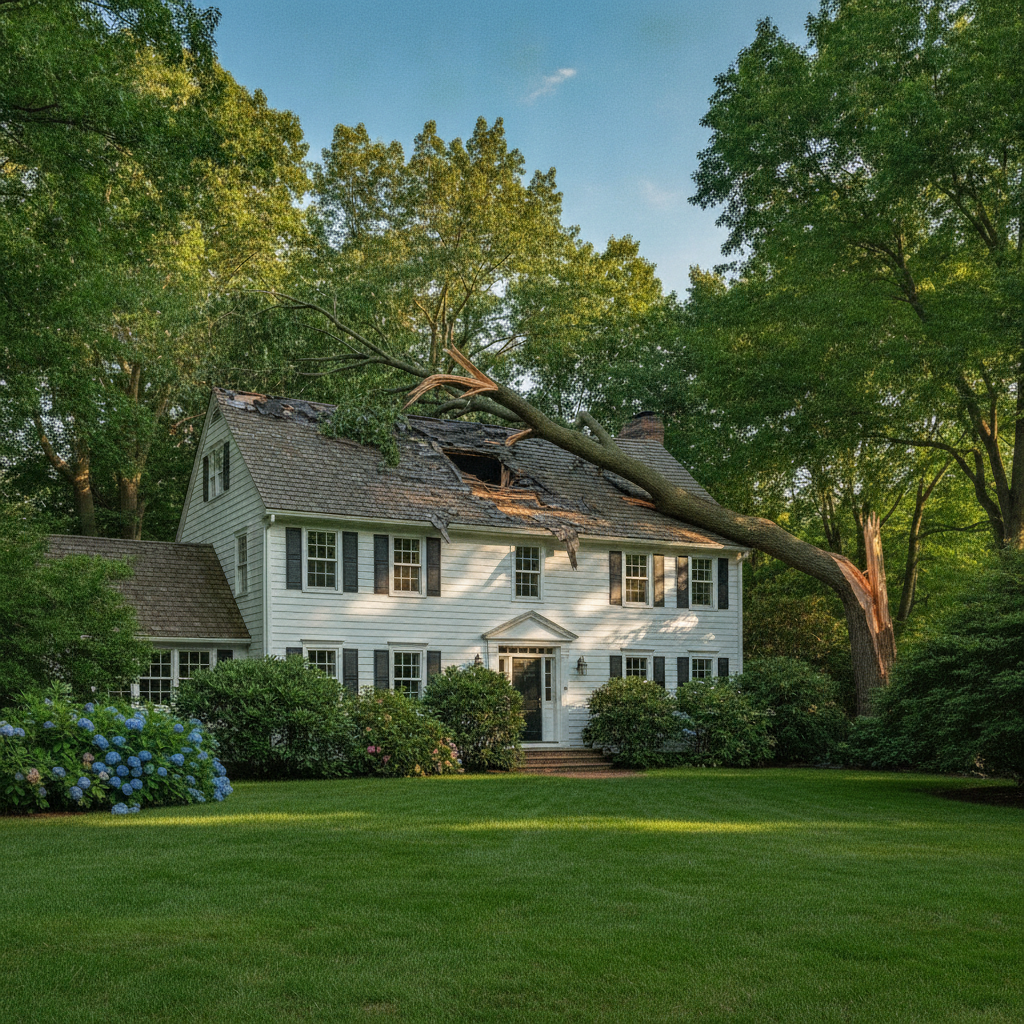
A tree branch through your roof is one of the most jarring storm outcomes a homeowner faces. The short answer: do not climb up there. Contain the interior damage, photograph everything, call your insurer, and get a licensed roofer on-site for a proper structural assessment. Whether you need a section repair or a full replacement depends on the structural damage below the shingles, the age and condition of your existing roof, and what your insurance carrier agrees to cover — and only a hands-on inspection can tell you which way that assessment goes.
This guide walks you through exactly what to do in the hours and days after impact, how a professional evaluates the damage, and how a homeowners insurance claim typically works for storm damage in New York and Connecticut.
Immediate Steps: What to Do in the First Few Hours
1. Stay off the roof — seriously
A storm-damaged roof can have hidden structural failure beneath the surface. Wet sheathing, cracked or fractured rafters, and debris-laden surfaces make even a cautious climb dangerous. Leave the roof to licensed professionals with the right equipment and training.
2. Contain water inside the structure
Move furniture, electronics, and valuables away from the impact zone. Place buckets under active drips. If you can safely access the attic, lay down plastic sheeting over insulation and stored items. The goal is to stop interior materials from absorbing water — wet drywall, insulation, and structural lumber create secondary damage that complicates both repairs and claims.
3. Document everything before touching anything
Photograph and video the exterior from the ground — the branch, the impact zone, surrounding shingle damage, gutter disruption. Then document the interior: ceiling staining, attic damage, any visible daylight through the deck. Date-stamped photos are the foundation of a strong insurance claim. Per guidance from the Insurance Information Institute, thorough documentation of damage before cleanup or temporary repairs is one of the most important steps in the claims process.
4. Arrange temporary tarping through a licensed contractor
A heavy-duty polyethylene or poly-woven tarp secured over the breach will stop further water intrusion until permanent repairs begin. This is a legitimate, insurer-recognized step — most carriers expect it and will include it in the claim. Have a licensed roofer install the tarp rather than attempting it yourself; this keeps everyone safe and ensures it’s installed correctly enough to actually stop water. Keep the receipt.
5. Notify your insurer promptly
Call your homeowners insurance carrier as soon as practical — most policies have notification requirements, and delays can complicate coverage. Ask the claims representative what documentation they need, whether they will send an independent adjuster, and whether you should get contractor estimates before or after their adjuster visits. The answers vary by carrier, so follow their process. Do not discard any debris or begin permanent repairs before the adjuster has had a chance to assess the scene.
How a Professional Roofer Assesses the Damage
A licensed roofer doing a storm damage inspection isn’t just looking at shingles — they’re evaluating the whole assembly, layer by layer.
Shingle and surface damage
Shingle damage from a branch impact is rarely limited to the impact point. The roofer will look for cracked, displaced, and missing shingles in the surrounding area, and assess whether the pattern of damage is repairable in a way that will perform long-term. One underappreciated issue: shingle matching. Shingle lines change, and today’s equivalent may not match the color or texture of a 12-year-old existing roof. If the repaired section stands out visually, that’s a real-world problem for curb appeal and resale — and often a reason an insurer agrees to a full-slope or full-roof replacement rather than a patch.
Deck and sheathing integrity
The roof deck — typically oriented strand board (OSB) or plywood — is the structural layer beneath the shingles and underlayment. A branch impact can puncture it, crack panels, or compromise the fastener holding pattern in the surrounding area. Damaged deck must be replaced, not patched over; a proper repair involves removing the affected section and installing new sheathing before relaying underlayment and shingles.
Rafter and structural framing
This is where the assessment gets serious. A heavy branch or one with significant momentum can fracture or deflect roof rafters. Rafter damage requires a framing repair — work that goes beyond roofing into structural carpentry — before any surface work begins. If rafters are involved, the roofer will typically identify the scope but may coordinate with a licensed structural contractor for that phase.
Underlayment and water infiltration
Ice-and-water shield and synthetic underlayment are the waterproofing layers between the deck and shingles. A branch that punctures through shingles and deck will have compromised underlayment as well. Inspecting for pre-existing moisture penetration — staining, rot, soft spots — often reveals whether the impact was truly isolated or aggravated an already-weakening section of roof.
Roof age and overall condition
Age matters in the repair-vs.-replace decision. If the roof is near the end of its typical service life — for architectural asphalt shingles in the Northeast, InterNACHI’s Standard Estimated Life Expectancy chart puts the baseline at 20–30 years, and real-world NY/CT conditions (freeze-thaw cycles, summer UV and heat, coastal storm exposure) tend to put practical replacement closer to the lower end of that range — then patching storm damage on an aging roof may not be a sound investment. A competent roofer will be honest with you about whether a repair is going to perform for another decade or whether you’re putting good money after bad.
Repair vs. Replace: How the Decision Gets Made
There is no universal formula, but the assessment generally follows this logic:
| Scenario | Likely outcome |
|---|---|
| Small impact zone, deck intact, rafters undamaged, roof under 15 years old, good shingle match available | Section repair is viable |
| Impact zone is limited but shingle matching is impossible, roof is 20+ years old | Full slope or full replacement is often warranted — and easier to justify to the insurer |
| Deck punctured, one or more rafters fractured, widespread surrounding damage | Structural repair + full replacement of affected section minimum; may be full roof |
| Pre-existing widespread deterioration (granule loss, cracking, prior leaks) plus new impact | Full replacement — insurer may cover storm-caused portion; pre-existing condition is a separate discussion |
The roofer’s written scope of work and photo documentation become the basis for the insurance claim. A detailed estimate — broken down by deck repair, underlayment, shingles, ridge, flashing — gives the adjuster a clear picture of what the damage actually requires.
How a Storm-Damage Homeowners Insurance Claim Typically Works
Homeowners insurance claims for storm-caused roof damage are common in New York and Connecticut, particularly in summer — the region’s thunderstorm season, combined with hurricane-season peripheral events, means falling trees and large branches are a recurring hazard. Here is how the process generally works:
Coverage basis matters. Most standard homeowners policies cover sudden, accidental roof damage from storms. Whether your policy pays on a replacement-cost value (RCV) or actual cash value (ACV) basis makes a significant difference. RCV policies pay to replace the roof at current material and labor costs. ACV policies factor in depreciation — so an older roof may receive considerably less than the cost of a new one. This is carrier-dependent; read your declarations page or ask your agent.
The adjuster’s assessment vs. the contractor’s scope. Your insurer will send an adjuster (or use a remote-assessment service) to estimate the damage. The adjuster’s estimate and the contractor’s estimate sometimes differ — in scope, in pricing, or in what line items are covered. If there is a gap, your contractor can submit a supplemental claim with documentation. This is a normal part of the process.
Your deductible applies. Your policy deductible — which may be a flat dollar amount or a percentage of the dwelling coverage for wind/hail events, depending on your policy — comes off the top. The specific deductible structure varies by carrier and policy; confirm this with your agent before making decisions.
Insurance does not guarantee full coverage, and amounts vary. Every carrier and policy is different. What your neighbor received for a similar claim may differ from your outcome based on policy type, age of your roof, your deductible structure, and the specific documentation you provide. The information here is educational — confirm specifics with your carrier and, if needed, a licensed public adjuster.
What Gunner Roofing does in this process. As a GAF Master Elite® contractor — a designation held by fewer than 3% of roofing contractors nationally, per GAF — Gunner Roofing brings the documentation discipline and technical depth that insurance claims require. We provide a detailed written inspection report, photograph every damage layer, and produce an itemized scope of work that aligns with how adjusters evaluate claims in NY and CT. We handle the building permit on every project, in every case. If you’re in Westchester County, NY or Fairfield County, CT, a Gunner assessment is a good first call after you’ve notified your insurer.
Frequently Asked Questions
My roof has a branch through it — is it safe to stay in the house?
In most cases, yes — as long as you stay out of the room directly below the breach, the ceiling looks structurally intact, and there is no electrical hazard. Keep the area cleared, contain water, and get a licensed roofer on-site quickly. If the breach is large or you have any doubt about structural integrity, contact local authorities.
Will my homeowners insurance cover a tree branch through my roof?
Most standard homeowners policies cover sudden, accidental roof damage from falling trees or branches. Coverage is subject to your policy’s terms, deductible, and whether it settles on replacement-cost or actual-cash-value basis. Availability and amounts vary by carrier — confirm with your insurance carrier.
Do I need to replace my whole roof after a branch impact?
Not always. A small impact on a younger roof with intact deck and framing may be repairable as a section. An older roof, a large impact zone, fractured rafters, or an impossible shingle match may point toward partial or full replacement. Only a hands-on inspection by a licensed roofer can answer this for your specific situation.
Can I tarp my own roof after storm damage?
Not recommended. A storm-damaged roof is structurally compromised and the surface is dangerous — even for experienced people. A licensed contractor installs a proper tarp quickly, safely, and in a form your insurer will recognize. Keep the receipt.
How long does a storm-damage insurance claim take in NY or CT?
Timelines vary by carrier. Many straightforward claims move from adjuster visit to approved scope within a few weeks; scope disputes extend that. Good documentation — photos, contractor estimate, receipts — helps. Confirm timelines with your carrier.
What should I look for when hiring a roofer for storm damage?
Hire a contractor licensed and insured in New York and Connecticut, with verifiable manufacturer credentials and a written scope. Avoid storm chasers soliciting door-to-door after events. Gunner Roofing is fully licensed, insured, and bonded in NY and CT, and is a GAF Master Elite® contractor — fewer than 3% of roofing contractors nationally qualify for that designation.
A tree through your roof is stressful, but the path forward is straightforward: keep everyone safe, document thoroughly, call your insurer, and get a trusted local roofer on-site fast. If you’re in Westchester County, NY or Fairfield County, CT, contact Gunner Roofing for a storm-damage assessment.
Get a fast, free quote
No inspection visit needed - we measure your roof from satellite imagery and send your quote.