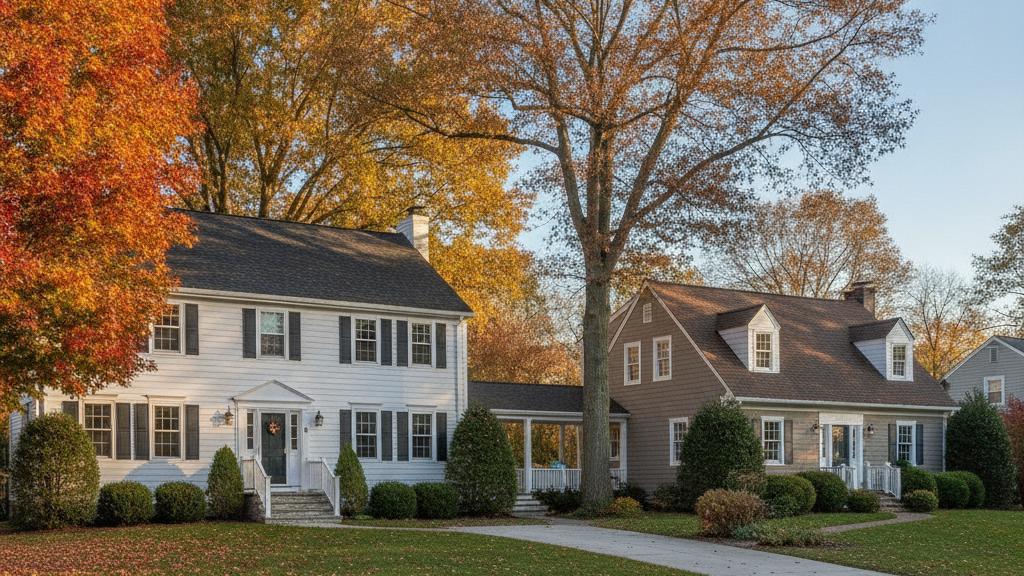
Westchester County’s Colonials and Capes look their best when the siding color works with the architecture — and when the material behind that color can survive a New York winter and still look fresh a decade later. The short answer: for traditional styles, restrained palettes hold up best visually and physically. Classic whites, warm grays, soft sage greens, and muted blues for the body — with strong trim contrast — read authentically on Colonial and Cape forms and weather well in Westchester’s climate. The choice of material is as important as the choice of color; a color that looks great on a fiber cement panel is a different proposition than the same color factory-molded into a vinyl profile.
| Home style | Strong palette choices | Materials that hold the color |
|---|---|---|
| Colonial (symmetrical, full two-story) | White/cream body + black or dark-green shutters + white trim | James Hardie HZ5 fiber cement; premium vinyl |
| Cape Cod | Pale gray, sandy buff, soft blue body + white trim | HZ5 fiber cement; thicker vinyl profiles |
| Tudor / half-timbered | Off-white stucco body, dark brown/black timber contrast | HZ5 fiber cement panels (smooth) for the stucco sections |
| Victorian / Italianate | Three-color: body + sash + accent detail | HZ5 fiber cement (paintable); cedar (CSSB-graded) |
| Post-war ranch/split-level | Broad range; tone-on-tone contemporary reads well | CertainTeed vinyl; HZ5 fiber cement |
Why Westchester’s climate and housing stock are different from Fairfield County’s
Westchester County’s character is set by two overlapping forces that don’t apply to Fairfield County the same way.
The Hudson River corridor and inland gradient. The Hudson River moderates temperatures for riverside communities — Tarrytown, Irvington, Yonkers, Dobbs Ferry, Hastings-on-Hudson — giving them milder winters than areas five miles east. White Plains, Scarsdale, New Rochelle, and inland Yorktown sit in a colder, more exposed freeze-thaw zone, where winter temperature swings are more severe. Per Wikipedia’s documentation of the Hudson Valley, the river creates a thermal moderation effect on the immediate western edge of the county. This matters for siding: homes on the warmer riverine strip cycle through freeze-thaw less aggressively than inland properties, but the inland stock still demands cold-climate-rated materials.
The railroad-suburb Tudor and Colonial inventory. Westchester’s character was largely built out during the late 19th and early 20th centuries as the Metro-North rail lines opened up the county to New York commuters. The result is a housing stock — most visible in Bronxville, Larchmont, Pelham, Rye, and the river towns — dominated by center-hall Colonials, Tudor Revivals (stucco-and-half-timber), and Foursquares. These are traditional architectural forms that demand traditional palettes.
Colonial homes: the colors that hold
Colonials in Westchester — particularly the center-hall and Georgian forms that dominate Larchmont, Rye, Pelham, and the river towns — have used a narrow set of palettes for good historical reasons. Symmetry and proportion are the architectural points; color is the finish, not the statement.
Classic white and cream. White clapboard is the standard reference point, and for good reason: it reads cleanly against a dark roof, holds up under New England winter light, and ages gracefully with quality primer and paint. Cream and warm off-white carry slightly more weight on larger two-story Colonials where pure white can bleach out in full sun.
Gray — cool and warm. Medium grays, blue-grays, and warm greige tones have become the workhorse palette for Westchester Colonials in the last decade. They read period-appropriate, pair easily with both charcoal and warm-toned shingles, and perform well on fiber cement because the neutral tones are less susceptible to UV-driven color shift than saturated colors.
Deep body tones. Dark navy, forest green, and slate black have become popular on larger Colonials in Scarsdale, New Canaan Road-adjacent blocks, and Rye — particularly on homes where the architectural detail justifies the contrast. Darker bodies demand higher-quality finish products, as UV and thermal cycling push paint failure on exposed south and west walls faster than on light bodies. With factory-applied ColorPlus Technology on James Hardie fiber cement, deeper tones are more durable than field-painted alternatives because the finish is applied at controlled factory conditions before the board is cut and installed.
Shutters and trim. Colonial shutter and trim logic is simple: contrast is structural. Black shutters on white or gray siding, white shutters on darker bodies, dark forest green against cream — these combinations persist because they articulate the window surround and reinforce the symmetry of the facade. Use a minimum three-inch trim board on windows; thin trim details read cheap on a traditional Colonial.
Cape Cod homes: the right scale
Capes are smaller and simpler than Colonials, and the palette logic adjusts accordingly. A dark, saturated body color that reads as bold on a large center-hall Colonial can overwhelm a Cape’s smaller mass. Lighter, medium-tone bodies — pale blue-gray, sandy taupe, warm white — fit the scale of the form better.
Where Capes succeed on darker palettes, it’s usually with strong trim contrast doing the work: a medium charcoal or slate body paired with crisp white trim and soffits, well-detailed around the dormers, creates visual clarity without the heaviness that a dark body alone produces. The dormer windows and roofline are the primary architectural features of a Cape; keep the trim work there clean.
Tudor Revival: a special case
The Tudor Revival stock in Bronxville and similar Westchester suburbs — stucco body, half-timber framing, steep roof pitches — requires a different approach than clapboard homes. The stucco sections are architecturally expected to be near-white or pale cream; the exposed timber framing (or its modern equivalent) should be a sharply contrasting dark brown or near-black. That body-to-timber contrast is the defining visual character of the form; washing the two together with a low-contrast palette destroys the architecture.
Fiber cement panels in a smooth finish are well-suited to the stucco sections of Tudor siding replacements. They hold paint without the expansion cracking that plaster stucco is prone to after decades of freeze-thaw cycling in Westchester’s winters.
How the material affects what color is possible
Color selection is downstream of material selection. The two most common siding options Gunner installs in Westchester County are James Hardie HZ5 fiber cement and CertainTeed vinyl.
James Hardie HZ5 fiber cement. James Hardie’s HardieZone 5 product line is engineered specifically for climates with cold winters, significant freeze-thaw cycling, and snow — which describes all of Westchester County. The HZ5 line carries a 30-year limited, transferable product warranty (per jameshardie.com). The factory-applied ColorPlus Technology finish comes with a 15-year limited warranty against peeling, cracking, and chipping (per James Hardie’s ColorPlus warranty documentation). The factory application is the key advantage: pigment is applied to the boards in a controlled environment before installation, producing a finish that is more consistent and more durable than field-painted fiber cement. The color palette includes classic Colonial and Cape palettes. If you want a color outside that palette, fiber cement accepts field painting, but you lose the ColorPlus warranty and absorb the full repainting cycle.
CertainTeed vinyl. CertainTeed’s vinyl siding products hold color as an integral part of the extrusion — there is no finish to chip or peel, and the product requires no painting over its service life. The trade-off: vinyl color cannot be changed without replacing the siding, and thinner-profile vinyl can show thermal expansion movement at joints if not installed per the Vinyl Siding Institute’s nailing specifications. For Westchester County’s temperature swings, thicker-profile vinyl (CertainTeed’s higher-end lines) performs more consistently through winter cycles. The available palette is wide; most neutral Westchester Colonial and Cape palettes are achievable.
What Gunner recommends. For a traditional Westchester Colonial or Cape where color durability and period accuracy both matter, James Hardie HZ5 fiber cement with ColorPlus Technology is our premium lead. For homeowners who want lower lifetime maintenance and a solid mid-range product, CertainTeed vinyl delivers well. We are a James Hardie Elite Contractor and a fully licensed, insured, and bonded contractor in New York. Every Gunner siding project includes full water-resistive barrier installation, correct flashing at all penetrations and roof-to-wall junctions, and verified ground clearances.
Historic districts in Tarrytown and Irvington: what you need to know
Two Westchester communities — Tarrytown and Irvington — have documented historic-district frameworks that bear directly on exterior siding changes.
Tarrytown. Per Wikipedia, Tarrytown’s historic districts were established beginning March 1979, covering 19th and early-20th-century housing stock. The Village of Tarrytown Village Code (Ch. 9 and Ch. 191) gives the Architectural Review Board authority to review construction, reconstruction, or exterior alteration visible from a public street; changes in a designated historic district require a Certificate of Appropriateness. If your Tarrytown property is within one of these districts, exterior material changes — including siding and color — require review before work begins.
Irvington. Per Wikipedia (summarizing the National Register of Historic Places listing), the Irvington Historic District was listed on the NRHP in 2014 and comprises 212 contributing buildings with housing stock dating primarily from 1859 to 1930. NRHP listing documents the significance of the district; for local exterior-review requirements, confirm with your local building department or historic-district commission — requirements vary by municipality.
General advisory. Many Westchester municipalities have local historic preservation processes, design review, or HOA covenants that affect siding material and color choices. Requirements vary by municipality; confirm with your local building department or historic-district commission before finalizing material or color selections.
Gunner handles the building permit on every project in New York and is experienced with the review process in Westchester municipalities.
Five practical rules before you pick a color
- Look at your roof first. The roof color is fixed for 20-plus years. Every siding palette needs to work with it, not against it. Westchester Colonials often carry dark charcoal or warm brown shingles — both have different compatible siding palettes.
- Test samples in November light. New York fall and winter light is cool and low-angle. Colors that read warm in summer showroom conditions often read flat or cold on a north or east wall in November. Buy sample boards and mount them on the actual wall for a few days before committing.
- Inland homes can go darker. Properties in White Plains, Scarsdale, Yorktown Heights, and similar inland locations don’t face the salt-spray degradation of Long Island Sound coastal properties. Darker palettes — navy, forest green, slate — are more sustainable in inland Westchester than in coastal Fairfield County, provided the material is up to it.
- Riverside homes: mind the humidity. Hudson River-adjacent properties have higher ambient moisture levels than inland sites. Fiber cement handles this well; raw wood or inadequately primed substrates are more vulnerable. Ensure any siding installation includes a continuous water-resistive barrier, as required by IBC 2021 §1403.2.
- Trim contrast is the detail work. On a traditional Colonial or Cape, the trim detail — corner boards, window casings, frieze board, rake and fascia boards — is what makes the architecture readable. Underfunded trim work (too thin, mismatched, painted instead of prefinished) undercuts even a well-chosen body color.
Frequently asked questions
What are the most popular siding colors for Colonials in Westchester County, NY? Classic whites, warm grays, blue-grays, and deep navy tones are the dominant choices. White and cream bodies with black or dark-green shutters and white trim are the traditional reference point. Warmer grays and greige tones have grown popular in the last decade as a period-appropriate alternative. For the deepest dark palettes — navy, charcoal, forest green — fiber cement with factory-applied ColorPlus finish performs better than field-painted products over Westchester winters.
What siding material holds color best in Westchester County’s climate? James Hardie HZ5 fiber cement with ColorPlus Technology finish performs well in Westchester’s cold winters and freeze-thaw cycling. The ColorPlus finish carries a 15-year limited warranty against peeling, cracking, and chipping. The HZ5 product line carries a 30-year limited transferable product warranty. Vinyl holds color without repainting but can show thermal movement at joints in Westchester’s temperature range if not installed to VSI nailing standards.
Do I need approval to change siding color in a Westchester historic district? It depends on your municipality and whether your property is within a designated historic district. In Tarrytown, the Village Code gives the Architectural Review Board authority over exterior alterations visible from a public street; changes in a historic district require a Certificate of Appropriateness. In other Westchester municipalities, requirements vary — confirm with your local building department or historic-district commission before proceeding.
How is Westchester County’s siding climate different from Fairfield County, CT? Both counties face similar freeze-thaw cycling and cold winters, but Westchester does not have the same Long Island Sound salt-spray exposure that affects Fairfield County’s coastal homes in Greenwich, Norwalk, and Westport. Inland Westchester — White Plains, Scarsdale, Yorktown — tends to run colder and drier than the Hudson River townships, with harsher winter cycling. Hudson riverside communities benefit from some thermal moderation. The result: color durability in Westchester depends primarily on UV exposure and thermal cycling, not salt-driven paint degradation.
What Cape Cod siding colors work in Westchester? Pale blue-gray, sandy taupe, warm white, and soft sage work well on Cape forms at Westchester’s residential scale. Strong white trim contrast — particularly at dormers and corner boards — reads clearly and reinforces the Cape’s roofline character. Avoid very dark body colors that overwhelm a Cape’s smaller mass; if you want a bolder palette, let trim contrast do the visual work.
Ready for a free, no-obligation estimate on your Westchester home’s siding? Get a quote online at GunnerRoofing.com.
Get a fast, free quote
No inspection visit needed - we measure your roof from satellite imagery and send your quote.