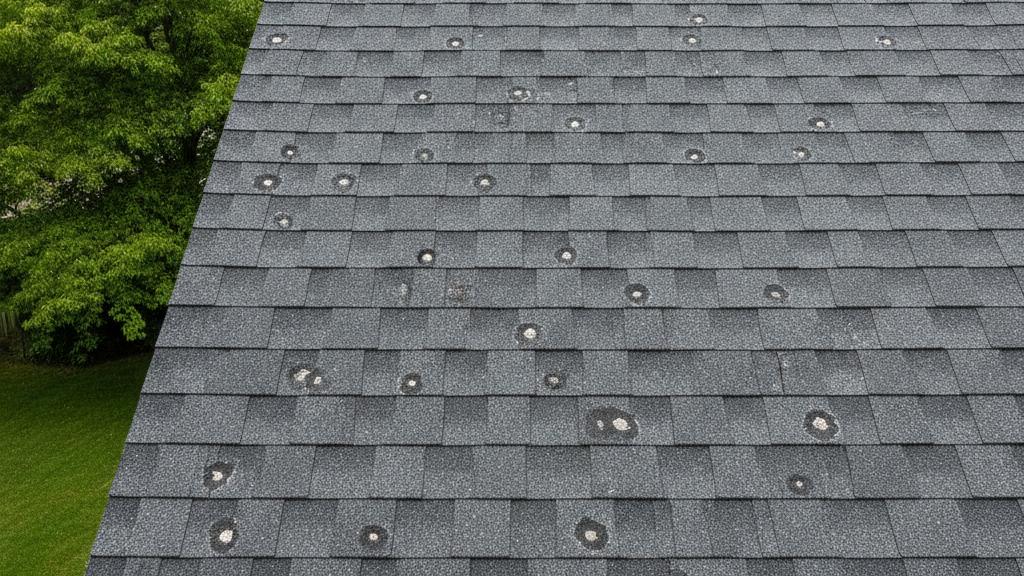
After a summer thunderstorm moves through Westchester or Fairfield County, the question isn’t always visible from the ground: did that hail actually damage your roof? The short answer — hail leaves distinctive marks a trained eye can identify, and in New York the clock starts running the moment the storm passes. Here’s what to look for and how to protect yourself before your insurer’s deadlines close.
What Hail Actually Does to an Asphalt Shingle
Asphalt shingles have three functional layers: a fiberglass mat at the core, an asphalt coating over it, and a surface layer of mineral granules that reflects UV and protects the asphalt. Hail attacks all three simultaneously.
When a hailstone hits, it first blasts the granule layer loose. Underneath, if the impact is forceful enough, it fractures the fiberglass mat — the structural backbone of the shingle. That fracture is what separates functional (structural) damage from cosmetic damage, and it’s what determines whether your insurance claim covers a full replacement or gets denied.
Per research by the Insurance Institute for Business and Home Safety (IBHS), small dents with intact mats result in negligible water leakage. Large dents and mat tears allow significant water leakage — meaning damage that looks surface-level can be a leak waiting to happen after the next rain.
The Visual Signs: What You’re Looking For
You don’t need to get on the roof to begin an assessment — but these are what a professional inspector will document:
1. Circular Granule Loss (“Bald Spots”)
The most visible sign: roughly circular patches where the granule surface has been stripped, exposing the dark asphalt mat beneath. Unlike the gradual thinning of normal weathering, hail spots have distinct edges. The pattern across the roof is random — not concentrated near edges or ridges the way foot traffic wear would be.
2. Bruising (Soft Spots Under the Surface)
This is the diagnostic test that separates functional damage from cosmetic. Press gently on a shingle near an impact mark. Per IBHS guidance, hail that fractures the fiberglass mat leaves a “soft spot you can feel when pressing on the shingle” — a subtle sponginess rather than the firm feel of an undamaged shingle. No soft spot = likely cosmetic. Soft spot = mat fracture = functional damage.
3. Cracks or Tears in the Shingle Surface
On severe impacts — typically from hail at or above 1.5 to 2 inches in diameter — the shingle surface can crack or tear outright, visible to the eye without touching.
4. Ridge Cap Damage
IBHS identifies ridge caps as “especially vulnerable” on an asphalt shingle roof. Because they sit at the peak, they receive impacts from multiple angles. If ridge caps are dented or show heavy granule loss, treat it as a strong signal that the field shingles below also took hits.
5. Collateral Evidence on Other Surfaces
Don’t limit your inspection to the shingles. Fresh dents in aluminum gutters, soft metal flashing, downspout fins, or air conditioning unit fins are the confirmation step. If those surfaces show pocked, uniform dents consistent with a single storm event, hail is confirmed — and the same storm hit your roof.
What Hail Damage Is NOT
Normal weathering looks different. Per IBHS:
- Granule loss along the shingle edge is normal aging, not hail.
- Uniform discoloration or thinning across the whole surface is age-related UV exposure.
- Marks from installation tools or foot traffic are localized, non-random, and non-circular.
- Heavy rain alone dislodges granules, but without the circular impact pattern.
The key diagnostic: hail impact marks are random, circular, and consistent in age. All marks from one storm look the same — same weathering stage, same depth of granule loss.
Size Matters: When Hail Becomes a Roof Problem
Not all hail is equal. The NOAA Storm Prediction Center defines severe hail as 1 inch in diameter (quarter-size) or larger — that’s the NWS threshold for a severe thunderstorm warning. Hail at 2 inches (hen egg-size) or larger is classified as “significant severe.”
For asphalt shingles specifically, IBHS research draws a meaningful line at the sub-severe threshold — hailstones under 1 inch in diameter. Sub-severe hail knocks away protective granules and, per IBHS, can make a roof “up to ten times more susceptible” to damage from subsequent large-hail events. That means a roof that got hit by small hail last summer may sustain far worse damage from this year’s severe storm than it would have otherwise.
IBHS uses 1.5-inch and 2.0-inch diameter hailstones in their standard lab impact testing — the range where mat fracture and functional failure begin for typical architectural shingles.
Impact-Resistant Shingles: What UL 2218 Means
Requirements vary by municipality; confirm with your local building department or historic-district commission — but some insurers may offer premium discounts for impact-rated roofs, and the performance benefit in our storm-prone region is real.
How Soon Do You Need to File a Claim in New York?
This is where many homeowners lose coverage they’re entitled to. New York homeowners insurance policies are governed by NY Insurance Law § 3404, which establishes the state’s Standard Fire Policy. The deadlines it sets are the floor — your policy cannot be less favorable, but it may give you more time.
| Requirement | NY § 3404 Deadline |
|---|---|
| Notice of loss to insurer | “Immediate” written notice |
| Proof of loss (sworn statement) | 60 days after the loss |
| Lawsuit if coverage denied | 24 months from inception of the loss |
“Immediate” is the critical term — and it’s intentionally vague. In practice: notify your insurer within days of a storm, not weeks or months. Waiting until you notice a leak indoors — often months after the storm — creates a real risk that the insurer will dispute when the damage occurred and whether it’s covered.
One important protection: under NY Insurance Law § 3420, an insurer cannot void your claim solely because your notice was late unless the delay materially impaired their ability to investigate. The burden of proving that prejudice falls on the insurer. But that’s a legal defense, not a strategy — file promptly.
What About Connecticut?
Like New York, Connecticut’s standard homeowners policy requires prompt notice of loss and a proof of loss within the policy’s stated period.
For claim-specific deadlines, the Connecticut Insurance Department (portal.ct.gov/cid) is the authoritative resource. The practical guidance is the same as New York: notify your insurer as soon as you suspect damage — the same week as the storm if possible. Availability of coverage and the amount of any settlement depends on your individual policy’s terms; confirm with your carrier or the CT Insurance Department.
Functional vs. Cosmetic Damage: Why the Distinction Can Cost You
Many homeowners — and some adjusters — miss this distinction. Some insurers now include cosmetic damage exclusions in their policies, meaning they won’t pay for hail marks that are visible but don’t impair the roof’s ability to shed water.
The practical test: mat fracture, confirmed by the soft-spot press test, is functional damage. Granule loss exposing the asphalt mat to UV is functional damage. Shallow surface dents with no mat fracture or bare asphalt exposure may be cosmetic.
Before accepting a denial or a partial payment, get a second opinion from a licensed roofing contractor. If you and the insurer can’t agree on the amount of a covered loss, most policies include an appraisal clause that allows each party to hire their own appraiser, who then agree on a neutral umpire — this process exists precisely for disputed storm damage assessments.
What Gunner Does After a Hail Storm
When a homeowner calls after a storm, a proper inspection doesn’t stop at the shingles. A full assessment covers the field shingles, ridge caps, valleys, metal flashing at chimneys and dormers, gutters and downspouts, and any penetrations (skylights, vents). Every Gunner roof replacement includes ice-and-water shield at code minimums, leak barrier through all valleys, step and counter-flashing at all penetrations, and correct attic ventilation — because a replacement done properly addresses the whole system, not just the surface you can see.
Gunner is a GAF Master Elite® contractor — a designation held by fewer than 3% of roofing contractors nationally (per GAF). That status makes GAF Golden Pledge® and Silver Pledge™ warranty options available on qualifying GAF installations, an important consideration when you’re navigating a major storm-damage replacement.
Get a free, no-obligation inspection. If your home took hail this season, don’t wait for a leak to tell you there’s damage. Get a professional assessment and a free estimate at GunnerRoofing.com.
Frequently Asked Questions
Q: How do I know if my roof has hail damage or just normal wear? Hail damage shows a random pattern of circular impact marks — granule-bare spots with distinct edges, soft spots (bruising) you can feel by pressing gently on the shingle, and matching dents on gutters and metal flashing from the same storm event. Normal wear is gradual and uniform across the surface, concentrated near edges and ridges.
Q: Does hail damage always cause a leak? Not immediately. Per IBHS research, small dents with intact fiberglass mats cause negligible water leakage. But mat fractures — detectable as soft spots — allow significant leakage, and even granule loss without mat damage accelerates UV degradation and shortens the roof’s useful life.
Q: How long do I have to file a hail damage insurance claim in New York? Under NY Insurance Law § 3404, you must give “immediate” written notice of loss to your insurer and submit a proof of loss within 60 days of the loss date. Practically speaking, notify your insurer within days of the storm. You have 24 months to bring a lawsuit if coverage is denied, but administrative remedies have shorter windows.
Q: What is UL 2218 Class 4, and should I care about it? UL 2218 Class 4 is an impact-resistance rating for roofing materials. Requirements vary by municipality; confirm with your local building department or historic-district commission — but some insurers may offer premium discounts for impact-rated roofs. They’re worth considering if your area sees frequent severe hail events.
Q: What’s the difference between cosmetic and functional hail damage? Functional damage impairs the roof’s ability to shed water — mat fracture, torn shingles, or granule loss exposing the bare asphalt. Cosmetic damage is aesthetic impact (surface dents or marks) with no underlying structural impairment. Some insurers now include cosmetic damage exclusions; if your claim is denied on that basis, get a second inspection from a licensed contractor before accepting the decision.
Q: Should I get on my roof to check for hail damage myself? Only if you’re comfortable doing so safely — but much of the initial assessment can be done from the ground. Look for granule accumulation in gutters and downspout splash areas after the storm. Check A/C fins, gutters, and flashing for fresh dents. If any of those surfaces show impact marks, call a professional for the roof inspection itself.
Get a fast, free quote
No inspection visit needed - we measure your roof from satellite imagery and send your quote.