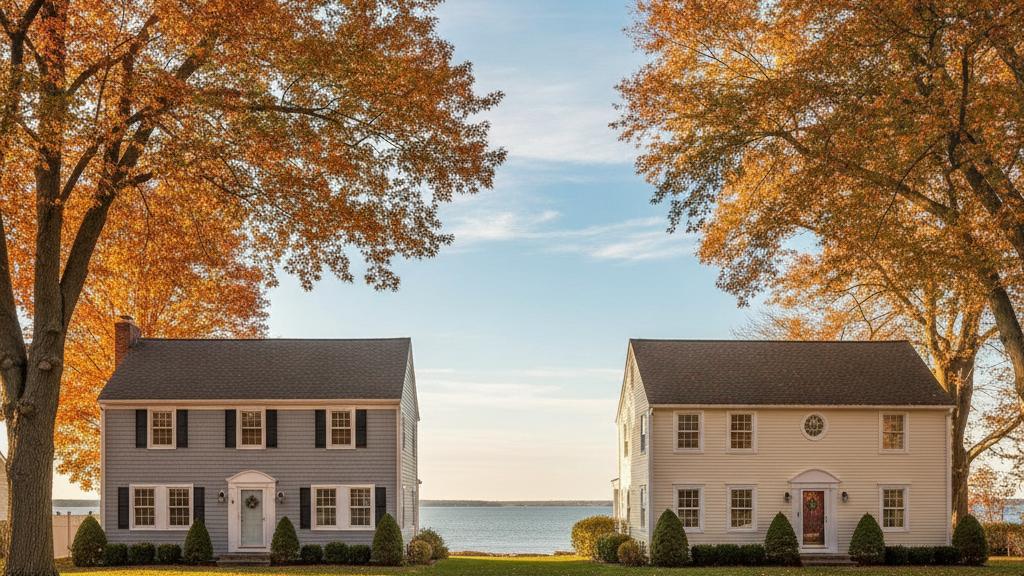
For homes along Westchester County’s Long Island Sound shoreline — in Rye, Mamaroneck, New Rochelle, and Larchmont — siding faces demands that inland Westchester houses simply don’t. Salt air, sustained wind off the Sound, and the moisture load from Nor’easters accelerate every siding failure mode. James Hardie fiber cement, installed to HardieZone 5 (HZ5) specifications, is the strongest choice for these conditions. Premium vinyl is a practical lower-cost alternative with real trade-offs. Cedar is a legitimate option for traditional coastal homes, but it requires a genuine maintenance commitment near the water.
| Material | Salt-Air Corrosion Resistance | Storm Wind Performance | Maintenance Level | Coastal Durability Expectation |
|---|---|---|---|---|
| James Hardie fiber cement (HZ5) | High — inorganic faces don’t corrode or swell | High when correctly installed | Low (periodic repainting; follow manufacturer guidance for joint treatment) | Longest; use lower end of published InterNACHI range in coastal conditions |
| Premium vinyl (CertainTeed) | Moderate — no corrosion, but UV chalking accelerates in salt spray | Moderate — profile-dependent; needs spec-compliant nailing | Very low (no painting) | Moderate; use lower end of InterNACHI range for coastal exposure |
| Cedar | Lower without maintenance — absorbs moisture, salt air works under finish | Moderate | High — paint/stain on a consistent cycle, more frequently near water | Shorter without maintenance; longer with disciplined upkeep |
Why Westchester’s Sound Shore Is a Different Environment
Westchester County’s southern communities — Rye, Mamaroneck, Larchmont, New Rochelle, Port Chester — sit directly on or within a short walk of Long Island Sound. This is a genuine microclimate difference from inland Westchester towns like White Plains, Scarsdale, or Armonk. The coastal zone carries:
- Salt air: sodium chloride in the atmosphere accelerates corrosion of metal fasteners and works under paint on wood substrates, promoting delamination and rot
- Higher sustained humidity: proximity to open water means the wall assembly of a coastal home handles more moisture cycling than one several miles inland
- Wind exposure: Sound-facing elevations take direct wind from the northeast — exactly the direction of arriving Nor’easters — with fewer obstructions than inland sites
- Storm splash and spray: on homes close to the water, direct salt-spray contact during storms adds to the long-term load on any exterior cladding
These conditions don’t make siding impossible — people have lived and owned homes along the Sound for well over a century. But they make material selection and installation quality genuinely consequential.
The same dynamics apply to homes just across the water in Fairfield County, CT: Greenwich, Stamford, Norwalk, and Westport all share Long Island Sound exposure. If you’re asking this question from the Connecticut side, the material guidance here applies equally.
James Hardie Fiber Cement: The Strongest Coastal Choice
James Hardie fiber cement — manufactured to HardieZone 5 specifications for the Northeast — is built from Portland cement, sand, and cellulose fiber. The panel faces are inorganic: they won’t corrode, swell, or absorb salt the way wood does. This is verified by James Hardie’s own ASTM E136 non-combustible rating, which reflects the inorganic cement composition.
The HardieZone 5 designation matters beyond marketing. Per the James Hardie HZ5 Best-Practice Installation Guide, it specifies climate-engineered product formulations and a required installation protocol for cold-climate, freeze-thaw, and high-moisture zones in the Northeast U.S. For coastal homes, three HZ5 installation requirements matter most:
WRB behind the panel. IBC 2021 §1403.2 requires a water-resistive barrier behind exterior cladding. The HZ5 guide specifies this on all re-siding projects, with proper lapping and integration at all window and door flashings. On every Gunner siding project, we install a full WRB with correct flashing at all penetrations — this is part of our standard scope, not an add-on.
Corrosion-resistant fasteners. The HZ5 guide specifies stainless steel or hot-dip galvanized nails. In coastal applications this is especially important: carbon-steel fasteners can corrode and cause surface staining on the panel face over time.
Ground and roof clearances. HZ5 specifies minimum clearances from grade and roof surfaces to prevent chronic moisture contact at the bottom edge — a failure mode that’s more common in high-humidity coastal zones.
James Hardie backs the substrate with a 30-year non-prorated warranty and the ColorPlus factory finish with a 15-year limited warranty against peeling, cracking, and chipping.
Gunner is a James Hardie Elite Contractor, which means our installation crews are trained to HZ5 specification — not just general fiber cement best practices.
Premium Vinyl: Practical, but Know the Coastal Trade-offs
Premium vinyl siding — such as the CertainTeed profiles Gunner installs — is a viable choice for many Sound-area homes. It doesn’t corrode, requires no painting, and heavier-gauge premium profiles outperform builder-grade products in both wind and impact scenarios, per the CertainTeed installation guide and VSI industry standards.
The limitations for coastal homes are real:
Vinyl can chalk and fade faster under the combination of direct UV and salt-spray exposure than fiber cement with a factory-applied ColorPlus finish. The color change is gradual, not sudden, but it’s more pronounced for homes on exposed Sound-facing elevations.
In wind events, vinyl’s interlocking profile depends on correct nailing per the VSI installation manual — too tight and it can’t expand thermally; too loose and it can rattle or lift under pressure. On a coastal home that takes sustained wind from Nor’easters, installation quality is the critical variable.
Vinyl also becomes more brittle in cold temperatures. This is primarily an installation concern rather than an in-service failure mode, but it reinforces the importance of doing replacement work before hard winter cold arrives — another reason fall is the right window to act.
For homeowners who want low maintenance and a lower upfront investment than fiber cement, a well-installed premium CertainTeed profile is a sound choice. For homes immediately on the Sound or on an exposed shoreline lot, we recommend fiber cement as the stronger long-term option.
Cedar: Right for the Right Home, with Eyes Open
Cedar is a beautiful, historically authentic material — and Gunner is a Cedar Shake & Shingle Bureau (CSSB) member contractor who installs it on appropriate projects. Near the Sound, cedar is the right choice for specific situations: period-appropriate Shingle-style homes, traditional Colonials where the homeowner wants natural wood character, or owners who are genuinely committed to a proper maintenance program.
The maintenance requirement near salt water is serious. Cedar needs to be painted or stained and sealed on a consistent schedule, per CSSB installation and maintenance standards — and that cycle is more frequent near salt air than inland. Unpainted or neglected cedar absorbs moisture, develops mold, and deteriorates. Done right, it’s a durable material with a long service life. Done on a “set it and forget it” basis near the Sound, it will fail faster than the alternatives.
If cedar is the right material for your home, be clear-eyed about the maintenance commitment before choosing it.
The Installation Layer That Matters as Much as the Material
Regardless of which cladding you select, coastal performance depends heavily on what happens behind it:
- Self-adhered vapor-permeable WRB: A product like Henry Blueskin VP100, fully lapped and sealed at all edges and penetrations, is the primary moisture defense. The siding is a rain screen; the WRB is the line.
- Flashing at every opening: Every window, door, hose bib, electrical penetration, and roof-to-wall junction needs properly integrated kickout and step flashing. Omit one and moisture enters the wall assembly regardless of what cladding is in front of it.
- Ground and eave clearances: Maintaining manufacturer-specified clearances from grade and from roof surfaces prevents the chronic moisture contact that rots sheathing from the bottom up.
Gunner pulls the permit on every siding project and treats all three of these as standard scope — not optional upgrades.
Act Before the Nor’easters Arrive
If your Sound-facing home has siding showing warped panels, visible cracking, peeling paint in a pattern that suggests moisture behind the panel, or soft spots near window and door trim, fall is the practical window to act. Nor’easters typically run November through March. Getting siding work done before sustained coastal wind and freezing temperatures set in is straightforward; waiting until after the season means one more winter with compromised cladding. The HZ5 guide specifies cold-weather installation practices, so work can proceed in fall conditions.
For a free, no-obligation estimate on siding for your Westchester County coastal home, get started at GunnerRoofing.com.
Frequently Asked Questions
Is James Hardie siding good for homes near the ocean or Long Island Sound?
Yes. James Hardie fiber cement, installed to HardieZone 5 specifications, is designed for the cold, wet, freeze-thaw conditions of the Northeast, including coastal exposure. The inorganic panel faces won’t corrode or swell, and the HZ5 protocol specifies moisture management details — WRB, flashing, fastener type, and ground clearance — that are especially important for homes near Long Island Sound in Westchester County.
Does salt air damage vinyl siding?
Vinyl doesn’t corrode from salt air the way metal components do, but sustained salt-spray exposure can accelerate UV chalking and fading. Premium vinyl profiles hold up better than builder-grade products. For homes directly on or adjacent to Long Island Sound, fiber cement generally provides better long-term performance, though well-installed premium vinyl is a reasonable choice for lower-exposure coastal lots.
What towns in Westchester County face Long Island Sound coastal exposure?
The primary Sound-facing communities in Westchester County are Rye, Mamaroneck, Larchmont, New Rochelle, and Port Chester. Homes on or directly adjacent to the Sound in these towns face salt air, coastal wind, and storm exposure that inland Westchester towns — White Plains, Scarsdale, Yonkers — do not.
How do I know if my siding is failing before Nor’easter season?
Key warning signs: warped or buckled panels; visible cracking or splitting; paint peeling in a pattern that suggests moisture from behind; soft spots when you press near window or door trim (indicating rot in the sheathing or substrate); and gaps in caulking at penetrations and trim joints. Two or more of these is a reason to get an inspection before storm season. Fall is the right window to address them.
Does Gunner handle the building permit for siding work in Westchester County?
Yes. Gunner pulls and manages the building permit on every siding project. Permitting requirements vary by municipality in Westchester — requirements vary by town; confirm details with your local building department — and Gunner handles the permitting process as part of every job.
What is HardieZone 5 and why does it matter for coastal homes?
HardieZone 5 is James Hardie’s climate-engineered product specification for the cold Northeast, covering New York, Connecticut, and similar climates. It specifies a particular product formulation for freeze-thaw resistance, plus a required installation protocol covering WRB, fastener type, flashing, and clearances. For a coastal home, the moisture-management requirements in the HZ5 guide are directly relevant — they address the same conditions that salt air and storm exposure create.
Get a fast, free quote
No inspection visit needed - we measure your roof from satellite imagery and send your quote.